


Share This

Investment Strategy
Nov 13, 2026
• Crude prices falling below USD 100/bbl have improved sentiment towards India.
• Foreign investors have bought over INR 70,000 crore of Indian equities in early November.
• Improving earnings, attractive valuations and returning FPI flows strengthen the investment case for Indian equities.
• Within India, we favour large caps given more attractive valuations, narrowing earnings growth gaps with SMIDs and potential FPI flow concentration.
• Emerging markets remain attractively valued, with stronger earnings growth than developed markets, supporting further upside in the EM value trade.
Back on FPI Radar
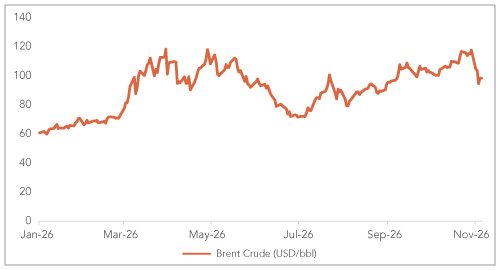
The past few weeks have been eventful for global markets, with monetary, political and geopolitical developments driving sharp moves across asset classes. The Fed held rates but struck a hawkish note, keeping the possibility of a December rate hike alive. The US mid-term elections delivered a bigger-than-expected Democratic victory, raising concerns around tighter AI regulation and a slowdown in data-centre investments. Meanwhile, signs of easing tensions in the Middle East and reports of quiet US-Iran negotiations brought oil prices back below USD 100 a barrel.
Crude price back below USD 100/bbl
Source: Bloomberg, Sanctum Wealth
For India, this combination proved favourable. The correction in global AI stocks and the fall in crude prices improved sentiment, triggering strong FPI buying and a sharp rally in large-cap stocks and benchmark indices just ahead of Diwali.
In this note, we look at what drove these developments and what they mean for markets going ahead.
Global Macro Update
Let’s start with the US mid-term elections, not so much for their political implications, but for what they mean for the economy and markets. While a Democratic victory in both houses was expected, the scale of the win was a surprise. Voters expressed their frustration with the rising cost of living, while AI and data centres also emerged as important election issues.
A Democratic majority could strengthen congressional oversight of President Trump, particularly on government spending and foreign policy. However, its ability to shape the course of the Middle East conflict would remain limited, given the White House’s central role and the broader US-Iran dynamics at play. Moreover, Democrats will not assume office until January, leaving Trump and the Republicans largely unchecked in the interim. Any impact on foreign policy and government spending, therefore, is likely to be gradual, with the implications becoming more apparent over time rather than translating into immediate policy shifts.
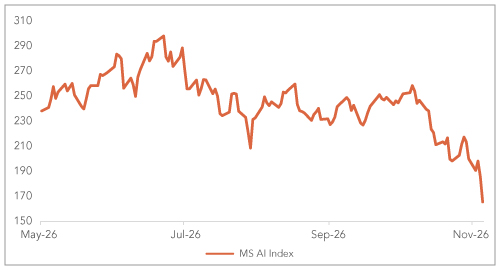
On AI, fears of a major slowdown in the data-centre buildout may be overstated. Neither party wants the US to lose its lead over China in the AI race, and slowing investments may be easier said than done. That said, with positioning in the AI trade already crowded, even a moderation in spending growth could unsettle markets. AI investments have been a key driver of earnings growth and elevated valuations, leaving little room for disappointment.
Fears of slowdown in AI buildout impacted the AI trade
Source: Bloomberg, Sanctum Wealth
MS AI Index is a composite index comprising of AI beneficiaries, AI power capex companies and key Hyperscalers
Meanwhile, the US economy remains resilient. October payrolls rose by 165,000, against expectations of around 60,000, while unemployment fell to 4.1%. August and September payrolls were also revised up by a combined 84,000. Q3 GDP growth accelerated to 3.4% annualised from 2.2% in Q2, while wage growth remained firm at 3.1% YoY.
However, inflation remains a concern for the Fed. October headline inflation grew 0.4% MoM which could translate to about 4% YoY, while core inflation was also estimated at 2.8%. Higher energy prices remain one source of inflation, while the AI buildout is adding to demand for electricity, copper and memory, potentially keeping input costs elevated.
At its October meeting, the Fed held interest rates unchanged, although two members dissented in favour of a rate hike. With growth remaining resilient and inflation still above target, the Fed has little room to manoeuvre, keeping a December rate hike firmly in play. A sustained decline in oil prices could provide some relief, but the path back to its 2% inflation target remains uncertain.
Overall, the mid-term elections do little to change the broader U.S. macro picture. The economy remains resilient, but increasingly dependent on AI investment, while inflation continues to constrain the Fed. Any meaningful slowdown in AI spending, whether due to tighter regulation or weakening Hyperscalers balance sheets, could therefore have wider economic and market implications.
Global Market Update
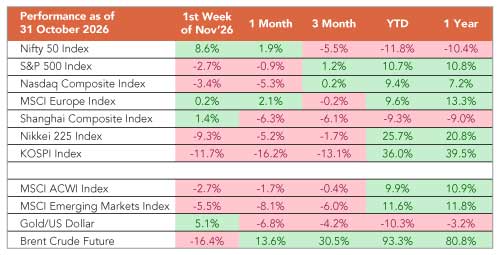
October saw a broad correction in global equities as investors reassessed valuations, particularly in the technology and AI space. Global equities fell 0.8%, with the Nasdaq declining 5.3% and emerging markets losing 8.1%. The weakness extended into the first week of November following the Democrats’ decisive election victory, which added to concerns around tighter AI regulation and slower data-centre investments. The Nasdaq 100 suffered its sharpest single-day fall since March 2020, although markets recovered some ground towards the end of the week.
Source: Bloomberg, Sanctum Wealth
Above returns are only price change in local currency terms and not total returns
Bond markets fared relatively better, with global aggregate bonds gaining 1.7% in October as investors sought safety. However, resilient US jobs data and persistent inflation kept Treasury yields elevated, with the 10-year yield hovering around 4.9% in the first week of November. Markets increasingly began pricing in a possible Fed rate hike in December.
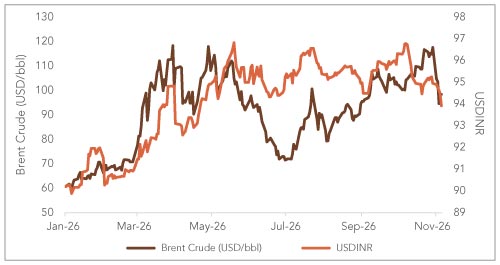
Oil was another key driver of market sentiment. Brent crude surged 13.6% in October to nearly USD 118/bbl amid escalating Middle East tensions. However, signs of de-escalation and hopes of reopening the Strait of Hormuz brought prices sharply lower in the first week of November, taking them below USD 100/bbl. This provided some relief to oil-importing economies, particularly India, China and Europe.
Looking ahead, the AI trade is likely to remain under pressure as investors reassess earnings expectations and valuations. The risk is less a collapse in spending than a moderation in its growth trajectory, which could weigh on semiconductor and data-centre infrastructure companies. Select hyperscalers and cash-generative businesses appear relatively better positioned.
Emerging markets, meanwhile, offer opportunities beyond the AI rally. While Taiwan and South Korea remain major beneficiaries of the semiconductor cycle, Brazil offers exposure to commodities and energy, while China presents opportunities across AI, e-commerce, digital platforms and clean energy. Potential policy support from Beijing provides additional upside, although we view this as optionality rather than our base case.
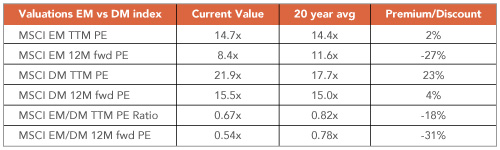
Despite the recent rally, EM valuations remain attractive relative to developed markets, with earnings growth providing an additional source of support. While emerging markets have delivered strong returns over the past three years, their performance over five- and ten-year periods continues to lag, suggesting meaningful scope for further catch-up. We had recommended adding exposure to EM value nearly two years ago, a call that has served our clients well. We believe the theme continues to offer opportunities, albeit with greater selectivity. India, with its strong domestic fundamentals, presents a distinct investment opportunity that we discuss separately.
Earnings growth of EM outpacing DMs

Valuations of EM relative to own history as well as relative to DM attractive
Source: Bloomberg, Sanctum Wealth
All data as of 31st October 2026. The 12M trailing EPS growth as of Q2CY26.
In fixed income, we remain cautious on longer-duration US Treasuries, as persistent inflation, large fiscal deficits and rising government borrowing could keep yields elevated. Short- and medium-duration bonds remain relatively attractive.
Overall, markets are likely to remain selective, with greater emphasis on income, quality and balance-sheet strength rather than simply chasing growth. For India, the combination of lower oil prices and a shift away from crowded AI exposures could provide a more supportive backdrop.
India Macro Update
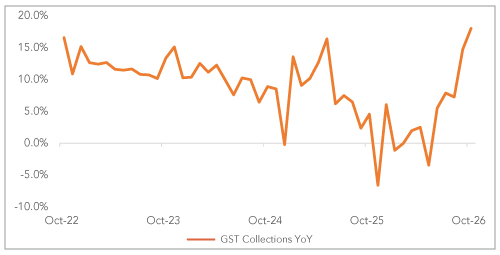
Despite higher energy prices and external headwinds, India’s economic activity remains resilient, although some indicators point to a moderation in demand. GST collections grew 22.9% YoY in October, while credit growth remained strong at 18.2%, reflecting healthy underlying demand. Power demand and auto sales have also remained supportive. There are, however, pockets of weakness, with softer FASTag collections, e-way bills and consumer confidence suggesting some moderation in consumption, particularly in rural areas where tractor sales have declined. On the investment front, improving net FDI inflows and sustained government capital expenditure are encouraging signs. Overall, the economy is holding up well, with underlying momentum remaining intact despite pockets of softness.
GST collections picking up after some moderation
Source: Bloomberg, Sanctum Wealth
On the other hand, Inflation remains a key risk. The CPI inflation increased to 5.5% in September, up from 4.8% in August 2026. Price pressures are starting to spread beyond food to several core categories. Around 46% of the CPI basket is now experiencing inflation above 4%, reflecting the impact of higher commodity prices, a deficient monsoon and rising input costs. While the RBI believes these pressures are largely supply-driven and have yet to become broad-based, the risk of inflation proving more persistent is increasing.
The rupee has recovered as crude prices eased below USD 100 per barrel, while foreign flows have also shown signs of improvement. The key variable remains oil: a sustained moderation would ease pressure on the currency and inflation, while renewed escalation in West Asia could quickly reverse these gains. Higher US interest rates remain a headwind, but are a relatively smaller concern if oil prices and foreign flows stabilise.
Rupee highly dependent on crude prices
Source: Bloomberg, Sanctum Wealth
Overall, India’s growth outlook remains supported by healthy corporate balance sheets, government investment and domestic demand. The external environment and monsoon remain important risks, but a moderation in oil prices could keep inflationary pressures manageable.
Equity Outlook
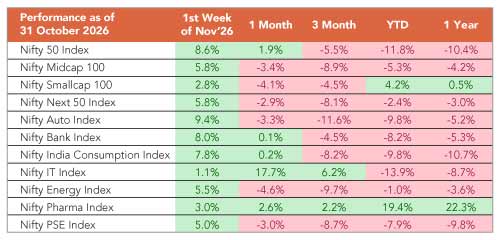
Indian equities saw a mixed performance in October, with gains in IT, pharma and PSU banks offset by weakness in metals, capital goods and NBFCs. More importantly, mid- and small-cap stocks remained under pressure, even as the large-cap indices held up better. Sentiment has improved sharply in November, helped by easing crude prices and a return of foreign buying, with FPIs purchasing over ₹70,000 crore of Indian equities so far this month. The rebound has been led by financials, NBFCs, realty and consumer-facing sectors, while IT has lagged after its strong October rally. Large caps have continued to lead, with foreign investors probably favouring relatively liquid and higher-quality businesses.
Source: Bloomberg, Sanctum Wealth
Above returns are only price change and not total returns
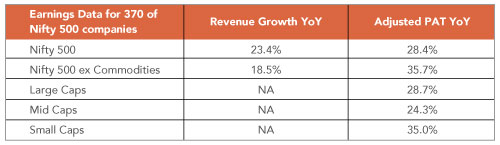
The Q2FY27 earnings season has been encouraging so far. Among the 370 Nifty 500 companies that had reported results as of 3 November, revenue grew 23.4% YoY, while adjusted PAT rose 28.4%, accelerating from 14.2% in the previous quarter. The recovery has also been broad-based: large caps delivered profit growth of 28.7%, compared with 24.3% for mid-caps and 35% for small-caps. With large-cap earnings catching up and valuations looking relatively more attractive, the case for a large-cap preference has strengthened.
Source: Amsec, Ikigai Newsletter
Data as of 3rd November and cover 370 companies
While earnings growth could moderate in H2FY27 due to a higher base and cost pressures, the underlying trajectory remains constructive. Strong first-half performance should support full-year earnings growth in the high teens. More importantly, the benefits of policy measures, including GST rationalisation, personal income tax cuts and monetary easing by the RBI, are now beginning to feed through to the real economy and corporate earnings. We believe this provides a stronger foundation for earnings growth, making the current recovery more than just a low-base rebound and supporting a constructive outlook for Indian equities.
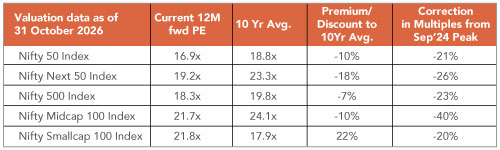
The prolonged market correction, alongside an improvement in corporate earnings, has made Indian equities more reasonably valued. The Nifty has moved back towards its long-term valuation average, while India’s premium over emerging markets has fallen close to a 20-year low. Valuations across mid- and small-caps have also moderated but is still expensive in pockets.
Source: Bloomberg, Sanctum Wealth
Foreign investor sentiment has shown early signs of improvement in the first week of November. Stronger-than-expected earnings and more attractive valuations could help revive interest in Indian equities, particularly as foreign ownership has fallen to around 14%, close to historical lows. The correction in global AI-related stocks and moderation in crude prices have also provided some support. However, a sustained recovery in foreign flows will depend on greater stability in the rupee and an improvement in India’s relative growth outlook.
The outlook for Indian equities is looking increasingly constructive. The recent correction has improved valuations, earnings recovery is gaining traction and there are early signs of foreign investor sentiment turning more positive. While the near-term outlook remains sensitive to developments in West Asia and any renewed escalation that pushes energy prices higher, the domestic fundamentals remain supportive.
Within equities, we favour large caps, where valuations are more attractive and the earnings growth gap with mid- and small-caps has narrowed. A sustained return of FPI flows could further favour large caps, as foreign investors are likely to gravitate towards more liquid, higher-quality companies, as seen in recent trading sessions. Overall, we see the current environment as an opportunity to gradually increase equity exposure, with a preference for large caps.
Fixed Income Outlook
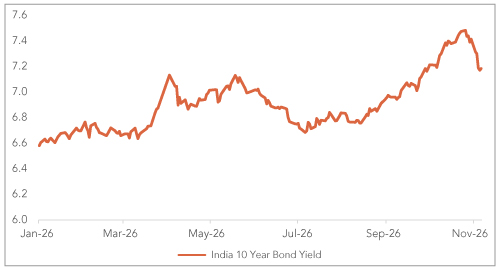
Indian fixed income markets witnessed significant volatility over the past few weeks. October saw a sharp sell-off in government bonds as the RBI’s 25 bps repo rate hike to 5.50%, along with its shift from a neutral to a calibrated tightening stance which caught markets by surprise. Rising inflation, tightening liquidity conditions and expectations of further rate hikes pushed the 10-year G-sec yield up by around 23 bps to 7.41% by month-end. However, the first week of November saw a sharp reversal, with yields easing to around 7.2%, supported by a steep correction in crude oil prices, a stronger rupee, improving liquidity and renewed foreign portfolio inflows. While this provided some near-term relief, the underlying monetary policy and inflation concerns remain largely unchanged.
Indian bond yields have declined after a sharp move up
Source: Bloomberg, Sanctum Wealth
Looking ahead, we remain cautious on duration. While lower crude prices and improving foreign flows are supportive, inflationary pressures remain elevated and the RBI’s tightening cycle only just begun. Persistent global fiscal borrowing requirements and uncertainty around global bond yields also limit the scope for a sustained decline in domestic yields. The trajectory of inflation and crude prices will be key near-term triggers. In this environment, we believe the risk-reward remains more favourable in the shorter end of the yield curve.
Accordingly, we recommend maintaining a preference for shorter term debt instruments, where investors can capture attractive accrual without taking excessive interest-rate risk.
Gold and Silver Outlook
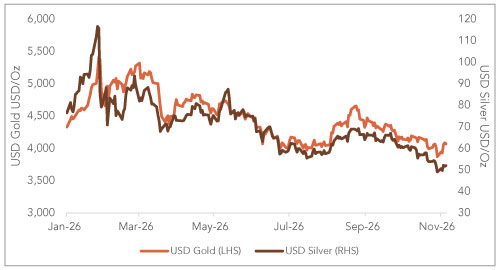
Gold and silver remained under pressure in October, correcting 6.8% and 18.7%, respectively, in USD terms. While both have recovered some ground in November, gold remains down nearly 6% and silver around 27% year-to-date. The correction reflects profit-taking, elevated real yields, a stronger dollar and expectations of higher-for-longer interest rates, with leveraged position unwinding amplifying the sell-off. Silver’s sharper decline also reflects its higher volatility and greater sensitivity to industrial demand.
We view the recent correction as a cyclical setback rather than a deterioration in gold’s longer-term investment case. Structural drivers, including geopolitical uncertainty, fiscal pressures and continued central-bank diversification, remain firmly in place. Gold has historically moved through periods of consolidation before resuming its upward trajectory when macroeconomic or geopolitical catalysts emerge. While the near term could remain volatile and range-bound, a moderation in US real yields or a weaker dollar could provide the trigger for the next leg of the rally. Given that the underlying fundamentals remain supportive, we prefer to stay invested.
Gold and Silver now negative year to date
Source: Bloomberg, Sanctum Wealth
Our view on silver is more tactical. Unlike gold, silver has a much higher industrial component, making it more sensitive to the global growth cycle and themes such as AI, electronics and clean energy. It is also considerably more volatile. Since our re-entry, silver has corrected sharply. While we do not believe the current levels warrant an exit in haste, we would look to use a recovery to gradually exit the position and redeploy the capital into gold or equities, depending on the prevailing market opportunities. Unlike gold, we see silver as a tactical allocation rather than a long-term strategic holding.