


Share This

Portfolio Commentary
Jul 31, 2026
Indian Equities: Tide is turning | Relative performance improving
• AI Infrastructure euphoria sees profit booking | MSCI Korea declines ~30% from June ‘26 high
• Domestic macro steady amid global volatility | credit growth, GST collections near highs
• Even after rebound, Nifty remains below Jan 26 peak, but valuations have reset closer to long-term averages
We believe the prolonged phase of India’s relative underperformance is nearing an end. Indian equities have been relative underperformers versus global markets over the past couple of years. As highlighted in our previous note, we believed that the market could be approaching an inflection point. While India may not necessarily emerge as an outright outperformer in the near term, we believe this phase of persistent underperformance is now behind us. The data below suggest the tide might have just turned in India’s favour.
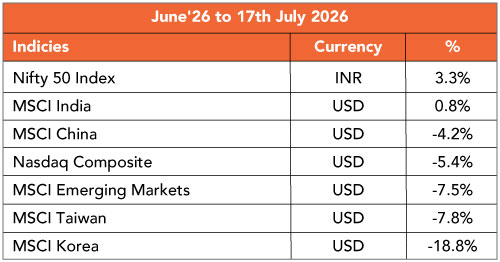
The Nifty 50 fell to an intra-quarter low near 22,183 in April amid escalating Iran-Israel-USA tensions and fears of a Strait of Hormuz disruption to energy supply, a material macro risk for an import-dependent economy like India. As diplomatic efforts progressed and crude oil prices eased through May and June, the index staged a steady recovery, closing the quarter near 24,000, aided further by a late-June MSCI Emerging Markets rebalancing that briefly added to volatility before flows normalised.
The domestic macro backdrop remained a source of comfort through the volatility. Gross GST collections for June rose nearly 14% y-o-y, systemic credit growth increased 18.6% y-o-y during the June 2026 quarter, underlining resilient demand even as global sentiment swung. On flows, FIIs remained net sellers through most of the quarter, but this was comfortably absorbed by domestic institutions, anchored by SIP inflows running close to ₹31,000 crore a month, which continued to provide a steady floor under the market, much as they did through FY26.
Portfolio Performance: Broad based recovery barring IT sector
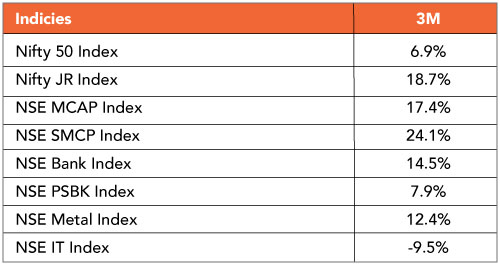
The June 2026 quarter tested conviction early before rewarding it. Among sectors, banking staged a strong recovery, supported by improving credit growth and resilient asset quality.
The performance of our strategies relative to their benchmarks must be viewed through this lens. A summary as of 30 June 2026 is provided below:
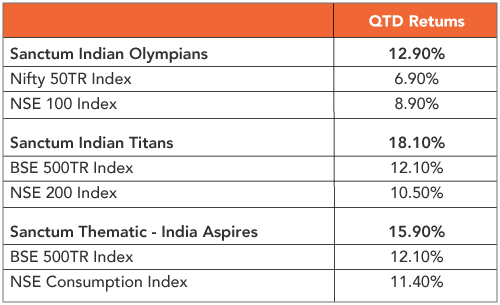
As of 30 June 2026
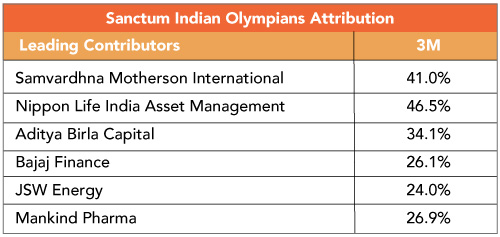
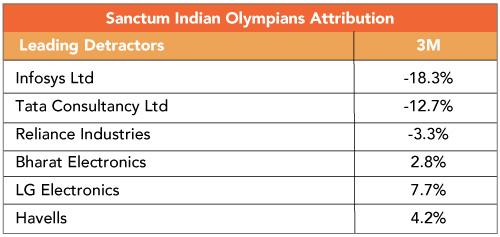
Sanctum Indian Olympians has outperformed its benchmark by 550 bps, continues to stand out among the large-cap funds. The strategy ranked Quartile 1 over 6 months and 1-year periods. From a sector allocation perspective, our underweight stance in IT and selective positioning in lending financials contributed positively over the past year. Additionally, our bottom-up stock selection, particularly in Aditya Birla Capital, Bajaj Finance and Axis Bank within financials, contributed materially to performance. In the auto sector, Samvardhana Motherson and Mahindra & Mahindra were key contributors, while Divi’s Laboratories and Mankind Pharma drove performance within pharmaceuticals. Looking ahead, we continue to believe that improving credit growth should support stronger performance from lending financials.
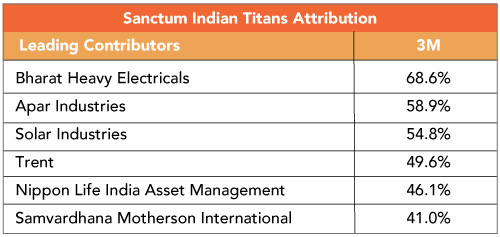
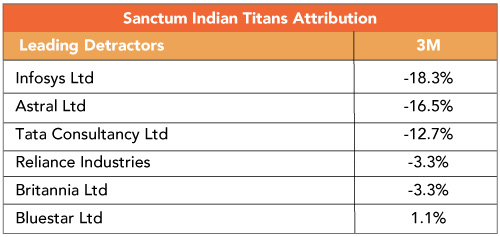
Sanctum Indian Titans staged a strong recovery after a relatively subdued second half of FY26, outperforming its benchmark by ~600 bps during the quarter. As highlighted in our previous note, we believed the worst of underperformance was behind us, and this conviction has been validated through broad-based recovery across the portfolio. Portfolio changes implemented during the March quarter have also delivered encouraging results. New additions such as Solar Industries (defence supply chain) and Nippon Asset Management (capital markets) generated returns of ~50% each over the last 3 months, while an increased allocation to Apar Industries further supported the performance. Other notable contributions were from Bharat Heavy Electricals, Trent and Samvardhana Motherson.
India Aspires, our concentrated consumption-focused thematic strategy, maintained a deliberately defensive cash position through the second half of FY26 by holding higher cash levels. This approach enabled us to deploy capital effectively during the market correction and build positions at attractive valuations. Our bottom-up stock selection, including CarTrade Tech, Radico Khaitan, Eternal, Krishna Institute of Medical Sciences and InterGlobe Aviation contributed significantly to the strategy’s strong performance over the past 3 months.
A three-month attribution summary of the top five contributors and detractors for each strategy is provided in the tables below
Portfolio Positioning: Themes we continue to back
• Lending Financials: likely to outperform in the near term, supported by strong credit growth in the coming quarters.
• Capital Markets: we have incrementally added exposure to asset managers, reflecting confidence in the long-term financialization of savings.
• Defence, Energy and Power: structural tailwinds from government allocation, data centre expansion and the green energy transition make this a multi-year opportunity.
• Consumption and Retail: K-shaped demand, with some segments outperforming while others face rising input costs and margin pressure; any reallocation will be deliberate and data-driven.
• Information Technology: while the sector has seen a severe derating, we await clearer signs of demand stabilising. We prefer platform companies over product companies, and product over services, given their stronger linkage to durable demand.
• Commodities and Exports: we remain opportunistic, considering tactical allocations on a case-by-case basis as global trade dynamics evolve.
Sector in focus: Information Technology
If lending financials was the sector clients asked us about most last quarter, IT has taken that place this quarter. The Nifty IT index was the standout laggard of Q1 FY27, falling nearly 10% even as the broader market recovered.
The sell-off reflects softening discretionary technology spend among Western enterprise clients, as budgets are reprioritised amid rising AI investments, alongside cautious commentary from global IT services peers and a lack of visible near-term growth drivers. Indian IT services companies remain financially strong, with healthy balance sheets and free cash flow generation, but revenue growth visibility has clearly deteriorated over the past two quarters.
Valuations have corrected meaningfully and are no longer a barrier to owning quality names. The top four IT majors now trading at 13-17x PE multiples amid low-to mid-single digit revenue growth between FY26 and FY28. What is missing, in our view, is a clear signal that the demand environment is troughing, either through improving deal wins and TCV disclosures, or a more constructive tone on discretionary spend from US and European clients. We would rather be a quarter late to a genuine inflection than early into a value trap.
Our preference continues to remain in favour of platform companies, especially linked to domestic demand, then product companies and lastly, services companies.
Outlook: Volatility behind us, a more selective climb ahead
Q1 FY27 validated the reset we anticipated at the end of the March quarter. From a valuation perspective, the recent market correction has made Indian equities more attractive. The Nifty 50 is currently trading at a 12-month forward P/E of 18.8x, a 10% discount to its long-period average (LPA) of 21x, while the price-to-book (P/B) ratio of 2.7x is 5% below its historical average. On a trailing basis, the index trades at a 12-month P/E of 21.6x and a P/B of 3.0x, representing discounts of 7% and 4%, respectively, to their long-term averages.
However, the environment is increasingly shifting toward stock-specific performance, where earnings quality, valuation discipline, and selective stock picking will play a more decisive role than broad market momentum. While near-term volatility is likely to persist, long-term investors should view periods of market weakness as opportunities to build positions in high-quality businesses aligned with India’s structural growth themes.
Near-term risks are real and worth flagging: a below-normal monsoon forecast could weigh on rural demand and food inflation; the US-Iran situation, while easing, is not fully resolved; and the US Federal Reserve’s rate path under its new leadership remains a swing factor for FII flows. We are also watchful of evolving global trade policy and currency movements, which could affect export-oriented sectors. In this environment, we continue to believe that a disciplined, bottom-up approach to stock selection, rather than broad index exposure, is the most reliable driver of outperformance, and we remain committed to it.
We enter the second half of CY26 with measured optimism rather than complacency. The conditions that supported this quarter, a valuation reset, resilient domestic fundamentals and steady domestic flows, remain in place even as global cues stay uneven. We do not expect markets to move in a straight line; periods of volatility are likely, and we view them as opportunities rather than threats. Our focus stays where it has always been owning high-quality businesses at sensible valuations and letting disciplined, bottom-up stock selection, rather than index direction, drive returns over time. As the market shifts from a phase led by liquidity to one led by earnings, we believe this approach positions our strategies well to compound value for our clients through the cycle.
Here is how our flagship strategies have performed over different time periods.
Portfolio Performance
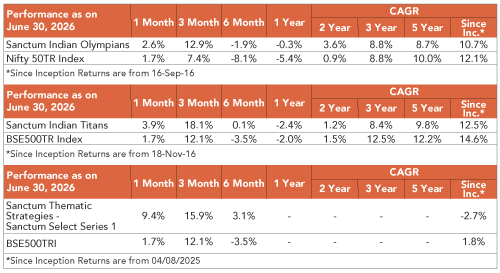
All returns are on TWRR basis, after fees and expences.