


Share This

The Age of Ambiguity
Aug 4, 2026
Markets can live with bad news. What they can’t live with is ambiguity regarding the rules. That’s the story of this month, and it’s the overarching theme whether it’s Washington or Beijing or Tokyo: the institutions we rely on to navigate war, inflation, and political risk are all, in their own way, choosing to say less at exactly the moment when investors need them to say – and do – more. It starts with the Fed.
The Fed’s Credibility Problem
Fed Chairman Kevin Warsh’s latest press conference should worry investors more than the headlines let on. Labelling it as just hawkish would be an understatement; it was possibly the most troubling one from a Fed chair since post-meeting press conferences began in 2012, and I don’t say that lightly. Does the Fed want us to neither ask nor listen?
My concern isn’t just that Warsh sounded worried about inflation; it’s that he gave no roadmap for what happens next. He warned about price pressures, offered little justification for not increasing interest rates, and then, interestingly, cast doubt on the Fed’s own preferred inflation gauge, the PCE deflator, as if following it might be a mistake. That’s a dangerous combination, and that’s what concerns me the most. If the Fed – or Warsh – believes inflation is too high, the framework it has long relied on may be flawed. When markets have grown too reliant on the central bank’s guidance, the honest move is to explain when patience runs out. Instead, Warsh floated the idea that task forces might revisit the inflation framework early next year. Changing the measuring stick while you’re still above target doesn’t read as intellectual honesty; it reads as moving the goalposts, and markets will treat it that way.
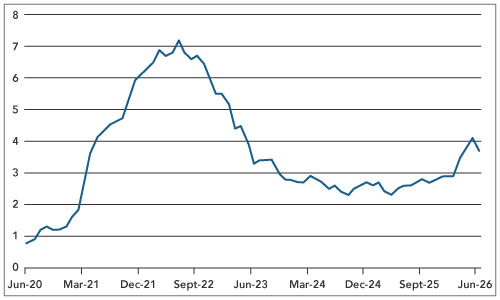
The economic data doesn’t make this easier either. Last week’s data showed core PCE is still running at 3.3% over 12 months. Private domestic final sales grew a robust 3.9% annualised in the second quarter. While this isn’t an economy that is weak enough to make easing obvious, inflation isn’t benign enough to rule out another hike either. In my opinion, there is now a material chance of a rate hike in September, even if it’s just about the Fed – and Warsh – regaining some credibility. There’s a bitter irony here: While Warsh tried to wean markets off dependence on Fed communication, he may end up forcing the rest of the Committee to tighten just to restore the institution’s credibility.
Chart 1: US Headline PCE: 3.7% is Not 2.0%…
Source: Bloomberg
Given everything else in play this year, this was not the moment for the Fed to say less. Ambiguity isn’t independence. It isn’t conviction. It’s a mistake. And it’s not the only place a credible framework has gone missing — the same problem is showing up in the oil industry, too.
Oil and the Politics of Brinkmanship
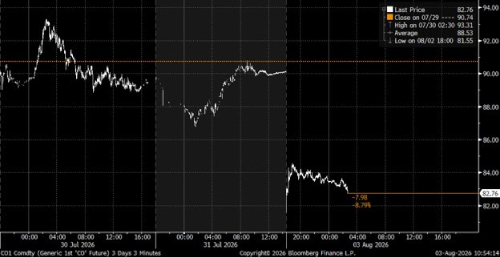
OPEC+ agreed on Sunday to raise September quotas by roughly 188,000 barrels a day, completing the reversal of the 1.65 million bpd of voluntary cuts that began in 2023. I expect the group to pause any further increase in production while it negotiates new 2027 baselines. It would be best not to take the headline number at face value, as the real supply picture is tighter than it looks because the ongoing conflict has already knocked out meaningful exports from Iran, Russia, and Kazakhstan.
In a peaceful world, this extra OPEC+ supply would be a clear argument for lower prices. However, times are different now. President Trump once again threatened serious military escalation before pulling back from the brink. Markets may exhale after each TACO moment, but a pattern of threats without a defined endgame isn’t a strategy; it’s a habit, and habits like this keep oil infrastructure, shipping insurers, and the Strait of Hormuz permanently on the risk desk’s watchlist. Thanksfully as the markets opened today the peace seemed to be holding and with it oil prices markedly lower.
Chart 2: Just Another Weekend of Confusion in the Oil Market
Source: Bloomberg
Here’s what worries me the most: broader US military action wouldn’t actually resolve anything in the region. It would just push energy prices higher, lift inflation expectations, squeeze consumers’ purchasing power, and hand the Fed an even harder problem to tackle. It would also feed a narrative I think is already taking hold globally – that American foreign policy is being run on presidential temperament rather than strategic intent. The rest of the world isn’t asking Washington to prove how close to the edge it’s willing to go. It’s asking Washington to step back from it.
It must be abundantly clear by now that we have to stop treating oil as a simple supply-and-demand trade. Right now, it’s a geopolitical option, and its premium rises every time US policy becomes harder to predict.
China: Support, but Don’t Wait for a Bazooka
Questions also arise about whether Beijing is managing a slowdown or managing the optics of one. China’s latest data should unsettle anyone still hoping for a clean reflation story. The official manufacturing PMI declined to 49.2 in July from 50.3 in June, below the benchmark that separates growth from contraction, with new orders registering a sharper drop. The non-manufacturing PMI slipped to 49, its weakest print since December 2022. It’s worth noting here that second-quarter GDP growth had already cooled to 4.3%, missing the government’s own 4.5–5% target.
This is no longer just a story about an unwind of property sector problems. Domestic demand is soft, consumer confidence is fragile, and traditional manufacturers are watching orders shrink while costs climb. Meanwhile, high-tech and equipment output stay strong. What you’re left with is an economy presenting a rather contradictory picture: a handful of globally competitive strategic industries riding above a domestic cycle that’s losing altitude.
I don’t expect China to unveil the dramatic stimulus that markets keep hoping for, and investors should stop waiting for it. The Politburo has promised faster deployment of existing fiscal firepower, more support for demand, and steps to stabilise the property market. The PBoC says it will keep policy loose and adjust its tools “in a timely manner” — the classic central-bank language for don’t hold your breath.
Some of this caution is self-imposed, and understandably so. A credit-fuelled stimulus could juice near-term growth, but it would also deepen local government debt, worsen industrial overcapacity, and reignite the price wars Beijing has been trying to stop. Policymakers are trying to put a floor under growth without rebuilding the excesses that got them here. We expect faster infrastructure spending, targeted consumer subsidies, support for unfinished housing projects, selective rate or reserve cuts, and continued local-government debt restructuring. The one lever that would actually move the needle – real transfer of income to households – still looks politically off the table.
That’s why the equity market isn’t buying the story yet. While valuations are cheap and policy is supportive on paper, nobody can show me the mechanism that turns “supportive” into stronger household income, better pricing power, and higher returns on equity. Policy headlines can spark a rally, but only earnings can sustain one.
My view: stay selective, not broad. Selective Technology, automation, healthcare, high-end manufacturing, and the consolidation winners can outperform. A genuine re-rating of the whole market needs one thing Beijing hasn’t delivered yet: clear proof that policy has shifted from protecting production to protecting households.
Technology: The Burden of Proof Just Went Up
Last week’s earnings didn’t kill the AI trade, but they made it a lot less forgiving. Investors will still fund enormous capex, but only when a company can show accelerating cloud revenue, rising contracted demand, better infrastructure utilisation, or a credible path to free cash flow. Spending money is no longer proof of anything. It’s table stakes.
The macro backdrop still supports the broader thesis. US equipment spending rose at a 15.2% annualised rate in the second quarter; intellectual-property investment was up 8.8%. But total non-residential construction kept falling, because the (Biden) CHIPS Act semiconductor build-out is unwinding faster than data centre construction can replace it, and data centres are still under 6% of total non-residential construction spend. That gap tells you the AI story is real, but it’s narrower than the headlines suggest. It also highlights that the tech capex story was never just about the Trump era.
The first phase of this cycle rewarded those who could get their hands on scarce compute. As the AI landscape matures, the next phase will reward those who can actually monetise it, and the businesses that can turn AI into measurable productivity, not just a slide in an investor deck.
AI is still a genuine economic cycle. It just stopped being a free pass.
Japan: Intervention Buys Time, not Solution
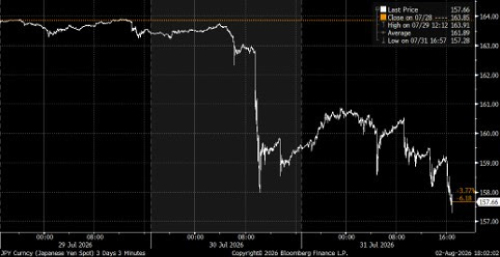
Tokyo’s intervention in the yen shows officials have decided this weakness is disorderly, not just uncomfortable. Any such intervention can scare off speculative shorts for a while. It cannot out-argue an inappropriate interest rate differential forever.
Chart 3: JPY/USD Sees Heavy-handed Likely Transitory Intervention
Source: Bloomberg
The Bank of Japan held rates steady but hardened its language. Strong industrial output, firmer retail spending, and broadening inflation all point to an earlier hike than the market had priced. I still favour October, but I’d put real odds on September, especially if the Fed tightens first and puts fresh downward pressure on the yen.
Intervention has changed the risk skew in one useful way: further yen weakness is now more likely to draw an official response. But a sustained rebound still needs one of two things — a genuinely tighter BoJ, or lower US yields. Intervention alone was never going to be either.
August Strategy
The US midterms are under 100 days out. We expect politics to keep economic policy, tariffs, energy, and geopolitics on tenterhooks, and expect that collision to show up as volatility, not as a single clean catalyst.
My stance: constructively cautious. We advise investors to stay invested – global growth and corporate investment are still holding up – but be selective about where to invest. We favour profitable AI beneficiaries, quality names with strong free cash flow, selected North Asian tech, energy as a geopolitical hedge, and businesses riding multi-year defence and infrastructure spending.
In fixed income, we’d stay wary of the long end of the US curve: Fed credibility risk, fiscal supply, and inflation risk are all working against it. Short-duration, high-quality bonds are doing the carry work for now; add duration selectively, and only after yields overshoot.
Gold still earns its place as a strategic holding. Gold is becoming a more useful hedge, though I wouldn’t call it a clean directional trade yet.
China stays a stock-picker’s market, not an index bet, until policy support actually shows up in household demand and earnings.
The risk chain for August is simple, and it’s the one I keep coming back to: escalation lifts oil, oil lifts inflation expectations, inflation steepens the Treasury curve, higher yields force the Fed’s hand, and tighter financial conditions squeeze equity valuations.
The global economy is more resilient than the headlines suggest. The problem is about policy credibility. My advice isn’t to run from risk; it’s to demand better compensation for the ambiguity you’re being asked to hold.