

Share This

The Rest of the World Turns Up
Jul 6, 2026
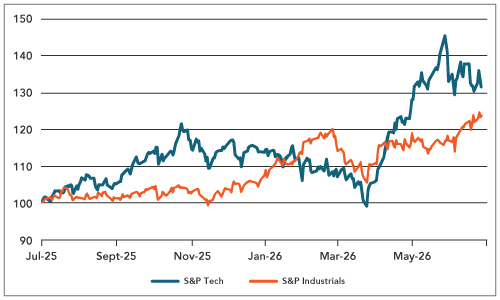
• A revival of the global industrial sector challenges the tech sector for market leadership.
• A broadening of sector performance potentially bodes well for market performance through the Q2 results season.
• Fed Chair Warsh reiterates commitment to inflation targeting.
• Investors should broaden their investments by region and sector.
• US internal geopolitics is a potential tail risk for markets by the late third quarter.
This was not another week of AI stocks dragging the indices higher while the rest of the market looked on. The industrial sector turned up. Factories, miners, capital goods, cyclical businesses of all kinds reasserted themselves across enough of the world to force a genuine change in how investors are thinking about positioning. Global equities had their best week since May. Europe hit a record. South Korea jumped 6%. Japan added 1.5%. The broadening we have been waiting for may finally be arriving, and it matters.
A market driven by a single theme is always fragile. For much of this cycle, generative AI and its semiconductor supply chain have done the heavy lifting. Technology is real and the investment behind it is enormous, but when one trade becomes too crowded, the rally sits on a narrow foundation. What shifted this week is that the global industrial economy started to pull its weight. That is a healthier market, even if it feels unfamiliar after two years of tech dominance.
None of this means abandoning technology. Quite the opposite. Second quarter earnings season is approaching, and the sheer scale of AI-related capital spending over the past year — on chips, data centres, power infrastructure, cooling systems — should flow through into strong revenues for many of the companies that have led this market. The rotation we are seeing is less about tech falling from grace and more about the rest of the world catching up.
Chart 1: Global Economic Surprise Indices – Inflation and Growth
Source: Bloomberg
The industrial picture
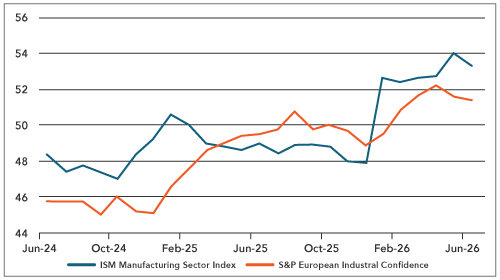
The clearest way to understand what happened this week is through the purchasing managers’ surveys — monthly polls of factory managers that ask, in effect, whether business is getting better or worse. A reading above 50 means expansion; below 50 means contraction. What the June surveys showed, across multiple regions, was a world in which factories are busy, order books are filling and — crucially — the cost pressures that have tormented manufacturers for three years are finally starting to ease.
In the United States, the manufacturing index came in at 53.3, comfortably in expansion territory and the sixth consecutive month of growth. New orders remain strong and, perhaps most encouragingly, factory input prices fell sharply — a signal that inflation in the goods economy is cooling. That is good for corporate margins and good for central bank confidence.
Europe provided the most striking evidence of genuine broadening. The Eurozone reading held above 50 for a fifth consecutive month, its strongest run since early 2022. Germany — which has spent the better part of three years as the principal drag on global industrial momentum, weighed down by high energy costs and weak Chinese demand — edged back into expansion for the first time in years. This is not a trivial development. European industrial companies have been priced by markets as though stagnation was their permanent condition. Even a modest normalisation creates significant upside from those valuations, and this week’s price action in European equities reflected exactly that. We continue to see room for European stocks to catch up, and this backdrop supports that view.
Asia added to the picture. Japan’s factory activity rose to its strongest quarter since early 2014 — a country whose manufacturers have spent a decade waiting for a cycle that finally appears to have arrived. China moved back into expansion, though the detail remains mixed: domestic production improved and technology exports held up well, but export orders softened for a second month and the property market continues to cast a shadow over consumer demand. India was the one disappointment, with growth slipping to near its weakest pace in four years as domestic demand softened.
Taken together, this is a multi-regional industrial upturn, not a uniform boom, but broad enough to matter. It supports our continuing preference for emerging market equities, where valuations remain undemanding and the industrial tailwind is only beginning to be reflected in prices.
Chart 2: Strengthening Global Industrial Confidence
Source: Bloomberg
Rates, inflation and what it means for your portfolio
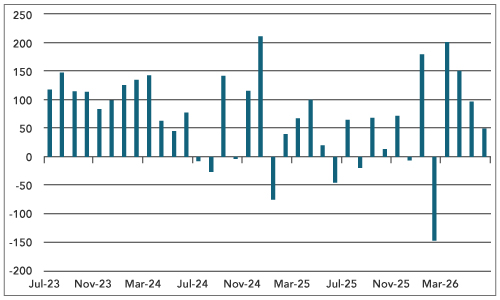
The other significant development of the week came from the United States labour market. June payrolls — the monthly count of jobs added to the economy — came in at just 57,000, roughly half of what economists had expected, with the previous two months revised down as well. That is a notably weak number, and it did two things for markets: it calmed fears of imminent Federal Reserve interest rate rises, and it gave non-U.S. assets — bonds, gold, emerging markets — room to breathe.
The Fed, however, is not offering easy reassurance. Chair Kevin Warsh, speaking at the European Central Bank’s annual forum in Sintra, was unambiguous: the 2% inflation target is not negotiable, and investors hoping the Fed might quietly tolerate somewhat higher inflation are going to be disappointed. He also signalled a deliberate move away from the kind of forward guidance, explicit hints about future rate decisions, that markets have come to rely on. In plain terms: watch the data, not the Fed’s words.
This creates the central tension for portfolios right now. Equities can perform well in this environment, the industrial broadening supports corporate earnings well beyond U.S. software companies, valuations outside America remain reasonable, and the immediate threat of rate rises has receded. Bonds are a more complicated story. The inflation legacy of the Iran crisis has not been fully absorbed, services inflation remains stubborn, and the Fed is not in a hurry to cut. We would rather own equities and treat duration, longer-dated bonds, with caution.
Chart 3: US Labour Market Weakens
‘000 change in non-farm payrolls
Source: Bloomberg
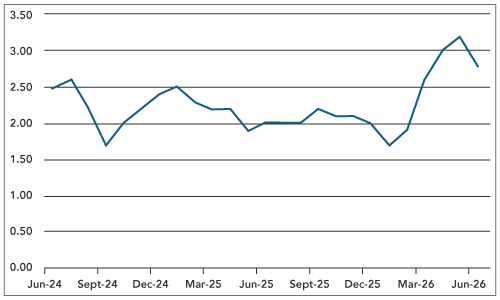
On inflation, Europe offered some genuine relief. Eurozone inflation slowed to 2.8% in June, below expectations and down from 3.2% the previous month. That is still above the ECB’s target, but the direction is right, and it supports the view that the ECB can afford to pause its rate rises in July. Oil, meanwhile, was essentially flat on the week, with Brent crude near $72 a barrel. That matters because oil is both an input cost for almost every business and a significant driver of headline inflation.
U.S.-Iran talks have made some progress, and shipping through the Strait of Hormuz has partially normalised after months of disruption. The fear premium that had pushed energy prices higher has moderated. But this situation is not resolved. The death of Supreme Leader Khamenei and the seeming incapacity of the new leader has left the Iranian regime navigating an uncertain succession, and the nuclear negotiations remain fragile. This is quieter than it was, but not over. It remains a live tail risk for energy prices and, by extension, for inflation and central bank policy.
Chart 4: Eurozone inflation Dips
Source: Bloomberg
What investors are doing — and what they are not
One of the more counterintuitive features of this week is that despite strong equity performance, investors are not euphoric. A weekly survey of individual U.S. investors — a useful, if imperfect, gauge of sentiment — showed the proportion describing themselves as bullish falling sharply to 31%, well below its long-run average, while the bearish camp grew to 42%. Separately, more money left long-term mutual funds than entered them last week.
This is, oddly, encouraging. Markets tend to struggle when everyone is already positioned for good news. The fact that many investors remain sceptical of this rally — still anchored to the AI-only narrative, still cautious about the industrial theme — means there is a significant pool of capital that has not yet moved. If the macro evidence continues to improve, that capital will follow.
The debate, though, is whether this industrial upswing is durable or whether it is partly a mirage – manufacturers stockpiling ahead of tariff uncertainty, defence contractors filling order books because of geopolitical anxiety, companies building inventory as insurance against supply disruption rather than because end demand is genuinely strong. Canada’s factory survey, for example, showed strong activity but also input costs at their highest since mid-2022, driven by oil, transport and tariff pressures. That is not the profile of a clean, demand-driven recovery.
We think the balance of evidence favours the more optimistic reading, principally because AI capital spending is now spilling beyond software into the physical economy — power grids, copper wiring, industrial cooling, data centre construction, grid infrastructure. That creates real earnings for real companies across Japan, Europe and the emerging world. But we are watching services inflation and oil prices closely, because either could quickly change the picture.
The week ahead
The coming week is relatively quiet but not unimportant. The key releases are services sector surveys on Monday — a useful complement to the manufacturing data we have been discussing, since services remain the dominant part of most developed economies — and the minutes of the Federal Reserve’s most recent policy meeting on Wednesday. These minutes matter more than usual. They are the first published under Chair Warsh and may reveal how the new Fed leadership is thinking about the intersection of AI-driven demand, energy price volatility and its own reduced appetite for giving markets explicit guidance about the future.
A note on the 250th Anniversary
The United States marks 250 years of independence this weekend, and it is a milestone that deserves genuine celebration. The country’s capacity for reinvention, and its central role in shaping the global economy, including the AI revolution that has defined this market cycle, remains without parallel. There is no serious competitor to the depth, liquidity and dynamism of American capital markets.
But the anniversary has also, rather painfully, held a mirror up to how divided the country has become. The political and social fractures that have been widening for a decade were visible in the celebrations as much as in the arguments surrounding them. This is not simply a matter of domestic concern. Fiscal policy, trade relationships, the independence of institutions, the reliability of alliances — all of these flow from political coherence, and all of them have market consequences.
We suspect that the state of American democracy will be a more prominent market conversation in the second half of 2026 than it has been so far. That is not a prediction of crisis. It is an observation that the risks are real, that they are underpriced, and that they are worth taking seriously. Worth watching, indeed.
The confirmation we want to see in the weeks ahead is continued outperformance from Europe, Japan, industrials, banks and miners alongside stable bond yields and oil prices. The risk signal to watch for is a renewed spike in oil or a rebound in U.S. wage and services inflation — either would quickly test the durability of this week’s rotation. For now, the evidence points to a global industrial pulse that is improving convincingly enough to challenge the narrow U.S. tech leadership that has defined markets for much of this cycle. That is the medium-term theme, and this week gave it genuine momentum.