

Share This

The Price of Capital is Trying to Tell us Something
Aug 17, 2026
Markets keep pretending the bond problem is about inflation and the Fed. It is not, or at least not only. The uncomfortable truth is that too many credible borrowers now want the same pool of capital at the same time. Governments are running deficits as if savings were limitless, while AI, defence, grids and energy infrastructure are demanding hundreds of billions more. In the 1990s, technology boomed as Washington borrowed less. Today both are bidding aggressively. Investors know what that means, even if few say it plainly: capital is scarce again, and its price may stay higher than markets want.
AI, sovereign debt, and the global auction for savings
While the US equity market has continued to make new highs, bonds have been more circumspect. Indeed, given the backdrop last week of the US treasury selling 30-year T-bonds at the highest yield since 2001 and news that the US deficit swelled to $432 billion in July, the bond market is right to feel anxious. However, there is a more structural problem. For most of the past four decades, when investors had to explain the level of long-term interest rates, they turned to inflation first. Was it rising? Were expectations becoming unanchored? Or, was the central bank behind the curve? But recent government deficits and the sheer volume of Treasury issuance represent a problem that requires deeper assessment. Private investment was rarely the main event. Of course it mattered, but rarely it was important enough to influence long-term interest rates. That may no longer be true, however.
Private debt issuance is a bigger challenge for investors’ attention
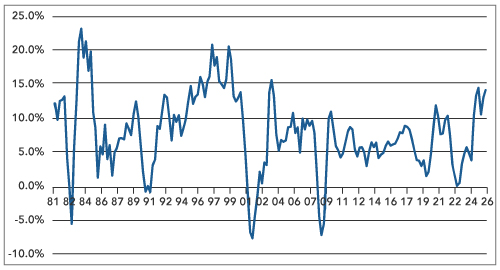
Artificial intelligence has emerged as one of the largest private-sector investment programmes in modern economic history. Hyperscaler capital expenditure is expected to be $750 billion in 2026, and Alphabet, Amazon, and Meta alone have issued bonds worth almost $220 billion so far this year—more than double their combined issuance for all of 2025. Investors are increasingly concerned on account of capital scarcity rather than sticky inflation and a less credible government deficit reduction plan. The bond market, though, has an even bigger problem. While inflation is indeed more bearish than even the worst expectations, elevated capex funding requirements of big tech firms—at a time of apparent government prolificacy—is a major challenge to stock markets, even if they are not very optimistic about the future of the US inflation. History shows us that the bond market can take on parts of a big capital call from a tech boom. The natural comparison is the late-1990s technology and telecom boom, which was also an enormous investment cycle: A Bureau of Economic Analysis research estimates that information-processing equipment and software alone contributed 0.76 percentage points a year to US GDP growth between 1996 and 2000, about a quarter of the growth of the US economy over that time.
Chart 1: Real US Non-residential Fixed Investment Growth, 1980-2026
Source: Bloomberg
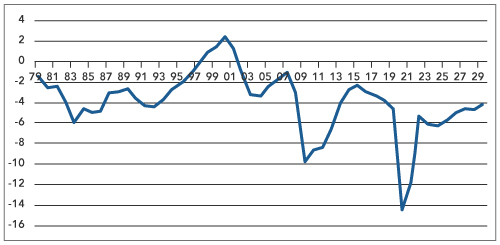
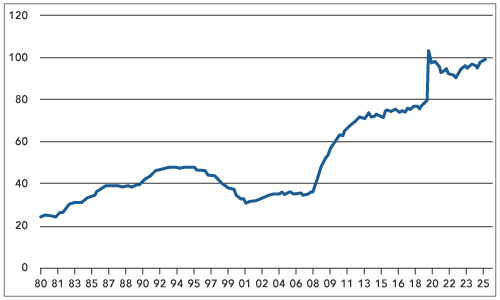
That boom demonstrates that huge technology-investment cycles are possible, and they can ultimately produce enormous productivity gains. But one crucial factor made 1990s different – the US government was progressively reducing debt. Federal debt held by the public dropped to about 34% of GDP by 2000 from roughly 48% in the early 1990s, and the federal budget moved into surplus; yes, you read that right: a surplus. Today, government debt held by the public is about 100% of GDP, and the Congressional Budget Office expects a deficit of $1.9 trillion – 5.8% of GDP – in 2026. Debt is forecast to rise to 120% of GDP by 2036.
Chart 2: US Government Deficit Projected to Rise to 5.8% of GDP in 2026
Source: CBO estimates
The difference can be simple to understand. In the 1990s, private investment demand was rising while government capital demand was on the wane. Today, private investment demand is rising even as government capital demand is already extremely high.
That distinction matters for interest rates. Long-term nominal yields are some combination of expected inflation, the equilibrium real return on capital, and a term premium. Investors have spent years focused almost entirely on the first component. The more interesting change may be happening in the second. If governments, AI companies, defence programmes, and energy systems are all bidding for capital at once, the price required to bring enough saving into the market should rise – even as inflation itself cools.
Chart 3: Federal Debt Held by Public – ~34% in 2000 vs ~100% Today (% of GDP)
Source: Bloomberg
Sovereign borrowing was nevertheless big even before AI took off. IMF estimates put global public debt at about 94% of world GDP in 2025, and 100% by 2029, with defence, ageing populations, and higher interest costs all adding to it. AI-related debt, meanwhile, has already accounted for about 15% of US investment-grade bond issuance this year, and Nvidia’s new financing scheme with the biggest asset managers aims to create a total of $500 billion of funding for AI infrastructure. The investment cycle is no longer a question of equity investors only, but it is more about how that money will be spent elsewhere.
The Global Perspective
The US is not funding this alone. Europe, Japan, and China have continued to be great pools of global saving – euro-area households saved around 14.3% of their disposable incomes in Q1 2026 and Japan and China still have huge current-account surpluses. But those countries are increasingly finding attractive avenues to channel their own savings: AI, defence, electricity grids, energy security, and semiconductor production. The world is not running out of money. But there are simply many more competing credible claims on it now than we have seen for some time.
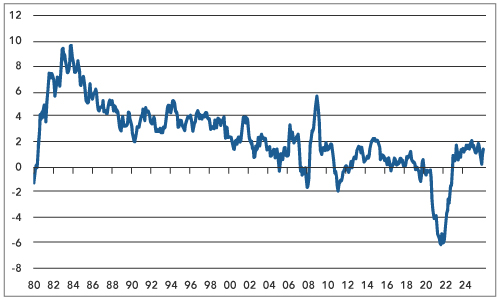
The dollar is the last piece of the puzzle. A strong dollar alongside high US real yields is the benign outcome: foreign capital is attracted by real returns, and the exchange rate has to do some tightening for the Fed. A weaker dollar and rising yields would be far more concerning: that foreign investors are demanding something in the form of compensation for a currency risk and an interest-rate risk at the same time as a currency risk is a feedback loop, and a feedback loop that only increases its own magnitude. The dollar will tell us as much as yields about whether higher US borrowing costs reflect the so-called American exceptionalism or a higher fiscal risk premium.
Chart 4: US 10-year Real Yields Low Relative to the 1990s
Source: Bloomberg
None of this makes AI a poor investment theme; in fact, it is quite the opposite. But scarce capital changes things. When money cost 2%, investors could tolerate distant cash flows and speculative business models. When it costs 6-8%, the questions get much less forgiving. Those companies that generate free cash flow, who can self-finance, who earn above their cost of capital, and whose assets retain value long enough to repay the debt used to build them will be in the ascendency. The AI boom may produce an unusual combination – some of the best corporate credits in the world sitting alongside some of the riskiest infrastructure credits wrapped in the same “AI” label. For now, though, corporate borrowing is rising, financing structures are getting more complex, power requirements keep climbing, and sovereign debt trajectories and yields remain uncomfortable.
Investment implications
Long-duration government bonds may remain structurally less attractive than a simple inflation forecast implies. High-quality corporate credit could outperform sovereign duration. Therefore, AI credit needs to be split into corporate and project risk rather than treated as one comprehensive asset class. Cash-generative equities – companies that can self-fund rather than relying on repeated capital-market access – should command a growing premium.
For most of the past 40 years, investors worried about where to deploy excess capital. The next decade may present a problem that is quite the opposite. Governments want capital. AI wants capital. Defence, energy security, and grid infrastructure all want capital too, and the rebuilding of strategic supply chains wants capital on top of that. There is no reason to think the world lacks the savings to fund it all – but there is every reason to think that investors will demand a higher price for providing it.
The bond market may simply be telling us that capital itself has become scarce enough to have a price again.