

Share This

The Global Price of Money is Rising
Sep 8, 2026
• Equity market calm looks mistaken: bonds and commodities repriced sharply higher last week even as major indices barely moved
• Seven developed market central bank meetings in the next two months could deliver up to three hikes, against a growth backdrop that is accelerating, not slowing
• The marginal buyer of US Treasuries is shifting from official reserve managers toward leveraged, less patient private capital
• Away from the AI infrastructure trade, technology exposure is broadening toward Apple’s consumer franchise and select Chinese small- and mid-caps
Markets are entering a potentially dangerous zone. Fewer than 60 days are left before the crucial US midterm elections, and between now and then the Federal Reserve, ECB, Bank of England, and Bank of Japan will hold seven policy meetings, potentially delivering as many as three interest-rate increases. The Iran conflict could drag on without a lasting resolution for, maybe, another two months, keeping oil above $90 a barrel and feeding inflation through higher transport, food, and production costs. Global long-term interest rates continue to rise. The cost of critical economic inputs such as money, energy, and geopolitical risk is moving sharply higher, even as equity markets appear calm — maybe mistakenly so.
That calm sits awkwardly against growth data. J.P. Morgan’s August Global Composite PMI tracked a 3.1% annualised pace, above its already-strong 2.6% forecast for the second half, with unusually broad sectoral and regional participation. Global GDP grew at an above-trend 2.5% annualised rate in the first half, and the risks to the second-half figure appear skewed to the upside. The backdrop to this week’s rate decisions is not a fragile expansion bracing for a shock, but a resilient one running hot enough to force central banks’ hands.
Beneath the calm surface
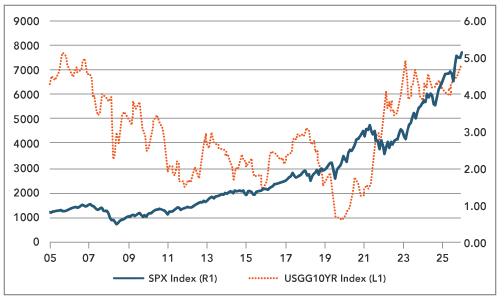
Equity markets finished the week with remarkably little drama: the S&P 500 edged up 0.1%, the Nasdaq gained 0.4%, and the Dow declined 0.3%. Bonds and commodities delivered a less comfortable message. The US 10-year Treasury yield ended close to 4.78%, the 10-year German Bund reached 3.34%, and Japan’s 10-year yield briefly moved above the critical 3% threshold for the first time in three decades, as the BoJ retreats from decades of ultra-loose monetary policy. Brent gained 7.6% over the week, WTI rose almost 10% to above $91 a barrel, and copper advanced around 2%. US 10-year yields have risen roughly 70 basis points over the past 12 months, with a similar rise in Germany—reflecting a tightening in global monetary conditions regardless of what central banks do next.
Chart 1: At Some Stage Rising Long Rates Will Become a Problem for Equities
US 10-year government bond yield and S&P500
Source: Bloomberg
An echo of 1994
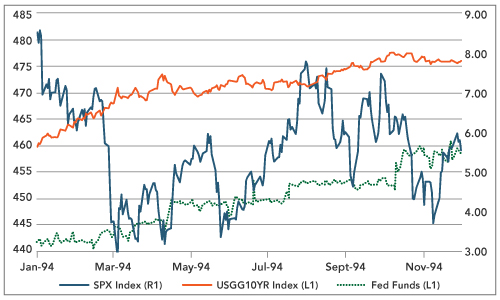
That combination — calm equities and sharply repricing bonds — has a precedent worth taking seriously. The 1994 bond-market sell-off offers a useful comparison: investors back then were surprised by a Fed tightening cycle and discovered that apparently diversified bond portfolios could all fall together. The current episode differs in its origins but not in its consequences. Persistent inflation, higher energy costs, vast borrowing requirements, and disappearing structural foreign demand for sovereign issuances mean diversification across US, European, and Japanese government bonds offers reduced protection when the price of money is rising everywhere.
Chart 2: The High Volatility of Markets in 1994 when the Fed Tightened and the US 10-year Pushed Sharply Higher
Source: Bloomberg
Now or later for the central banks
An ECB hike on Thursday looks like a done deal, and economists now pencil in a further hike in December. The final August PMI sent a 1.4% Q3 annualised GDP signal, pointing to resilience despite higher energy prices, with domestic demand supported by falling savings rates, firmer profits, and Germany’s fiscal stimulus. Core HICP ticked down to 2.4%, but pipeline pressures point to inflation staying above target; new ECB staff forecasts should revise growth up and imply just over three hikes in total, making the market’s pricing of a fourth move next March look reasonable.
The Fed faces the harder call on the data alone. August nonfarm payrolls rose 162,000 against a consensus of 56,000, unemployment held at 4.1%, and wages rose 3.1% year-on-year — not overheating, but not weak enough to excuse inflation that is running above target. Futures assign roughly 60% odds to a September hike, with PPI on Thursday and CPI on Friday likely deciding it before the 15–16 September FOMC meeting; consensus expects 0.4% month-on-month headline CPI, while J.P. Morgan’s own call is a milder 0.21% core reading that would leave the Fed on hold.
The politics make the call harder still. The Fed itself is split in its assessment of the situation: Governor Waller argues underlying inflation is falling and that good risk management means giving disinflation “a chance” while Chair Warsh believes inflation hasn’t improved, a view shared by hawkish dissenters who’d rather hike now than act more disruptively later. September is also the cleanest political window, sitting well before the 3 November midterms, and J.P. Morgan believes Warsh’s push for a hike — partly to establish his own credibility — could carry the vote.
Japan has moved furthest. A September BoJ hike is now viewed as virtually certain. FY27 budget requests rose 17% year-on-year, 10-year JGB yields have tested 3%, and reports of US concern over the weak yen add to the pressure. J.P. Morgan expects hikes in both September and December, which should take the policy rate to 1.5% by year-end, with scope to push above its 2.25% end-2027 forecast if fiscal expansion continues.
A diverging emerging market picture
The tightening bias is not confined to developed markets alone. China’s August PMIs point to improvement (read stabilisation), but the improvement is export- and technology-led while construction and home sales stay weak, and fiscal issuance is running behind last year’s pace. Elsewhere in Asia, the tone is firmer: industrial production in July rose across the region; Taiwan approved a supplementary budget worth 1.8% of GDP; and Korea’s fiscal impulse is swinging from a drag to real support in 2027 as tech-related windfalls get recycled into household demand. Central Europe faces the same forces as the ECB—sticky core inflation and resilient growth are keeping Poland and Czechia tilted toward tighter policy, even as Hungary keeps easing. The Bank of Israel cut interest rates by 25bps last week and Turkish inflation eased to 31.5%, though both face limits given the external backdrop. In Latin America, Brazil is slowing toward a below-potential pace as tight policy finally bites and Mexico is emerging from a weak patch toward above-potential growth.
Inflation rarely travels alone
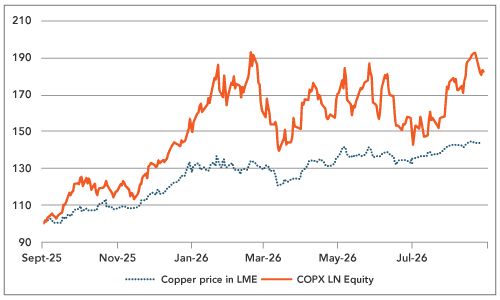
While oil is the most visible inflation risk, it is not the only one. With the Middle East conflict remaining unresolved and crude nearing $100 a barrel again, last quarter’s energy shock is not unwinding. Copper is up 50% year-to-date as electrification, data centres, defence, and infrastructure collide with slow mine supply; soft commodities remain exposed to the war in Ukraine, and a strong El Niño adds risk through harvests, food prices, and power demand. Copernicus recorded the highest daily global sea-surface temperature in its dataset on 22 August, at 21.1°C, and the WMO expects El Niño to intensify further. The transmission channel to markets runs through food, power, insurance, transport, and public finances. Climate risk is now part of the inflation and sovereign-risk conversation, not just a portfolio-exclusion question.
Chart 3: Copper and Copper shares (COPX LN) up sharply
Source: Bloomberg
Who is buying the bond market?
The marginal buyer of US Treasuries is changing, but not reassuringly. The old explanation for low US yields was excess Japanese and Chinese savings recycled into Treasuries; that official demand is now shrinking and being replaced by less reliable private and leveraged buyers. Foreign investors held $9.30 trillion in June, up $205 billion over the year, but official holdings fell $114 billion: Japan’s position dropped $38 billion to $1.12 trillion, China’s fell $98 billion to $633 billion. Together they still hold about $1.75 trillion, almost 19% of all foreign holdings, but that combined position shrank $136 billion even as private foreign holdings rose roughly $320 billion. This matters because both economies still run large surpluses. China’s current account surplus was about $379 billion in 1H26, Japan’s was a record ¥17.4 trillion — but that money isn’t automatically flowing into Treasuries. Higher JGB yields have also turned the currency-hedging math against Japanese buyers: an unhedged 10-year Treasury yields about 4.78% versus 2.9% on a JGB, but after a roughly 2.75% hedging cost, the hedged Treasury falls to about 2.0%, nearly 90bps below the JGB, leaving Japanese investors exposed to currency risk if they want the higher yield at all.
UK-recorded Treasury holdings rose $84 billion to about $940 billion, but London’s role as a custody and hedge-fund centre means this isn’t necessarily British savings; some likely reflects the Treasury basis trade, where hedge funds have built an estimated $830 billion of positions against $4 trillion of gross exposure and $3 trillion of repo borrowing. That, in a sense, is rented demand, not patient capital, dependent on repo access and prone to fast unwinds, as March 2020 showed. With official reserve managers retreating and Japanese hedged returns less attractive, leveraged private capital is filling more of the gap, and heavy US issuance may require a structurally higher term premium.
Technology broadens — or disappoints
Against that backdrop of tightening financial conditions, the equity story that matters most is whether technology can broaden beyond its most crowded trades. Semiconductors outperformed software last week. Apple’s product event scheduled on Wednesday, centred on new premium iPhones and potentially a first foldable, could offer a technology narrative beyond the crowded semiconductor and hyperscaler trades — Apple’s installed base and services revenue provide a different route to AI adoption, though execution and whether it can show genuinely useful AI remain the risks. China may offer another route away from crowded AI trades: desks report stronger demand for bullish options on the smaller-company CSI 500 and CSI 1000, the latter still around 16% below its May high. Chinese small- and mid-caps offer greater exposure to semiconductor design, automation, and domestic AI than the familiar internet platforms, with capital-market reform adding structural support — while Korean and Japanese AI beneficiaries already carry high expectations, this corner of China still carries low ones.
Investment conclusion
Weekly calm in equity indices shouldn’t be mistaken for an absence of risk. Oil is above $90, global long-term yields sit at multi-year or multi-decade highs, and the next marginal buyer of government bonds looks less dependable than in the past. Yet the growth backdrop likely forcing central banks to keep tightening is genuinely strong — global GDP is accelerating, employment PMIs are at three-year highs, and Asia is recycling tech windfalls into domestic demand. That is the harder trade-off for policymakers and portfolios alike: this isn’t stagflation, but an expansion running hot enough that the price of money must keep rising to meet it, even as US equity valuations leave little room for higher discount rates.
Portfolios should consider carrying less beta and more optionality, although, frankly, there is a good measure of growth out there. However, holding cash is no longer an admission of defeat when it offers a respectable return. Technology remains investable, but exposure should broaden beyond the most crowded AI winners toward consumer monetisation through Apple and, selectively, China’s domestic technology and smaller-company universe. Markets may keep rising, particularly if inflation surprises to the downside, but the balance of risks has shifted: global monetary conditions are tightening before central banks have finished tightening, and bond markets are increasingly demanding fiscal discipline rather than talk of it.