

Share This

The Market Finally Believes the War
Sep 15, 2026
For much of the past six months, markets treated the Iran war as some temporary disturbance. As the war progressed and conflicting narratives emerged, oil prices spiked and retreated. Bond yields rose, which encouraged some duration buying. If you were too bearish on bonds, you would be hurt by promises of ceasefires holding, or, in the case of equities, by the extraordinary upgrade to corporate profit forecasts.
Last week that complacency finally broke.
The most important development of the week was the Houthis making an extraordinarily rapid advance in Yemen, opening a second front near the Bab el-Mandeb, the southern gateway to the Red Sea. The conflict is now threatening two of the world’s most important energy corridors at once, and Saudi oil exports are increasingly bearing the brunt.
Chart 1: Zones of Conflict

Source: Encyclopedia Brittanica
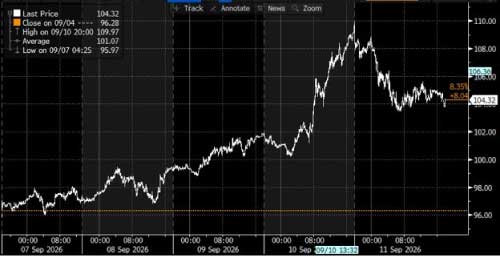
It’s therefore logical that oil prices have reacted. Brent finished the week at $104.61 a barrel — up roughly 8.7% despite falling on Friday; WTI closed just above $100. Shipping through Hormuz has dipped sharply, and Saudi infrastructure has been attacked, forcing markets to assign a meaningfully higher probability to persistent rather than temporary supply impairment. Oil moving meaningfully through $100 has shifted market expectations on monetary policy to the most bearish seen in this cycle.
Chart 2: Brent Oil Prices Have Surged Past $100
Source: Bloomberg
The bond market has stopped wishing the problem away
For months, markets seemed to think inflation would solve itself and central banks would eventually ride to the rescue. Last week, bond markets priced in something closer to our long-running worry: the next big move in global rates will be higher for longer (maybe much longer).
Markets now expect aggressive tightening through the first half of 2027 and almost no easing anywhere in the developed world before end-2027 — a view that would have sounded extreme only weeks ago.
The Fed meets this week (futures give close to a 90% probability of a 25-bp hike, which would take the funds rate to 3.75–4.00%, with a high probability of another move up in December). The ECB has already moved (deposit rate hiked by 25bps last Thursday to 2.50%, as the central bank explicitly cited the Middle East conflict and persistent inflation; new forecasts put headline inflation at 2.5% in 2027 and core at 2.6%, still above target). ECB’s forecasts point to further increases this year and into next. A December hike and the risk is tilted towards another move in March 2027.
So, the news is that we are now likely facing an emerging global hiking cycle where investors had hoped to see the tail end of an easing one. If the Taylor rule, which looks at how growth and inflation work on rates, were applied, then a further hike of 100bps to developed market rates would be a no-brainer. The tech boom is great, but it is boosting growth way beyond what was forecast when inflation was not such a big problem. Yes, AI may have productivity benefits, but they are not easily forecast by central banks right now. A 10-year Treasury bond yielding almost 5% changes the investment calculus — bonds are real capital competitors instead of being portfolio insurance, and equity arithmetic follows suit. The S&P 500 is now trading at around 19.3 times forward earnings (vs. the recent range of roughly 18–23 times — correction towards fair value rather than obvious cheapness) while investors can earn close to 5% risk-free. For the first time in years, there’s a price to pay for owning equities.
So, do we go all-in bearish now? No
There are reasons to be cautious, but markets are dangerous because compelling narratives feel most compelling right after prices have moved. Three counterarguments count:
First, the war can end. Diplomacy hasn’t died — Iran has discussed maritime-traffic management through Hormuz with regional foreign ministers and Oman; there has been direct Iran–Gulf engagement (including with the UAE) on the sidelines of the just-concluded BRICS summit. Gulf states have every incentive to find an exit route: none of them benefit from $120–150 oil if the price is physical risk to infrastructure, disrupted trade, higher global rates, and weaker global growth.
Second, American politics could constrain the war more and more. Midterms are coming, and the composition of the US Congress next year matters a lot. If Democrats take more seats, a hostile Congress could make continuation of policies harder, with appropriations oversight, and subpoenas putting War Powers under pressure — purse power is still the most practical check since wars need funding even when presidents have wide operational leeway. Markets are extrapolating conflict; politics may interrupt that extrapolation.
Third, the corporate sector is inconveniently healthy for a simple bear case. S&P 500 earnings expectations keep rising; continued earnings growth has pushed valuations down to more defensible levels even as prices have come under pressure; no one is pricing a recession yet either — JP Morgan sees US growth around 2.1% in both 2026 and 2027 (Asian growth expectations are notably stronger). A world of 5% Treasury yields and $100 oil is uncomfortable but does not necessarily imply a recession.
However, to be fair, more warning lights are flashing, and several indicators are becoming harder to ignore.
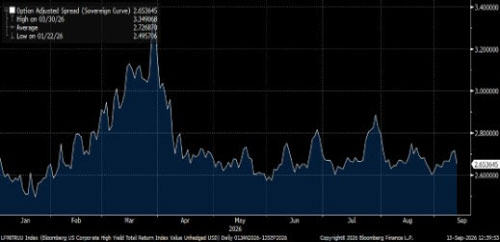
Credit is one; headline indices still look reasonable, but breadth underneath is weakening (lower-quality borrowers in particular aren’t keeping pace with the market’s apparent resilience). That’s often how credit cycles start turning — not all at once. Financing the AI investment boom is risky. US tech giants have issued around $220bn of bonds over the past year to build data centres — pricing distortions are even seen in investment-grade credit. Markets are now taking on enormous government issuance while private capex needs much more debt financing, so capital is no longer free, and somebody has to pay the clearing price, which must be higher.
Chart 3: US High Yield Bond Spread Still Well-Behaved (bps)
Source: Bloomberg
Liquidity is a second warning. The G10 liquidity indicator has deteriorated sharply. It’s an imperfect timing tool (as most are), but major contractions in global liquidity rarely make for an ideal backdrop when expensive equities, rising policy rates, heavier government borrowing, and balance-sheet restraint all pull in the same direction.
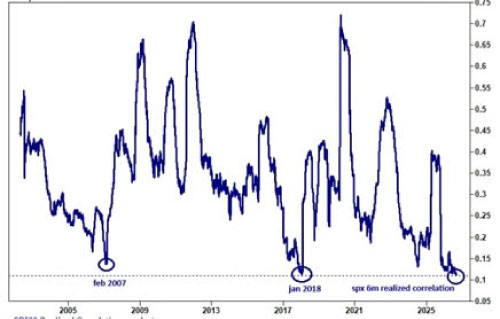
A third is market structure. Correlations between individual S&P 500 stocks have collapsed (CBOE’s three-month implied correlation index was recently near 12, against a 52-week high above 35). Low correlation sounds good — it presents significant stock-specific opportunities, but historical evidence suggests low correlation can also be a late-stage market where individual stories are winning, and the common macro factor is being ignored. When that factor reasserts itself, correlations tend to spike suddenly, usually because stocks start falling together. The rotation away from growth leadership, which seems to be rolling over, fits the same logic: at 5% yields, distant earnings are worthless relative to cash flows paid today.
Chart 4: Average Correlation Between S&P500 Constituents
Source: Goldman Sachs, Weekly ChartStorm
None of these signals say sell everything, but they certainly imply margin for error has shrunk.
Are US equities over-owned?
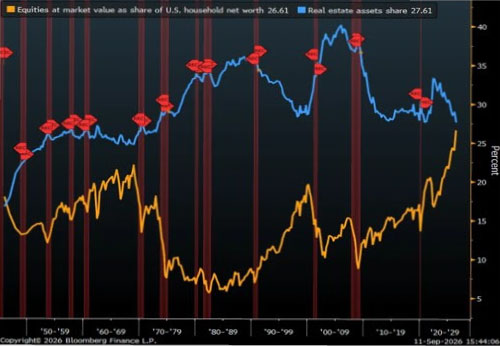
The latest Fed Financial Accounts show that households are much more sensitive to stock prices today than ever before. Economists worried about the housing wealth effect for decades, but the equity wealth effect may matter just as much, now that US households hold roughly a record $74 trillion in corporate equities (directly and indirectly) versus $49.8 trillion in owner-occupied property — up from just $38.6 trillion in equities in 2022.
A 20% drop in equities wouldn’t just hit 401K investment statements — it would change retirement expectations, discretionary spending, confidence, and likely corporate hiring. The Fed knows tightening becomes more dangerous when the financial system is as sensitive to asset values.
There’s also the ownership concentration problem. Foreign holdings of American equities are near record highs. Overseas investors have kept pouring money into US assets (long-term securities purchases were $207bn in June alone, after $263bn in May). “Own America” was a great trade while US growth beat expectations, dollar strength prevailed, and the Fed was expected to ease eventually. Now asymmetry looks different with 5% Treasury yields, rising political risks, and the Fed preparing to tighten further.
Chart 5: Equities and Real Estate as a Percentage of US Household Net Worth
Source: Bloomberg
Where do we go?
Not everything is about hiding in cash. The more interesting question is whether capital should move geographically — and our answer is yes, and it should move to Asia.
The gap between US and Asian monetary conditions is getting unusually wide. US 10-year yields are around 4.8–5%, Chinese government yields are below 2%; and the US–China 10-year spread just hit a record high of 3.17 percentage points. China doesn’t have America’s inflation problem (actually its problem is quite the opposite: weak domestic pricing power and insufficient demand), so there’s no reason for Beijing to ride the Western tightening bandwagon, especially when its economy appears to be stabilising (JP Morgan cites stronger PMIs, better AI-related exports, accelerated central-government bond issuance, and an RMB800bn policy-bank facility; growth back towards 5% annualised GDP growth next quarter).
Japan is different but not scary. The BoJ will keep normalising, but a move to 1.25% isn’t restrictive by any conventional global measure — it is more like Japan is rediscovering interest rates after three decades without any.
Elsewhere in Asia, the technology cycle is still strong (Taiwan’s trade data show powerful AI-related exports and capital-goods demand; Korea has started to see benefits extend from corporate profits into employment and household income). Valuations are lower, too. Decent growth, less fiscal excess, less aggressive tightening, and more modest valuations make an increasingly attractive combination relative to the US.
We still recommend selective exposure to technology. The AI investment cycle is real even if some of its valuations have been fantasy — higher rates will expose weak business models and stretched financing structures, but they won’t stop companies from buying computing power where the underlying return is real. The next leg of the story therefore becomes more selective.
A market entering a different regime
Our conclusion is uncomfortable rather than apocalyptic. Markets have stopped assuming that the Iran conflict will go away when it suits them. Oil above $100 has forced investors to confront persistent (not transitory) supply disruption, and expectations for central banks have flipped from cuts to hikes — little easing priced before end-2027 now. That repricing is rational — but extrapolating indefinitely would be its own form of complacency: Wars end. Politics intervenes. High oil prices kill demand. High rates create their own disinflation eventually, too. JP Morgan sums it up well: $100 oil is hawkish initially, but an extreme, sustained energy shock could become destructive enough to growth that central banks eventually have to reverse course.
Markets don’t move smoothly from one equilibrium to the next. Our positioning is cautious rather than outright bearish:
• We like a bit more cash, hence recommend keeping duration shortish;
• We recommend avoiding weaker credit;
• We wouldn’t chase US equities just because they’ve corrected (corporate earnings are still an important cushion; valuations in the US have already moved closer to fair value);
• Asia increasingly has something that the US does not — growth without the same combination of fiscal excess, tightening monetary policy, and extreme foreign ownership concentration.
After a decade in which the easiest portfolio decision you could make was to buy America, maybe the most important question for investment in the next few years is not what will happen to America but what if the rest of the world offers better risk-adjusted return?
That is not yet a consensus trade, which is why it interests us.