


Share This

Manipulating the Price Isn’t Solving the Problem
Aug 24, 2026
The United States still enjoys some extraordinary advantages: the world’s deepest capital markets, its leading technology companies, the dollar’s reserve currency status, and an economy that has repeatedly confounded those predicting its demise. But markets are increasingly being made to believe in something that really doesn’t add up — exceptional growth, heavy private investment, extraordinarily large government borrowing, and low long-term rates, all at once. Scott Bessent says Washington has the tools to deal with the bond market. It does. The question is whether those tools address the problem, or merely manipulate its price for a while.
The bond market raises the rent
We covered the rise in global bond yields extensively the previous week. What changed last week was more important: declining confidence in Washington’s ability to address the causes of the move.
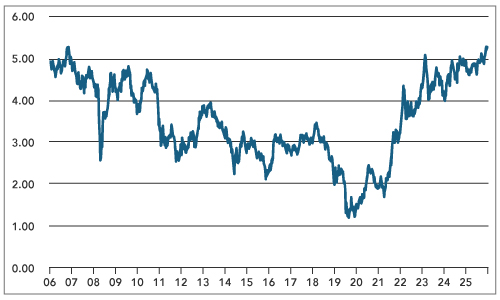
Last week, the US 30-year Treasury yield climbed to 5.34%, its highest since 2007. In an unexpected response to the rally, Treasury Secretary Scott Bessent announced an increase in the size of planned liquidity-support buybacks of 10- to 30-year securities, raising the per-operation amount to at least $4 billion from a maximum of $2 billion. The market initially obliged — 30-year yields fell almost 10 basis points, but the relief lasted barely a day. By Friday, yields were back around 5.25%, close to where they stood before the Treasury’s intervention.
Chart 1: US 30-year yield Hits 5.30% – Highest Since 2007
Source: Bloomberg
That price action tells us something important. The bond market is not against the idea of financing America — demand at Treasury auctions remains reasonably healthy, and foreign holdings, though down in June, were still 2.3% higher than a year earlier. America can almost certainly keep borrowing enormous amounts of money. The question is at what price.
Bessent has tools. But what are they solving?
Bessent is right that Treasury has plenty of tools: it can change the maturity composition of issuances, issue more bills and fewer long-term bonds, repurchase less-liquid off-the-run securities, and support repo-market liquidity and the leveraged basis trade through which hedge funds buy Treasury bonds while shorting futures. But such interventions only work when the structural problems behind them are also addressed; while those steps buy time, they do not turn the narrative on their own.
Markets have seen versions of these interventions before — Operation Twist, quantitative easing, the 2008 rescue facilities, and the COVID bridge. But authorities back then had credible explanations for what they were trying to fix, and markets accepted them because policy was buying time for an identifiable solution. The risk today is that any intervention increasingly looks like a substitute for one — and none of it changes the budget deficit.
Shortening the fuse
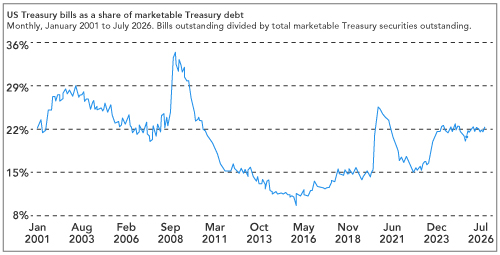
Treasury bills have risen to roughly 22% of outstanding marketable debt, above the 15–20% threshold the Treasury Borrowing Advisory Committee has previously regarded as sensible over the medium to long term. Issuing bills makes tactical sense — money-market demand is enormous, and issuing them reduces the volume of longer-dated debt that needs buyers today. But the core issue has not disappeared; simply, the maturity has shortened, and with debt already this large, shortening the maturity reduces the time over which higher rates feed into financing costs. Treasury is effectively swapping duration risk for refinancing risk.
Chart 2: Given High long term interest Rates the US issues More short-dated US T-bills
Source: U.S. Treasury Monthly Statement of the Public Debt (MSPD).
Oxford Economics has termed this yield-curve targeting, a better description than yield-curve control — Japan’s version involved the Bank of Japan setting bond prices and defending them with its balance sheet. America is not yet in that situation, but the direction is uncomfortable: Treasury appears increasingly willing to tilt issuance and adjust buybacks when long yields reach uncomfortable levels.
The arithmetic Washington cannot trade around
Federal debt passed $40 trillion last week for the first time; of this, roughly $32.3 trillion is held by the public. The Congressional Budget Office estimates the deficit reached $1.8 trillion in the first 10 months of the current fiscal, $169 billion worse than the equivalent period last year, with a full-year baseline around 5.8% of GDP.
Project it forward: assume nominal GDP grows 4.25% a year — that’s hardly bearish — and debt keeps rising by around $2 trillion annually. By the end of the current presidential term, gross government debt would approach $45 trillion, around 130% of GDP. That isn’t a forecast; it’s arithmetic, with no recession, banking crisis, or a new war assumed — just status quo. That is precisely what worries us.
Where is the fiscal constituency?
A more reassuring picture would be the administration acknowledging the arithmetic and spending political capital on it. We see little evidence of that: the Republican Party remains reluctant to raise taxes, entitlement reform stays politically toxic, defence spending is hardly likely to fall while America remains engaged in the Middle East, and interest costs have themselves become one of the largest items in federal spending.
DOGE’s mandate was to supply the spending-side solution. It generated headlines but never produced transparent savings large enough to alter the trajectory of climbing government debt. Tariffs haven’t been the fiscal elixir once advertised: after the Supreme Court ruled against the International Emergency Economic Powers Act tariffs, the government refunded $71 billion of duties in May and June, and in June alone refunds actually exceeded gross customs receipts, making tariffs a net drain on federal revenue for the month. Even if we set aside the legal battles, tariffs are an odd answer to problems facing America — they interfere with trade flows, raise costs somewhere in the supply chain, and push companies to reorganise production around political boundaries rather than economic efficiency, just as America is trying to raise its potential growth rate.
And then there is the (unending) war
The conflict with Iran is approaching six months, with little sign of a durable resolution in sight. Traffic through the Strait of Hormuz remains severely impaired, with oil flows well below pre-war levels. Current energy prices are therefore more than an inflation problem — a tax on the consumer, except that Washington collects none of the revenue. Higher petrol, diesel, and electricity costs severely curtail the purchasing power of households, hitting lower- and middle-income households the hardest, since essentials eat up more of their income. That matters because one apparent strength of the US economy this year may prove less durable than it looks.
The consumer was given a cheque in the first half
Goldman Sachs Chief Economist Jan Hatzius offers a respectable counterargument. He expects real US GDP growth of around 2.1% this year, as improving inflation and strong business investment keep supporting growth even as household spending slows. Plenty of investors will want to believe that, and America has earned some benefit of the doubt — betting against US exceptionalism has proved to be an expensive habit.
But even Goldman’s own numbers carry a warning. The spring spending surge leaned heavily on unusually large tax refunds: Goldman estimated tax-code changes would deliver roughly $100 billion in extra refunds in the first half, and by May had raised that estimate to an income boost approaching $140 billion, much of it going to households highly likely to spend it. But a refund isn’t recurring income, and Goldman now expects real consumer spending growth to slow to 1–1.5% in the second half, from around 1.8% in the first. Add in the elevated energy costs, and the underlying consumer spending story looks considerably less robust.
America increasingly rests on AI
The optimistic case therefore leans more and more on business investment — specifically, on AI. One of America’s biggest strengths is that it owns the companies capable of investments needed to dominate the next generation of computing; the hyperscalers have balance sheets, technology, talent, and access to capital that few companies elsewhere can match. Goldman Sachs Research’s Jim Covello makes a reasonable case that cheaper open-source models could help the hyperscalers rather than undermine them, since lower-cost models could help companies deploy AI profitably across more everyday applications and raise utilisation of all the capacity now being built.
But before investors think of any real return on AI, they’ll encounter a critical question: who will finance the enormously capital-intensive AI infrastructure? The US technology sector is entering capital markets with one of the largest investment programmes in corporate history, just as its government runs one of the largest peacetime structural deficits in history. Everybody wants the same capital: government for existing spending, technology for America’s future competitive edge, consumers for lower borrowing costs, and the property market for lower mortgage rates. America wants it all at once.
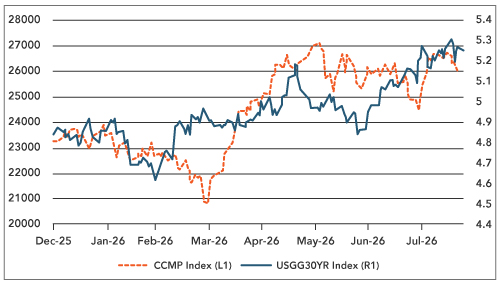
Chart 3: Rise in 30 year has been a Speed-break on the Performance of NASDAQ
Source: Bloomberg
The part of the American dream that looks hardest to believe
What I find hard to accept is markets assuming all the good outcomes converge at once — exceptional growth, exceptionally high investment, and exceptionally low long-term rates. Capital doesn’t normally work that way. Strong private investment increases the demand for savings. So do large government deficits, and so does a war that absorbs resources and disrupts energy supply. Greater inflation uncertainty raises the compensation investors require for supplying those savings. At some point the price adjusts, and the price of long-term capital is the long-term interest rate.
To us, Bessent’s interventions are more troubling than reassuring. If he truly understands markets, he knows that buying a few more long-dated Treasury bonds without a credible plan only delays the reckoning; it doesn’t remove it. Government debt eventually answers to something less accommodating than intervention: arithmetic.
Investment conclusion
None of this requires an American debt crisis to unfold, and that distinction matters. Treasury auctions need not fail, foreign investors need not abandon the dollar, the economy need not fall into recession, and AI need not prove a bubble. A far less dramatic outcome changes the investment landscape: long-term Treasury yields stay structurally higher. Goldman’s own rates work suggests somewhere between 5.2% and 6% could give investors sufficient value to absorb long-duration debt comfortably.
A long bond living in that range changes quite a few things: higher mortgage rates, a higher hurdle rate for private equity, lower present value for long-duration growth stocks, pricier infrastructure, and shifted property valuations. Most interestingly, it raises the financing cost of the very AI investment boom that many predict will preserve America’s economic exceptionalism.
There is a circularity here that markets haven’t fully confronted: America needs technology investment to lift productivity and make its fiscal burden more manageable, but technology needs enormous capital. Interestingly, government competes for that same capital, and the competition raises its price — which eventually threatens the investment itself.
Bessent can smooth that adjustment, and may postpone parts of it: Treasury has formidable tools, the Fed even stronger ones. But tools that change the price of government bonds aren’t the same as policies that change the underlying demand for capital. Markets tolerate intervention when they believe it is buying time for a solution; they grow far less accommodating when it looks like a substitute for one.
The bond market is not yet telling America that it cannot borrow. It is telling America that borrowing has become more expensive. Washington would be wise to listen.