


Share This

When Oil Moves, Markets Listen
Mar 10, 2026
For some time now, we have argued that the world is approaching the end of a long geopolitical cycle. History rarely moves in a linear fashion. Periods of relative stability are often followed roughly every eighty to ninety years by crisis phases in which institutions built by one generation are tested and rebuilt by the pressures of the next. These phases — whether the American Revolution, the Civil War, or the upheavals surrounding the Great Depression and the Second World War — tend to reshape the political and economic order that follows.
The events unfolding in the Middle East currently should be seen through that lens. What we are witnessing in the region is not simply a dispute between the United States and Iran, nor merely another Middle Eastern conflict. It increasingly resembles a rupture in the post‑war framework that has governed global economic and political relations for decades. The institutions, alliances, and assumptions that shaped the world after 1945 are being tested simultaneously — by geopolitical rivalry, energy insecurity, fiscal strain, and deep generational change. In that context, the current conflict may represent something larger: the final phase of the baby‑boomer era in Western leadership. Such transitions rarely occur smoothly. Historically, the old order tends to fracture before a new framework emerges.
• Oil markets have abruptly repriced geopolitical risks, with Brent rising nearly 28% in just five sessions
• Bond yields have moved sharply higher, suggesting markets are reassessing the inflation outlook
• Credit markets are beginning to show early signs of stress despite relatively orderly equity declines
• Asia’s energy-importing economies appear particularly vulnerable if oil prices remain elevated
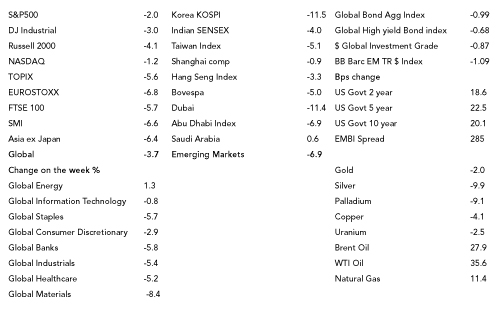
Table 1: Changes on the Week (%)
Iran Changes the Calculus
The escalating crisis around Iran has rapidly moved from a marginal geopolitical concern to the most important variable shaping global asset prices currently. Until recently, the possibility of a sustained disruption to energy flows through the Strait of Hormuz sat firmly in the tail of most investors’ risk frameworks. Over the past week, however, markets have been forced to treat that scenario as a credible probability rather than a distant possibility.
The speed of the repricing seen across commodities, equities, bonds, and currencies reveals how unprepared consensus positioning was for this outcome. Last week, Brent crude surged almost 28% over five sessions to $93 per barrel, one of the most compressed oil price shocks in recent memory. Global equities sold off broadly, bond yields rose sharply, and safe‑haven flows provided only partial insulation.
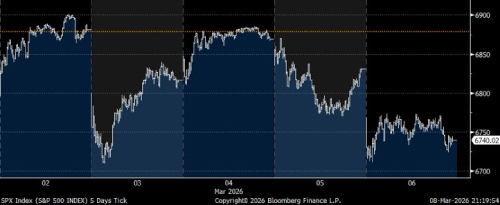
The S&P 500 fell 2.0% on the week. European indices fared worse, with the EuroStoxx 50 declining 6.8% and the FTSE 100 falling 5.7%. Asian markets, too, experienced some of the sharpest declines. The Korean KOSPI dropped 11.5%, reflecting both its strong performance since the beginning earlier in the year and the country’s acute dependence on imported energy.
Chart 1: S&P500 over the week
Gold Pauses After a Powerful Rally
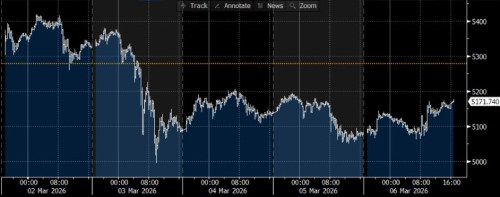
Gold has been one of the strongest‑performing assets of the past 12 months, surging an unprecedented 77.6% to reach $5,172 per ounce. The rally reflects sustained central‑bank buying, geopolitical hedging, and rising concerns about long‑term fiscal sustainability in major economies.
Against that backdrop, last week’s price action was notable precisely because gold failed to accelerate further even as geopolitical tensions flared. The metal declined 2.0% over five days while silver, which had surged dramatically over the past year, dropped nearly 10%. Such behaviour is typical of mature rallies when investors already hold substantial positions.
Chart 2: Gold $ oz
Source: Bloomberg
Oil Emerges as the Key Macro Risk
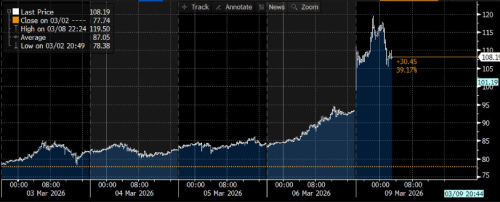
If gold reflected consolidation, oil markets told a very different story. Brent crude surged 27.9% over five sessions to $93 per barrel. The year‑to‑date increase in crude now exceeds 50%. These are not routine commodity fluctuations but one of the fastest repricings of energy risk seen in recent years.
Energy shocks propagate rapidly through the macroeconomic system. Inflation expectations rise first, followed by weakening growth expectations and central banks becoming more cautious about easing policy. Markets entered 2026 expecting falling inflation and gradual monetary easing. Oil prices approaching $100 complicate that outlook materially. Initial estimates put the hit to the macro picture at around 0.5% off global growth and US inflation surging 0.5-1.0%.
Chart 3: Brent Oil Spikes to $120bbl
Source: Bloomberg
Bond Markets Reprice Inflation Risk
For much of the past year, bond investors assumed inflation would steadily decline, which would allow central banks to begin easing policy. A sharp energy shock disrupts that narrative.
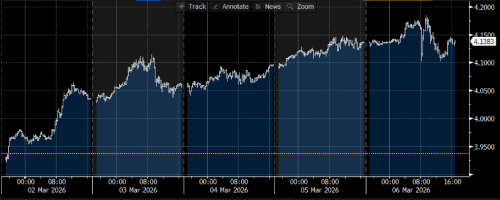
Government bond markets reacted quickly to the move in oil prices. The US 10‑year Treasury yield rose around 20 basis points (bps) to 4.14%. The two‑year yield climbed similarly, suggesting the market is repricing the entire expected interest‑rate path rather than simply adjusting long‑term risk premiums.
Chart 4: US 10 year government bond yield spikes higher
Then, there are fiscal dynamics to consider. The United States is already running a deficit of nearly $2 trillion, with public debt exceeding $34 trillion. History suggests that periods of geopolitical conflict widen deficits further through both higher military spending and economic disruption.
Emerging market debt has also felt the pressure. Emerging Market Bond Index spreads widened 15.8 bps over the past month to 239 bps. For energy-importing economies, the combination of higher oil prices, weaker currencies, and wider credit spreads can quickly turn into a balance-of-payments concern if the shock persists.
Credit Markets Show Early Signs of Strain
Credit markets are often the first place where systemic concerns appear. Global high‑yield bonds declined modestly over the week while bank equities fell sharply. While such movements remain orderly, they suggest investors are becoming more selective about risk exposure.
Private credit markets may face particular scrutiny going forward. Many funds offer periodic liquidity against portfolios of relatively illiquid loans. During periods of uncertainty, such a structure can expose tensions that remain hidden during stable market conditions.
Bank equities also deserve attention. Global banks fell 5.8% over the week and have now declined 9.7% over the past month. US banks alone are down more than 9% over the same period.
Such moves may reflect concerns about credit quality in energy-exposed sectors, mark-to-market pressures on fixed-income portfolios, and the broader uncertainty that rising energy costs introduce into the growth outlook.
GCC Markets: Structural Financial Strength
Despite the ongoing war, the resilience displayed by Gulf markets has been notable. Saudi Arabia’s Tadawul All-Share Index gained modestly during the week, reflecting the Kingdom’s improved fiscal position when oil prices rise. Higher oil revenues strengthen government finances and support domestic investment programmes.
The UAE experienced greater volatility, reflecting its integration with global capital flows. Even so, the broader regional picture remains one of considerable financial strength. Sovereign wealth funds across the Gulf represent one of the largest pools of long‑term capital in the world and provide a powerful financial buffer during periods of global instability.
Asia’s Energy Vulnerability
Across Asia, the market reaction reflects heavy reliance on imported energy. Korea, India, and Japan all experienced meaningful equity and currency weakness during the week. Higher oil prices place direct pressure on current accounts and inflation dynamics in these economies.
China, on the other hand, has displayed relative stability, reflecting diversified energy supply chains and a different macro policy framework. Nevertheless, a prolonged disruption to energy flows would eventually affect even the largest economies.
Conclusion: A New Risk Regime
In isolation, the market movements of the past week might appear manageable. Overall, however, they point toward a shift in the global macro environment. Oil prices have surged, bond yields have risen, credit spreads are beginning to widen, and currency pressure is emerging across energy‑importing economies.
None of these signals implies an imminent financial crisis. But history suggests investors should pay close attention when oil, credit, and currency markets begin moving in the same direction. Those signals are now becoming too difficult to ignore.
And as markets assess the consequences of war, we can only hope that diplomacy ultimately prevails. Praying for peace.