


Share This

Volatility not Disaster
Nov 12, 2026
• Mid-term elections reinforce the sharp reset of tech valuations
• The real impact of Democrat local government is at a subsector level focused on data centres
• The real story – higher bond yields keep up the pressure on equity valuation
• Indian equities are back as the non-tech portfolio diversifier supported by foreign buying
• Watch for the US inflation data this coming week- a potential market recovery spoiler
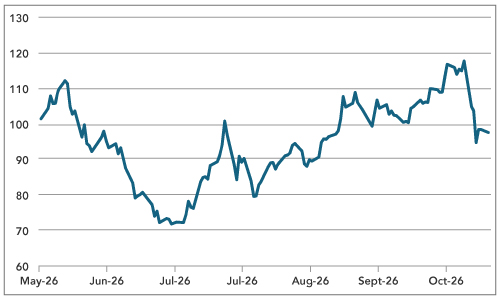
Volatility not disaster — that’s our take on a week that felt much worse than it actually was. On Thursday, the Nasdaq 100 fell 6.4%, its worst single-day decline since March 2020. Although that one session wiped out $2.3 trillion of value from the Nasdaq 100, by Friday’s close the S&P 500 had recouped much of those losses and was down 2.7% on the week. US jobs rose by 165,000 in October, almost three times the expected increase.
Chart 1: S&P500 Sharp Fall
Source: Bloomberg
The economy is fine; that in itself isn’t a worry. What’s changed is what and how investors will pay for the AI story henceforth. Voters have put limits on the data-centre boom, companies are cutting back spending, and bond yields near 4.9% offer a real alternative. This isn’t a crash; it’s a market learning that the easy part of the AI trade is over.
The Big Picture
The market spent the week pricing in a slower AI build-out. The Democrats took both houses of Congress, and NBC exit polls showed 56% of voters noting AI and data centres were a major factor influencing their voting decision. Qualcomm and Arm also disappointed, and memory stocks collapsed: on Thursday, SanDisk fell 22%, and Micron 17%.
We believe the political damage is exaggerated. Neither party wants to give China the AI race; Washington is less likely to legislate on safety than to build blocks. The real action is with the states. Texas has about a quarter of planned US data-centre capacity, and its incoming governor Gina Hinojosa campaigned for a moratorium (though such pauses may not last). But even that won’t stop the change. The bigger change started before the election as power shortages, local opposition, and stretched cash flow slowed investment.
UBS expects hyperscaler capex to rise 76% this year, then only 25% in 2027 and 6% in 2028. Spending isn’t falling; it is growing more slowly and judiciously. That helps Microsoft, Amazon, Alphabet, and Meta but hurts the companies that sell them chips and equipment. The market traded just that way. In the two days after the election, the 72 S&P 500 companies building out the build-out fell 13.3%, the five hyperscalers rose 1.7%, and the rest of the index was flat.
What investors are really asking is what’s left if you take away the growth of tech. AI spending has been driving much of US profit growth, investment, and equity gains for three years now. A slower build-out means less of all three. That’s not a crisis; it’s lower returns.
Economy
The US economy is not the problem, at least for the moment. October payrolls rose 165,000 against expectations of about 60,000, unemployment fell to 4.1%, and data for August and September were revised up by a combined 84,000. Wages rose 3.1% on the year, still below inflation, indicating real pay is falling. Strong hiring and squeezed real incomes make life awkward for the Fed. These figures do not signal a recession.
Elsewhere in the world it was quieter. Europe watched from the sidelines. The Bank of Japan held at 1.25% but said underlying inflation has reached 2%, opening the door to a December hike. In the Gulf, a Qatar-brokered plan to reopen the Strait of Hormuz pushed oil lower, and the S&P 500 energy sector lost nearly 12% on the week. Cheaper oil helps importers in Asia and Europe and cools global inflation.
Central Banks and Bonds
Bonds did their job in portfolios, but only just. The 10-year yield fell 8bps to 4.86% as investors shunned equities, but the yields subsequently rose after the jobs report. The 30-year ended near 5.27%. Markets put the odds of a Fed rate hike on 9 December at above 75%. This is a tightening cycle, and the fall in yields signalled a flight to safety, not a change in direction. Our concern is that yields will now rise again, for reasons that have little to do with the Fed.
The fiscal numbers are getting worse. The deficit for the year to September was $2.0 trillion, about 6.1% of GDP, against the 5.8% the Congressional Budget Office (CBO) expected in February. Net interest costs surged past $1 trillion, surpassing the country’s defence spending. The CBO expects debt held by the public to rise to a record 120% of GDP by 2036 from about 100% currently.
A divided Congress will not fix this. Democrats will block new tax cuts but will not cut spending, so gridlock freezes the deficit near 6% of GDP in an economy at full employment.
The Treasury trimmed its borrowing estimate last week and kept auction sizes unchanged, but the arithmetic does not go away. This week’s 10-year and 30-year auctions will show whether buyers want a higher yield to hold US debt. We expect the term premium, the extra return for lending over longer maturities, to keep rising.
Equities
The S&P 500 closed at 7,377, down 2.7% on the week and about 6% below its October record. The Nasdaq Composite is in correction territory. On Thursday, the chip index fell 12% while Nvidia was down 9%; Alphabet and Amazon each fell about 2%. Asia took the brunt: on Friday, the Nikkei fell more than 6%, and trading in Seoul was halted after an 8% drop.
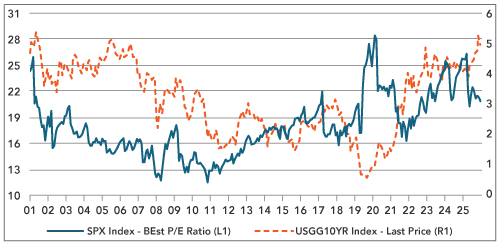
This is not 2000, when the S&P 500 traded at around 24 times forward earnings. On Bloomberg’s figures, it now trades at about 20 times this year’s expected earnings, and profit forecasts have been raised for three quarters running. But many strategists now call the market cheap, and we disagree. A P/E means little on its own; it has to be judged against what bonds pay. From 2002 to 2007, the last time the 10-year yielded between 4% and 5%, the S&P 500 traded at roughly 14 to 18 times. Today it is about 20 times (Chart 2). The past three years, when P/Es rose above 20 as yields climbed towards 5%, look like the anomaly. Those calling the market cheap use forecasts reaching into 2027, which assume another year of high-teens profit growth: exactly the growth we think is at risk.
Chart 2: High Long-Term Interest Rates Typically Mean Lower P/E Multiples
S&P 500 forward P/E (Bloomberg BEst, left axis) against the US 10-year Treasury yield (%, right axis).
Source: Bloomberg
Higher margins and more software in the index may make a modest premium justifiable but it doesn’t make the market cheap. When a risk-free bond pays close to 5%, equities have to earn their place in a portfolio. Fear beat price last week. Thursday’s drop was more than four standard deviations; VIX jumped 11.6 points (on only 16 days since 1990). That says as much about crowded positions as new newsflow.
The AI supply chain looks cheaper still at 13.1 times the next 12 months earnings (26% discount to index). But the earnings forecasts have risen more than 50% faster than the market this year and assume spending keeps accelerating ahead: if capex growth falls from 76% to 25% then forecasts will fail to hold their ground. A low multiple of falling number is not cheap.
The better parallel is late 2018: the Fed raising rates, Democrats taking the House, and tech leading a sell-off. The S&P 500 fell almost 20% before the 2018 Christmas Eve. The difference today is a 10-year yield of 4.9%, not 3.2%. A high multiple is fine as long as earnings forecasts keep rising. We think those upgrades will now flatten out, as slower investment takes away the chipmakers’ growth. That is our forecast, not yet the data. Without upgrades, the multiple has nowhere to go, and markets tread water.
Dan Ives, Wall Street’s best-known tech bull, calls this a golden buying opportunity, like March 2020 or April 2025. We agree the AI story is not over. But in 2020 and 2025, policy was easing. This time the Fed is likely to raise rates.
Credit, liquidity, and commodities
Credit is where a correction becomes something worse, and so far it is calm. Worries about CoreWeave’s borrowing and slightly dearer default insurance are worth noting, but Apple raised $7.5 billion of bonds on the day of the rout. That does not reflect a credit crunch. The risk emanates from the smaller, indebted data-centre operators whose plans assume full-speed growth. Their lenders, many in private credit, would feel a slowdown first.
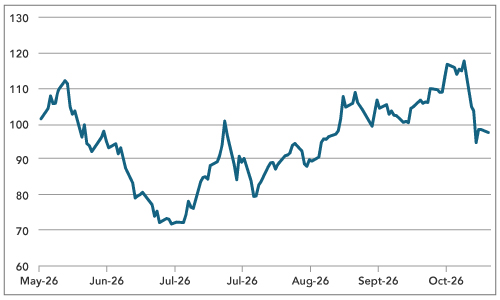
Oil’s fall from around $102 to $91 is a supply story, on hopes that the Strait of Hormuz reopens, and good news for inflation. Ironically with maybe less inflation risk gold rose to about $4,100 on Thursday while Bitcoin fell to around $76,000. Gold still does its job in a world of large deficits and political risk. Bitcoin does not.
Chart 3: Brent Oil price corrects 10%
Source: Bloomberg
Politics
The midterms were an earthquake for the Republicans. The Democrats won both houses, flipping Senate seats as far afield as Texas, Ohio, and Kansas, in perhaps the largest popular-vote win since 1976.
President Trump’s answer was to double down, naming Stephen Miller, the architect of his immigration policy, as chief of staff from Monday. The appointment of the most hardline figure in the administration as chief of staff signals little interest in compromise. Nevertheless, Senate Minority Leader Chuck Schumer has promised to fight Miller every step of the way.
In the short term, expect confrontation: investigations and hearings from January, including on AI, more rule by executive order, and the risk of bickering over shupown and debt-ceiling in 2027.
Nevertheless, over the longer term, we are more hopeful. A result this size cannot be ignored, and a president with two years left, and a hostile Congress, eventually have to deal. History favours patience: since 1945 the S&P 500 has averaged a 12% gain in the year after a midterm, and 9% in a second term. Restoring some checks on sudden policy moves is good for risk premia over time. It just will not feel like it for a few months.
Structural change: from capital gains to income
The shift we expect to outlast this cycle is from chasing capital gains to collecting income. For 15 years after 2008, cash and bonds paid almost nothing, so investors had to seek growth elsewhere, and growth meant technology. Now a 10-year Treasury yields 4.9%, while the 30-year yields more than 5%. If AI growth slows while governments keep borrowing, a certain yield will be worth more than an uncertain gain.
The evidence is already there of this shift. US REITs returned 16.7% in the first eight months of the year, outperforming the S&P 500 after three poor years. In the first quarter, US REITs yielded 1.7 percentage points above the 10-year Treasury, while private property offered almost no premium. Two caveats here: a December Fed hike would hurt rate-sensitive assets in the short term, and data-centre REITs carry the same AI risk as the chipmakers. Property – with steady, diversified rental income – presents an opportunity that investors should consider.
The GCIO asset-allocation view
This week does not justify a dramatic change. Instead, it confirms the direction we were already leaning towards: less reliance on capital gains, more on income and quality.
Cash pays well while the Fed tightens, giving us the option to buy if the correction deepens. In bonds, we prefer short- and medium-term maturities, and are wary of long US bonds while deficits run near 6% of GDP. Investment-grade credit is sound. In high yield, we would avoid companies that need the AI build-out to continue at full speed.
In US equities, we expect a sideways market. We prefer quality companies with strong cash flow and dividends over the chip supply chain, and the hyperscalers over their suppliers. Diversification is working: in each of this year’s three sharp falls in AI stocks, the rest of the market held up. Europe, with less AI exposure and cheaper oil, deserves a modest place. Japan, Korea, and Taiwan sit at the centre of the chip sell-off, and Japan faces a possible December rate hike; we would wait.
India stands out in emerging markets: domestic growth with little reliance on AI hardware. China remains tactical. Gold stays a core holding against fiscal and political risk. Listed real estate with steady rents is our preferred way to add income; we are more cautious on private credit to data centres. There is an increasing chorus of strategists who see the merits in investing in Indian equities as a diversifier from the current malaise in the AI theme…. and interestingly foreign buying is back
What we are watching
US inflation on 10 November. After a strong jobs report, a firm October CPI would all but lock in a December rate rise. A soft one would give equities room to recover.
The 10-year and 30-year auctions on 10 and 12 November. These are the first test of how buyers view US debt after a $2 trillion deficit year. Weak demand would confirm our fear that long yields are heading higher.
Nvidia’s results on 17 November. The market will look past the quarter to 2027 orders. Any sign of customers stretching deliveries, or hyperscalers trimming 2027 plans, would hit the whole chip chain, Japan included.
Washington under Stephen Miller. His first weeks in office will show whether the White House seeks any common ground with the new Congress, or prefers confrontation over spending and the debt ceiling.
Credit spreads in AI infrastructure. If the bonds and loans of indebted data-centre operators start to weaken, the correction is becoming something more serious.
Volatility, yes. Disaster, no. But investors should accept that the easy money in the AI trade has been made, and that income, not capital gains, will do more of the work from here.