

Share This

Not Yet Overwhelming?
Oct 27, 2026
The Fed has little room to move this coming week, most likely a hold but worried about the future. Oil is above $110, core inflation is broadening and growth has continued to run well above trend. When a central bank can’t ease the strain grows where borrowing needs are growing fastest. That was in two places last week: the companies building AI infrastructure and French government debt. A December rate hike is still in play.
Technology shares have fallen but the earnings behind them are still being revised up. The question is not demand; it’s who pays for the next round of investment and at what interest rate? That’s a question for credit markets and credit markets are whispering trouble. They aren’t saying it loud yet so investors have a window to position for trouble without paying too much.
What changed this week
• AI’s funding model has shifted still further. Meta’s capital spending of $34.9bn exceeded its $32.8bn operating cash flow in the third quarter, resulting in negative free cash flow for the first time since its IPO year. The shares fell 7%, and its credit-default swaps hit records, even as revenue grew 26%.
• Safety became selective. On Thursday, the US 10-year yield fell about 17bps intraday, while French 10-year yields hit 5.14%, their highest level since 2002. France’s spread over Germany briefly reached about 178bps, its widest since November 2011. On Friday evening, Moody’s (benevolently) left France at Aa3, with a negative outlook, against expectations of a more immediate downgrade.
• The Gulf risk changed shape. Intensifying attacks on shipping in and near the Strait of Hormuz led to oil reaching record levels ($116) in October. The New York Times reports US and Israeli plans for strikes after the 3 November midterms, possibly on Iranian energy infrastructure. Iran has threatened Gulf airports and pipelines in response.
The argument
The Fed has no room to retreat
The Fed is expected to hold on 28 October, but the debate is more about what happens in December. Three facts make it hard for the Fed not to hike in time: September CPI was up 3.7% y/y, and core CPI’s three-month annualised pace reached 3.4% (shelter, goods, and services were all firmer); WTI is $103 (up about 80% this year); activity has been strong: October flash composite PMI was 57.6 (down from the previous month but still strong), and jobless claims were 194,000. All 100 economists in a Reuters poll expect a December hike, and futures price in roughly 80% odds of one. The market still believes the Fed will keep inflation in check over the longer run. The 10-year breakeven inflation rate is only about 2.4% and the 10-year real yield is about 2.6% — up a full percentage point in one year. That’s what the Fed is guarding against—backing away with oil above $100 would put that trust at risk, and higher long-term interest rates would result.
What would change our mind: a disorderly credit event. In 1998, the Fed cut three times after the collapse of LTCM even as the economy remained strong. The difference at this point is that inflation is 3.7%, which makes any rescue potentially slower and more conditional.
Tech has corrected on funding, not on earnings
The MSCI USA Information Technology Index is about 8% below its September high, yet the street’s forward earnings estimate has risen about 8% since March. The index price has fallen while expected earnings have kept rising, so the sector has de-rated without losing earnings momentum.
Chart 1: MSCI USA Tech Sector Index Outpaces Earnings Forecasts
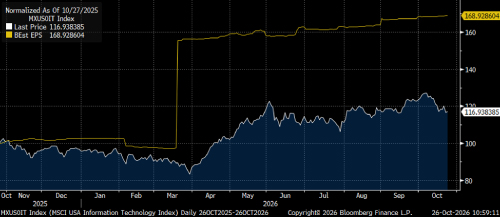
The catch is where those earnings come from. The IT sector’s upgrades have largely been driven by the capital spending of its customers: Meta, Alphabet, and Amazon sit in other sectors. When Meta’s capex exceeds its operating cash flow, the chipmakers’ earnings forecasts depend on the bond market’s willingness to fund their customers. JPM Asset Management estimates that 42 AI-related stocks account for 60–80% of S&P 500 earnings growth since January 2024. The earnings are real; their funding is becoming conditional.
If trouble comes, it will come through credit, and it has not arrived yet
US high-yield spreads have widened 74bps in a month to 338bps (widest since May 2025 but still below the long-run average of around 450–500bps). Stress is concentrated: CoreWeave CDS spreads are above 1,100bps; pricing SpaceX’s $40bn chip-financing vehicle is difficult; Meta’s CDS is at a record high. Money market assets are now $7.9tn and Commercial Paper outstanding is at its highest since 2009 — that does not indicate a funding squeeze.
It’s like 1999–2001, when telecom builders grew revenue but credit weakened because returns came in after coupon payments fell due. But today the largest builders have strong balance sheets. The weak links are at the edges: neoclouds, off-balance-sheet vehicles and their lenders. According to Moody’s, US life insurers alone held $85bn of AI investments in June.
Our conclusion: bad news is real but not yet overwhelming, so now is the time to build protection when it’s cheaper, rather than sell risk outright.
What works in this environment
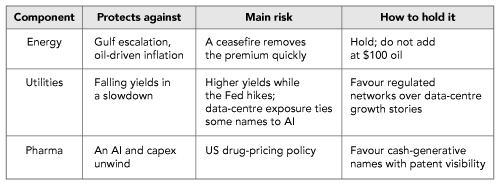
A basket of energy, utilities, and pharma works because each part protects against a different risk. It should not be expected to rise together. Energy pays off if the Gulf escalates. Utilities pay off if bond yields fall in a growth scare. Pharma pays off if the AI trade unwinds, because its earnings do not depend on anyone’s capex budget.
Short and intermediate Treasuries. Bonds with three to seven years’ maturities yield about 5% and are doing their job as a hedge. With headline inflation at 3.7%, we would not advise extending into longer maturities.
Gold: an opportunity created by forced selling. Gold has not been bid higher in response to the bad news; rather, it has been sold. It fell 4.1% last week to $3,996 and is down 7.5% this year, as leveraged investors have raised cash. Gold also fell in October 2008 and March 2020 before resuming its rise. The headwind is a 2.6% real yield. We would add in stages rather than all at once.
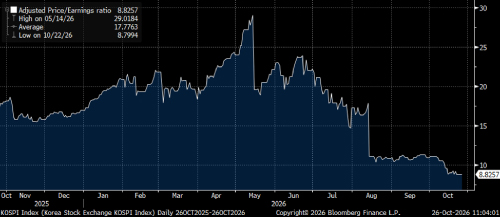
Korea: hold. The market is cheap on current earnings. CLSA’s forecasts put Samsung Electronics and SK Hynix on roughly 3–5 times 2027 earnings. The caveat is that memory earnings are cyclical and near a peak, and low multiples at peak earnings can mislead. That argues for holding, not adding.
Chart 2: Kospi Index PE at its Lows
What clients are asking us
Should I sell my technology holdings? No, but cut your exposure to a small group of them. Earnings are still being upgraded in the sector, and valuations are lower than during the April 2025 lows. The risk is concentration and funding, not demand. Moving part of a cap-weighted US holding into equal weight and favouring companies that fund themselves does that without betting against AI.
Is the Gulf escalation already in the oil price? Partly. Brent is at $115 (up about 80% this year), pricing in disruption to shipping but not damage to Gulf production, export terminals, power, or desalination plants. Iran has said those would be targets if strikes resume and US and Israeli planning points to weeks after 3 November. For Gulf-based investors it is a portfolio risk as well as local: we would keep energy as hedge; hold dollar liquidity; we advise against adding regional property and equity until the post-election window passes.
If the US midterm results are challenged? Noise and some volatility but probably not change. In a Votebeat survey of 31 election-law experts, all expected at least one congressional or statewide result to be challenged in court; 26 said it was unlikely any result would be overturned. Election officials from both parties have complained about federal involvement in election administration, while the Justice Department has dismissed fears of a challenge to the overall result. Market risk is delay: a week or more of uncertainty over control of Congress would put pressure on the dollar and lift Treasury term premia when bond markets are already sensitive to fiscal risk.
Does talk of US action against Cuba matter for portfolios? Not directly: Cuba’s economy is small and largely disconnected from the global market. At a Florida rally on Friday, Trump said US warships returning from the Iran war could stop off Cuba’s coast, and Secretary Rubio urged Cubans wanting change to work with the CIA. What matters more is what it signals: a US administration willing to use military pressure on several fronts at once. That keeps defence spending elevated and geopolitics premium on energy and gold.
Are my bonds still a hedge? Short and intermediate Treasuries are; long-dated bonds of fiscally stretched governments are not. Protection now depends on which government you lend to and for how long.
Elsewhere in brief
• Europe. The eurozone flash composite PMI fell to 51.9, below the 52.7 expected, with France contracting. The ECB, at 2.50% after two hikes this year, meets on 29 October, caught between energy-driven inflation and French spreads.
• China. Third-quarter GDP grew 4.5% y/y, but retail sales rose only 1.1%, and residential sales fell 21.3%. Growth is coming from exports and factories, not households. No change in our view.
• Japan. The BoJ is expected to hold on 30 October and prepare for a December hike. The JPY rose 0.7% and 10-year JGB yields fell 12bps, which adds pressure on JPY-funded carry trades.
• Emerging Asia and India. Oil above $100 is pushing central banks to tighten: the Philippines raised rates by 50bps, and Indonesia and India are expected to follow. India’s market is down about 14% this year. No change in our view.
Portfolio view
No change to strategic positioning. The week confirms our tilts and opens one opportunity. Positions not listed are unchanged.
What we are watching
1. FOMC, 28 October. Whether the statement treats higher long yields as doing part of the Fed’s work. A softer tone would cut December hike odds from about 80%.
2. France and the ECB, 27–29 October. An OAT–Bund spread held above 180bps, or ECB language on its bond-backstop instrument, would turn a French problem into a eurozone one.
3. US mid-term elections, 3 November. Watch for a delay in declaring control of Congress, and the post-election window for renewed strikes on Iran. Both would show up first in oil, the dollar, and Treasury term premia.
US high-yield spreads at 400bps. That is the level at which concentrated AI-credit stress becomes a broad tightening. Watch the pricing of SpaceX’s chip-financing vehicle and November’s large AI listings