

Share This

Too Much, Too Fast
Oct 21, 2026
• Inflation rises to 3.7%, yet the US 10-year yield falls 17bps to 5.07%
• Bonds rallying on bad inflation news implies investors are starting to price in trouble
• The tech boom meant to save growth is financed by ever-more expensive debt
• Too much, too fast: data-centre pushback, inadequate energy, a strained consumer
• Central banks are behind the curve; catching up will cause stress they must mop up
• Echoes of 2006–07, with geopolitics more intense than anything in decade
Bond investors have stopped fighting inflation and started preparing for its fallout. US CPI rose to 3.7% in September, the detail was broad and unpleasant, but the 10-year Treasury yield ended the week at 5.07%, down 17bps. Inflation no longer gives bond investors comfort. They’ve found something they fear about a lot. When bonds rally on bad inflation news, investors stop worrying about the price of money and start worrying about their money. The immediate fear was AI credit: the bonds of the most-leveraged AI borrowers fell and so did technology shares. We have been saying for some time now that regime change is coming. This week offered the first convincing evidence that investors are beginning to agree.
Wednesday’s worse-than-expected CPI initially produced the expected sell-off, taking the 10-year briefly to 5.33%, a level not seen since 2007. However, the reversal came within 36 hours. Throughout the year, bonds and equities have fallen together on inflation news. This week Treasuries were a safe haven again. The investment regime is evolving from an inflation problem into a credit problem, without the inflation problem going away.
We are not yet recession pricing. At about 4.7%, the 2-year Treasury yield is still up substantially this year, futures still price another Fed hike before year-end, and investors are beginning to price the risk that the growth story ends badly (not that it has already ended). That’s what matters. Credit markets are showing signs of strain now, but equity valuations and economic forecasts still depend heavily on continuation of the investment boom.
Inflation is Not Going Quietly
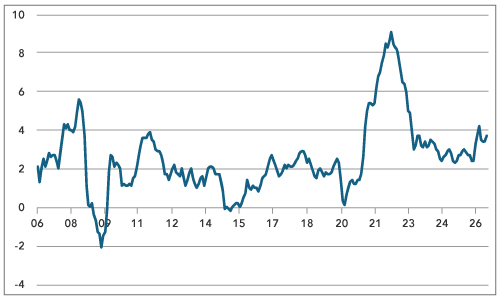
September’s inflation report shocked investors and markets alike. Headline CPI increased 0.6% on the month and 3.7% annually, against expectations of 3.6%. Core CPI rose 0.33% in September, and the rise was broad: goods, services, and services excluding housing were all firm. Producer prices rose 6.3% year-on-year, the fastest since December 2022.
Chart 1: US CPI at 3.7%
Source: Bloomberg
Oil’s back above $100, so partly explains the anomaly. The more interesting source of inflation is the one the bulls depend on for growth — Chicago Fed President Austan Goolsbee said AI data-centre costs are jumping out of their lane into aggregate overheating; memory prices, electricians’ wages, and grid equipment backlogs stretching to 2030 all tell the same story, too. A boom that uses power faster than it can be produced, copper faster than it can be mined, labour faster than it can be hired, and silicon faster than it can be grown adds to prices, not GDP alone.
The outlook for economic activity is becoming increasingly contradictory. Investment spending supporting US growth may be, in the process, doing more to inflate prices than necessary so that interest rates stay higher for longer; the longer this paradox persists, the harder it becomes to finance the investment cycle.
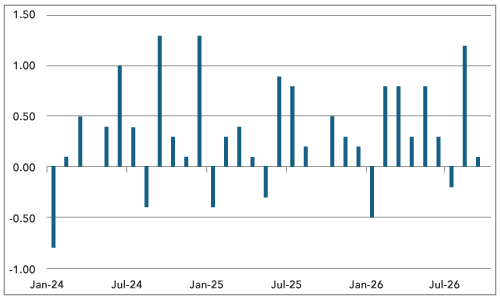
Chart 2: US retail sales growth drops (%)
Source: Bloomberg
Oil’s back above $100 so that explains some of it. The more interesting source of inflation is the one the bulls depend on for growth — Chicago Fed President Goolsbee said AI data-centre costs are jumping out of their lane into aggregate overheating; memory prices, electricians’ wages and grid equipment backlogs stretching to 2030 all tell the same story too. A boom that uses power faster than it can be produced, copper faster than it can be mined, labour faster than it can be hired and silicon faster than it can be grown adds to prices not GDP alone.
There is a growing contradiction in the outlook for economic activity. Investment spending supporting US growth may be doing more to inflate prices than necessary so that interest rates stay higher for longer; and the longer that contradiction persists, the harder it becomes to finance the investment cycle.
A Tech Boom Bought on Credit.
The hope has been that AI investment would carry growth while consumer spending dipped. The four largest hyperscalers will spend about $750bn on capex this year. The problem is how the boom is now paid for.
The first phase was financed from cash flow. The current phase is increasingly dependent on debt. But there are signs of market fatigue. AI-related debt issuance fell to $23bn in September from a record $113bn in June. CoreWeave’s bonds, issued in June at 9.63%, now yield around 15%. Even the best companies are being forced to paying up for money; JPMorgan and Goldman recently declined to underwrite most of a $5bn loan for the neocloud Volta.
Microsoft and Alphabet can self-fund. Many of the businesses in their eco-system cannot. The pace of expansion at the margin is increasingly determined by borrowers whose business models depend on utilisation rates, refinancing assumptions and continued growth in contracted demand. Lenders are also becoming concerned about concentration: similar exposures are appearing in high-yield funds, private-credit portfolios, infrastructure vehicles and insurance balance sheets.
When Everything Goes Too Quickly, Mistakes Are Made.
The mistakes of a boom are made when money comes in faster than the physical world can take it. Local opposition blocked or delayed at least 120 data-centre projects worth almost $200bn in the first half, says Data Center Watch. The FT reports that at least 47 major projects have been delayed or cancelled so far this year; energy solution is still inadequate: power, grid connections and electricians not chips are binding constraints.
These limits point to a weakness in the investment model. A developer may have financing and customers but without timely electricity connections capital makes little or nothing. Delays increase financing costs and shorten the period over which expensive equipment can produce an adequate return.
The investors’ verdict was becoming clearer this week too. Shares of companies closest to AI capital-expenditure budgets were hit hard (tech fell 6.4% — its worst week since April 2025). S&P 500 dropped around 2% but almost 70% of constituents rose instead. Money flowed into staples, healthcare, utilities and other previously neglected sectors. That’s rotation not capitulation. 37% of fund managers are still overweight tech (most since 2020) so positioning hasn’t been neutralised yet.
The Rest of the Economy Is Running on Fumes.
Strip out AI and the US economy looks tired. Core retail sales barely rose in September, consumer sentiment is near lows not seen since records began and one in five Americans missed a loan or mortgage payment in 2025 — highest since 2007; nearly 13% of credit-card balances are seriously delinquent (close to peak 2010). Housing shows it most clearly. With mortgage rates at 7.4%, Redfin has 600,000 more sellers than buyers — widest gap ever recorded back to 2013.
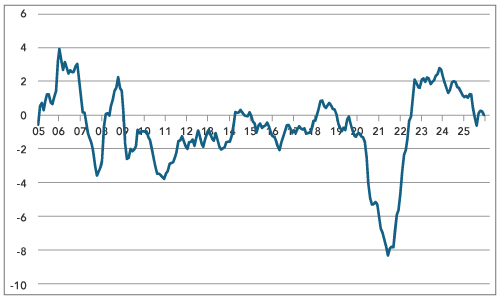
Chart 3: Real Fed funds Rate is Not Doing the Tightening
Source: Bloomberg
Growth has become unusually dependent on a narrow set of investment drivers. AI spending has helped construction, equipment orders, utilities, and parts of the industrial economy, but it can’t indefinitely make up for weaknesses elsewhere. A slowdown in AI financing would therefore remove an important source of incremental demand at precisely the moment when the consumer is least able to absorb it.
There is also a paradox. A big cut in AI investment would eventually ease some of the inflationary pressure on equipment, labour, and energy, but disinflation might not come through a painless improvement in supply; instead, it will require demand weakness and credit deterioration.
Shades of 2006–07
Housing was the first to turn in 2006–07. The first casualties were leveraged lenders at the margins of the system, which were outrightly dismissed as isolated problems. Banks were still reporting record profits and equities hit new highs in October 2007, months after credit markets had started cracking up.
The echoes are not music to the ears. Housing is stuck; leveraged AI borrowers are struggling; US high-yield spreads have risen about 64bps over four weeks to 331bps (Moody’s private defaults are 4.0%, but rise to 5.8% when payment-in-kind and maturity extensions are included). Distress deferred, not avoided.
The differences count. AI financing isn’t as embedded in the banking system as mortgages were in 2007, but risks are increasingly concentrated in private-credit funds, insurers, and infrastructure vehicles, too. The collateral is different, too: GPUs can be economically obsolete much faster than houses.
History warns us again. The railway boom of the 19th century and telecoms boom of the late 1990s transformed economies but destroyed vast amounts of capital invested in them. Economic success does not necessarily mean financial success for those funding expansion. AI may transform the world, but heavily leveraged investors will be nursing huge losses.
The lesson of 2007 is not that another financial crisis is inevitable. It’s that credit markets often see the excesses of an investment boom well before the wider economy does.
Central Banks Behind the Curve, and May Pay for It
Central banks are maybe slow to react. JPMorgan calculates that global policy rates outside China are only 17bps higher this year. The Fed has hiked once, and after last week’s CPI, the odds of an October move fell below 15% from 50%. The long end of the bond market has done the tightening for them.
For every time a central bank falls behind, the greater the risk that it must eventually do more than the market prices, and the greater the stress in the markets and economy it creates. The 1970s are the warning: an oil shock, a politically pressured central bank, and stop-go policy. With core inflation at 2.6%, we are not forecasting a return to double-digit inflation. The relevant parallel is the difficulty of managing monetary policy when inflation and financial stability demand conflicting responses.
The pressure on the Fed is real: the 2026 deficit reached $1.99tn, net interest topped $1tn, and foreign official Treasury holdings are the lowest since 2010. More supply, fewer buyers, and a tested Fed add up to a higher term premium.
Geopolitics Unlike Anything in Decades
Rarely have so many conflicts touched energy and trade at once. Ships are restricted through Hormuz, Iranian proxies are striking Saudi infrastructure, and drones are hitting cargo vessels in the Black Sea. Israel goes to the polls on 27 October and the US on 3 November, and a renewed operation against Iran has been discussed. The US has ‘promised’ further military action post the midterms.
The Most Consequential Midterms in Years, and an Angry Generation
With a US economy facing obvious imbalances, a war, and a deficit without a plan, the mid-term elections have taken on added importance.
Discontent among the young is rising, too: hundreds of thousands protested in France, demanding €10bn the state cannot afford, and youth-led unrest has hit parts of India. A generation priced out of housing and energy has become a political force, and political forces become fiscal problems, and fiscal problems influence bond yields. Younger generations increasingly see asset ownership and financial security moving beyond their reach. Across many developed economies, the political debate is about the concerns of the youth, job security, housing access, and secure income, to name just a few.
That matters for investors. Governments confronted by dissatisfied electorates are more likely to favour subsidies, fiscal transfers, industrial intervention, and protectionist policies. Such measures may address immediate political pressures without necessarily improving productivity or long-term fiscal sustainability.
A week’s market behaviour is a warning, not a verdict
Three things would prove we are moving towards a credit-led regime: wider spreads outside the most leveraged AI borrowers; a sustained return of negative equity–Treasury yield correlation; and evidence that financing conditions have weakened to the point where investment spending has been cut back. Until then, the market is differentiating between good and bad borrowers, not abandoning risk altogether. The opportunity for investors is to identify that distinction before it becomes indiscriminate.
What We Do With It
No strategic overhaul, but a change of emphasis:
• Cash at 4% is cheap insurance with credit spreads near their highs.
• Duration for protection, kept to 2–5 years; the long end carries the fiscal risk over the medium term.
• Cut AI-infrastructure beta, not AI exposure: favour cash-funded leaders and owners of bottlenecks such as power and grid over leveraged capacity builders.
• No reaching for yield: high yield does not pay for a turning credit cycle; check private credit for hidden AI exposure.
• Energy remains the best inflation hedge; gold a hedge against central-bank credibility.
The Week Ahead
Watch whether Treasuries keep hedging on bad equity days; a return to 5.33% on the 10-year would mean the inflation regime is back in charge. Watch high-yield spreads against the March high. Meta’s forthcoming results will be important, particularly as one examines the relationship between capital expenditure, cash flow, and financing commitments. Investors need to understand not simply how much the company intends to spend, but whether the economics of that spending continue to improve. Flash PMIs arrive on 23 October, the FOMC decision the following week, on 28 October, and third-quarter US GDP is due on 29 October. Oil prices and geopolitical developments ahead of the elections remain important risks.