


Share This

The Market Is Up. It Doesn’t Feel Like It.
Nov 16, 2026
• Up on the year, down underneath.
The S&P 500 is up 11% for the year, but most markets have fallen since August. This is a quiet correction.
• The problem is the cost of money, not earnings.
Rate-hike expectations are back. Tech earnings are still rising while share prices fall, so tech is being re-rated, not hit by a profit warning.
• Watch NVIDIA and the Fed. NVIDIA reports on 17 November and Jensen Huang briefs Congress on 18 November. The Fed and ECB meet in December.
The S&P 500 is up 11% this year, yet hardly anyone feels it. Over the past three months, however, the index has staged a retreat. The tech-heavy Nasdaq has also lost momentum, losing almost 7% in a month. Only about a third of the equity markets we follow are higher than they were in August.
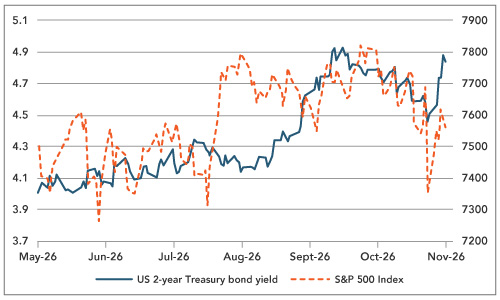
Last week, equities rallied 3% while the US 2-year yield jumped 35bps. Shares bounced just as the bond market told us the Fed still has more work to do. It is easy to lose your bearings in this maelstrom of market moves and geopolitics.
Chart 1: Sharp Rise in S&P500 Index at Odds with Snap higher in US 2-Year Yield (%)
Source: Bloomberg
In this week’s update, we have stepped back from the headlines and returned to our trend work: taking a careful look at a hundred markets across equities, bonds, credit, currencies, and commodities. The question is simple: Underneath the noise, what is winning, what is losing, and what is starting to change? We answer that this is not an earnings problem. It is a price-of-money problem.
The hits and misses
Of the hundred markets we track, twenty-five are in long uptrends that are now rolling over. Only eight are in downtrends that are turning up. This signifies a market losing its leaders, and not a market in a bear trend. It also explains the prevailing mood. Investors who look at their year-to-date column see gains. Investors who watch the market every day have lived through a quarter of slow damage.
The recent winners share a common trait: they are not looking for cheap money. Healthcare is the clearest example, which is up more than 10% in a month in the US. Among sectors, consumer staples and insurers, and in markets, Switzerland and the UK, have all done well. These are businesses/regions with reliable cash flows. In the past month, global consumer staples have beaten global technology by almost 20 percentage points, reflecting one of the sharpest switches into defensive themes we have seen this year.
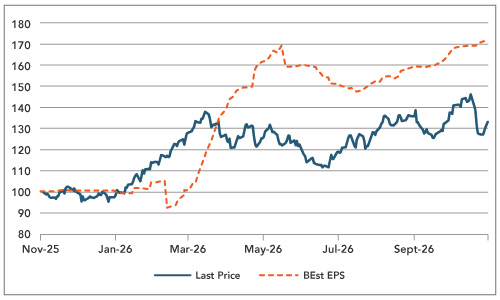
The second group of winners is anything that gains from higher short-term rates. Floating-rate loans, T-bills, and the dollar are all in uptrends. The third is energy sector earnings, which analysts are still pushing up hard, even as oil prices swing. Then there are Indian equities, which have turned after a lackadaisical year. India is now the best-performing region we have followed over the past month.
Chart 2: Global Energy Sector Price Appreciation and Large Upgrades to Earnings Forecasts
rebased to Nov-25 =100
Source: Bloomberg
The losers are the market’s long-duration assets, the ones whose value rests on cash flows far in the future. Technology is the obvious one. Korea and Taiwan, the year’s stars, have had sharp corrections of late. Gold and silver have lost their lustre, which is what one would expect when real interest rates rise, and the dollar is strong. Investment-grade bonds are drifting lower. China is still falling, and cheap is not the same as turning.
Oil deserves a word, because the headlines in the preceding week said it was rising. Brent fell 16% in the week to 6 November, its worst week since the start of the pandemic, as hopes grew of a resolution to US-Iran conflict. On Thursday, however, President Trump said America did not need a deal, tankers were attacked, and Brent jumped 3.3%. Nevertheless, oil ended the week lower. Oil has stopped falling. It has not yet turned.
Are corporate earnings cracking?
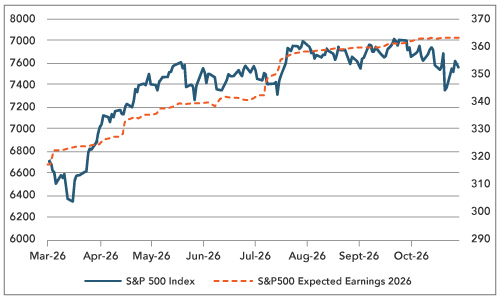
The consensus estimates for S&P 500 earnings this year peaked on 28 October and have slipped since. The fall is negligible, just 0.3%, and by November most of the year has already been accounted for, so some flattening is natural. But after a year that saw earnings estimates climb relentlessly, the stall is worth noting. The engine that carried the market through 2026 has stopped pushing.
Chart 3: Upgrades to US Corporate Earnings Forecasts Stall
Index and level of expected earnings in index points
Source: Bloomberg
We would not overstate it. Q3 earnings grew by about 31%, and most companies beat forecasts. That’s all good, but the warning signs are in the detail. Companies are beating estimates by much less than usual. Forecasts for communication services have been cut sharply. More of the market’s growth is coming from energy, the least dependable source of all.
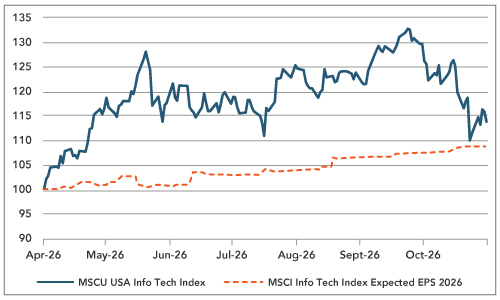
Technology hides the most intriguing aspect. While earnings estimates for the sector are still going up, the share prices are declining. Is that a profit warning? No. It is a de-rating: investors are paying less for the same earnings because the cost of money has risen. The S&P 500’s forward price-earnings ratio fell to 17.7 in early November, its lowest in more than three years.
Chart 4: Upgrades to Info Tech Sector Peak Out
Index and earnings rebased to April 25=100
Source: Bloomberg
That does not mean we are giving up on technology. The growth is real, and, in our view, there is more to come. The AI build-out is still in its early years, and the earnings are following through. What has changed is the price investors are willing to pay for that growth while interest rates are rising. When earnings rise and prices fall, opportunity is created. We would rather be buying quality technology names into this weakness than selling them.
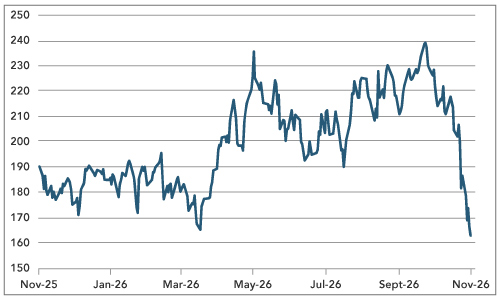
NVIDIA is a special case. The shares have dropped almost 30% from their October record. First came reports that Chinese buyers, including Alibaba, Tencent, and ByteDance, would receive only a miniscule share of the chips they had ordered. Then the board opened an investigation into reports that CEO Jensen Huang had been targeted in an alleged foreign intelligence operation. Investors know how to price an earnings miss, but they do not know how to price a governance and national-security issue hanging over the most important company in the AI build-out race. NVIDIA’s results come on 17 November, and Huang has been asked to brief Congress the next day. The results will tell us about demand. The briefing may matter more for the share price. Just for the record, consensus estimates are for EPS growth in the year to Jan 2027 of 35% and a P/E of 17.4x.
Chart 5: Nvidia’s – and Huang’s – Fall from Grace
Nvidia share price (USD)
Source: Bloomberg
There is a bigger point here, and it fits the long cycle we have been writing about. AI is no longer just a technology story. It is slowly becoming a question of national power, like oil in the last century. That brings governments, security services, and politics into the share price. It raises the risk premium across the whole supply chain, from Taiwan and Korea to the data centres in Texas, even while the earnings keep coming. This is what a generational shift looks like from the inside.
The bond market has changed its mind
This is the real change of the past fortnight. A month ago, the market believed the tightening cycle was almost over, and the debate was about when rate cuts would start. Then last week’s October’s inflation figures came in hot for a third consecutive month; a Fed governor said a 50bp hike should be considered; and the market now treats a December hike as certain. The 2-year yield rose 35bps in five days. The 10-year is back above 5%.
The Fed is not alone. The Bank of England raised rates on 5 November for the first time since 2023, and the market expects the ECB to follow suit in December. This is a global turn, not an American one.
Look at where the selling in bonds happened. It was concentrated at the short end, which tells us this is more about central bank policy. Long-term inflation expectations have barely moved. The whole rise in yields is in real rates. In simple terms, the market believes the central banks will win the fight against inflation, and that they will win it by slowing growth. That is reassuring for inflation. It is not good news for equity valuations, though.
There is an echo of 1994. Then, too, the market was caught off guard by how far the Fed was prepared to go, and the damage fell on valuations rather than on profits. The difference is that in 1994 the Fed started from low rates and governments were cutting deficits. Today it is hiking from 4% into a fiscal position that needs constant refinancing. That makes the long end more fragile today than it was then.
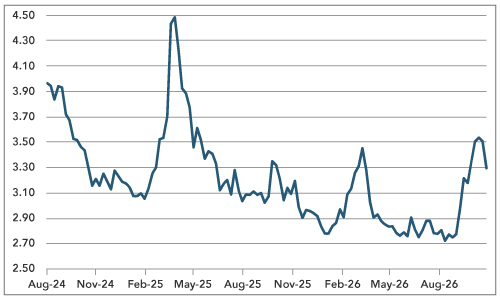
Credit appears calmer than equities but is no longer relaxed. High-yield spreads have come back from their early-November highs, yet remain well above where they were in September. Private credit default rates are at a record. Floating-rate borrowers feel each hike first. Credit has not broken, but it has stopped giving the all-clear.
Chart 6: US High Yield Spreads Drop from Recent Highs (bps)
Source: Bloomberg
What should we do with this?
We have not changed our broader view this week. Rather, this week, we focus on our priorities into the year-end.
On bonds, we buy duration only on good sell-offs, not as a matter of routine. Last week’s move took the 10-year back above 5%, a level where we start to pay attention. But the central banks are still surprising on the hawkish side, and we would rather wait for the Fed’s December decision before adding to our exposures. In the meantime, the short end pays well. Two-year Treasuries near 4.9% and T-bills above 4% are a comfortable home for defensive returns. In credit, private-market defaults argue for quality over yield.
On equities, we look to build a barbell. On one side, the defensive cash generators that are leading now: healthcare, staples. On the other, quality technology, where earnings are still rising and valuations have come down. We would use weakness around NVIDIA’s results and the Fed to add, not to sell. Korea and Taiwan sit in the same category: falling prices, rising earnings. India has turned, though it is overbought after a strong month. China remains a value trap until its earnings stop falling.