

Share This

Macro and Markets Review for October 2026
Nov 2, 2026
October was the month when markets started to distinguish between growth and the financing of growth. Global equities fell 0.8%, the NASDAQ lost 5.3% and emerging markets fell 8.0%. Yet global aggregate bonds rose 1.7%, energy gained 12.8% and healthcare 9.9%. The market did not abandon risk. It changed the price it was willing to pay for balance-sheet risk.
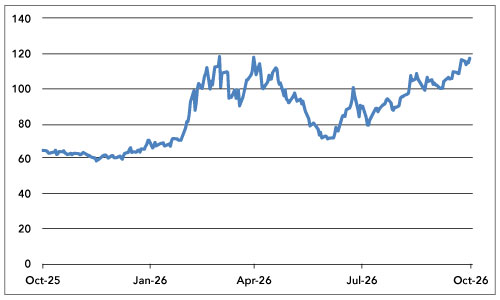
Three forces drove the month. Inflation moved back to the centre of the US debate, with September CPI at 3.7%. The long end of the Treasury market briefly pushed to levels last seen before the Global Financial Crisis. At the same time, the Gulf conflict lifted Brent 13.6% in October to almost $118 a barrel. The third force was more subtle: investors began to question whether the next stage of the artificial-intelligence investment boom can be financed as comfortably as the first.
The change in market behaviour is important. When the September CPI report surprised on the upside, the US 10-year yield initially rose to around 5.33%. Within 36 hours it had reversed sharply. Bonds rallied on bad inflation news because investors had found something they feared more than inflation alone: the consequences of expensive money for leveraged borrowers, capital expenditure and credit.
Growth itself remains respectable. Third-quarter US GDP grew at 3.4% annualised and consumer spending remained strong. But the composition of growth is increasingly uncomfortable. The consumer is saving less, the technology investment cycle is consuming more capital, and government borrowing remains extremely large. October did not deliver a recession signal. It delivered a reminder that strong nominal growth does not make capital cheap.
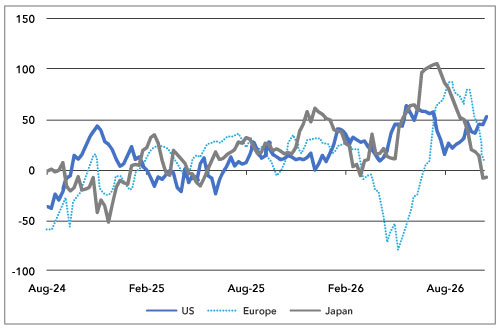
Chart 1: Global Economic Surprise Indices – Growth
Index
Source: Bloomberg
Inflation Is Back, but the Market Is Looking Beyond It
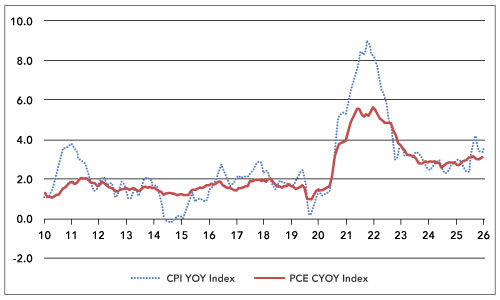
US headline CPI rose 3.7% year on year in September and the increase was broad enough to close the door on an easy Federal Reserve response. Core inflation was lower at 2.6%, but oil above $100 and pressure on energy-intensive supply chains leave the direction of travel uncomfortable.
The more important point is where inflation is coming from. Energy is one source. Capacity is another. The AI build-out is competing for electricity, grid connections, skilled labour, copper and memory. A boom that consumes scarce physical resources can lift nominal investment without producing the same increase in real output. That keeps the cost of capital higher for longer.
The Federal Reserve therefore has little room to rescue markets pre-emptively. It held rates at 3.75–4.00% in October, but a further move remains possible if inflation and oil stay firm. The policy problem is no longer simply whether growth is too weak or inflation too high. Financial stability and price stability are beginning to pull in different directions.
Chart 2: US CPI and PCE trending higher as inflation remains away from elusive 2% target for at least 10 years (%)
Source: Bloomberg
The Bond Market Is Becoming the Arbiter
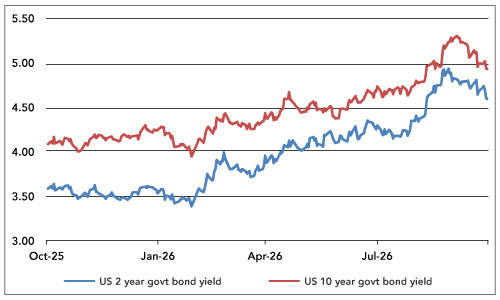
The 10-year Treasury yield began October around 5.3%, retreated below 5% by month-end and still finished at a level that would have looked extraordinary for most of the post-2008 period. The movement matters as much as the level. A fast rise in long yields forces deleveraging; a fast fall after bad inflation news says investors are beginning to price the damage caused by the rise.
The US fiscal backdrop offers little comfort. Fiscal 2026 closed with a deficit of about $2 trillion and net interest costs above $1 trillion. Supply remains heavy just as foreign official demand has become less dependable. The result is a structurally higher term premium even if the Federal Reserve eventually cuts rates.
Chart 3: US Treasury yields (%)
Source: Bloomberg
We remain buyers of quality government bonds, but selectively. Three-to-seven-year US Treasuries offer useful yield and genuine protection if the credit cycle weakens. Long-duration government debt is less straightforward because the same fiscal arithmetic that supports yields can undermine its defensive properties. In Europe the distinction is even clearer: Bunds remain preferable to French government debt while fiscal credibility is being tested.
AI: From an Earnings Story to a Financing Story
The technology correction in October was not primarily an earnings recession. The IT sector fell 7.0% and the NASDAQ 5.3%, but earnings expectations for the largest technology companies remain robust. What changed was the market’s focus on the balance sheet.
The first phase of AI investment was funded largely from operating cash flow. The next phase is increasingly dependent on debt, structured vehicles and outside capital. Capital expenditure among the largest hyperscalers is running at extraordinary levels. When capex reaches or exceeds operating cash flow, the return on AI investment becomes a bond-market question as much as an equity-market question.
The distinction matters. Microsoft and other cash-rich leaders can tolerate higher financing costs. The more leveraged parts of the ecosystem cannot. CoreWeave bonds traded at distressed yields during the month; credit-default-swap spreads widened sharply in several AI-linked borrowers; and private-credit investors became more sensitive to concentration in data centres and related infrastructure.
There is a useful historical parallel. Railways in the nineteenth century, telecoms in the late 1990s and the early internet all transformed the economy. They also destroyed capital in parts of the financing chain. A technology can be economically revolutionary and still be a poor investment at the wrong price or with the wrong balance sheet.
Gulf Risk Becomes a Macro Variable
Brent rose 13.6% in October and was almost 81% higher than a year earlier. The risk premium broadened beyond crude. Refining margins, LNG availability, tanker freight, insurance and shipping security all became transmission mechanisms from the Gulf into global inflation.
Chart 4: Brent crude pushes to October highs ($ bbl)
Source: Bloomberg
The market has priced disruption to flows. It has not fully priced a direct attack on Iranian energy infrastructure followed by retaliation against Gulf production, export terminals, power or desalination. Reports of renewed US action after the 3 November midterm election make that distinction important for the opening weeks of November.
For portfolios, energy remains insurance rather than a momentum trade. The best exposure is not necessarily the assets physically closest to the conflict. Integrated majors and refiners with geographically diversified production can benefit from higher prices and margins without carrying the same operational concentration.
Asset Markets
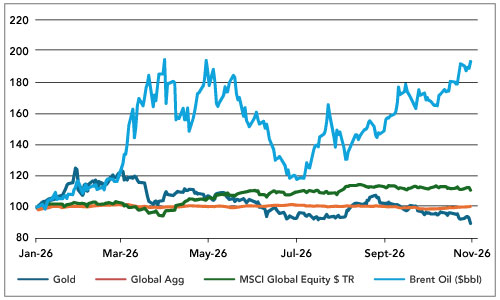
Chart 5: Asset Class Performances
rebased to Jan ’26 =100
Source: Bloomberg
Global Equities
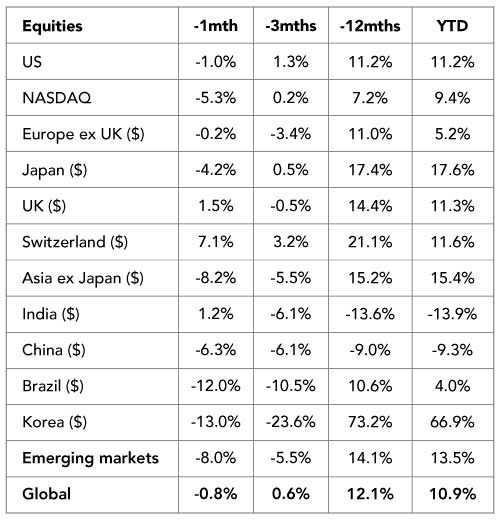
Global equities fell 0.8% in October, leaving them up 10.9% year to date. The headline disguises a substantial rotation. The US fell 1.0%, Europe ex UK was almost flat and the UK gained 1.5%. Switzerland rose 7.1%. By contrast, Asia ex Japan fell 8.2%, China 6.3%, Korea 13.0% and Brazil 12.0%.
The US market still has better earnings momentum than most peers, but concentration remains its weakness. Technology’s reversal exposed how much benchmark performance depends on a small group of companies and on the willingness of capital markets to finance their customers. We prefer quality cash generators and more equal-weight exposure to simply owning more of the same mega-cap risk.
Japan fell 4.2% in dollars during the month but remains up 17.6% for the year. We retain a positive strategic view. Corporate reform and improved capital allocation remain intact. The risk lies increasingly in Japanese government bonds and the currency as domestic inflation forces the Bank of Japan towards further tightening.
India rose 1.2% in October, a rare positive month in an otherwise difficult year, but remains down 13.9% in dollars year to date. Oil is the immediate macro constraint. A sustained Brent price above $110 worsens the current account, pressures the rupee and limits the RBI’s room to support growth. The long-term structural case survives; the near-term earnings arithmetic is less forgiving.
China fell 6.3% in October. Manufacturing, technology hardware and exports remain more competitive than the domestic economy. Household demand and property remain weak. We continue to separate the Chinese technology and industrial story from the broader macro story rather than treating the market as one trade.
Table 1: Equity Market returns to end Oct ‘26
Source: Bloomberg
Equity sector performance
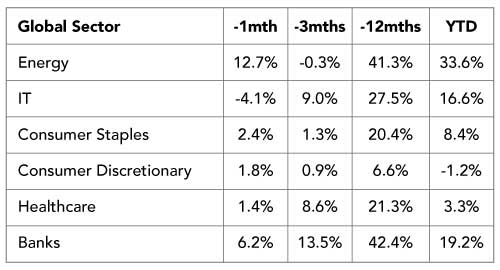
October’s sector rotation was unusually clear. Energy rose 12.8%, consumer staples 10.7% and healthcare 9.9%. Information technology fell 7.0% and banks 3.9%. Investors were not leaving equities altogether; they were moving towards cash flow, pricing power and businesses less dependent on another company’s capital expenditure budget.
That distinction is likely to remain important. The technology sector is not cheap in absolute terms, but it has de-rated while earnings have continued to grow. We would cut exposure to leveraged infrastructure beneficiaries rather than abandon AI. The most attractive businesses are those that either finance themselves or own scarce bottlenecks in power, grids, semiconductors and data infrastructure.
The defensives quietly did their job. Consumer staples rose 2.4%, healthcare 1.4% and consumer discretionary 1.8%. None of that is exciting, but in a month when the index went nowhere and the growth engine de-rated, modest positive returns from sectors nobody wanted to own were worth having. The rotation was not a risk-off move. It was a rotation from assets valued on the future to assets valued on current cash flow, which is what higher real discount rates are supposed to produce.
Table 2: Global Sector Performances to end Oct ‘26
Source: Bloomberg
Bond Markets
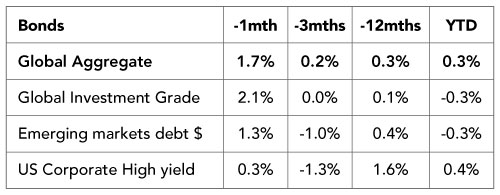
October was a good month for high-quality bonds. Global aggregate bonds returned 1.7% and global investment-grade credit 2.1%. Emerging-market dollar debt gained 1.3%, while US high yield rose only 0.3%. The pattern is consistent with a market becoming more defensive without yet pricing a broad recession.
Credit spreads have widened from exceptionally tight levels, particularly in the most leveraged borrowers. They are not yet at levels associated with a full credit event. That creates an awkward phase for investors: enough deterioration to justify caution, but not enough spread to compensate for reaching aggressively for yield.
Our preference remains short and intermediate duration, high-quality credit and liquidity. Cash near 4% is no longer an embarrassing holding. It is optionality. Private-credit portfolios deserve particular scrutiny for hidden concentrations in AI infrastructure, real estate and borrowers whose refinancing assumptions were built around lower rates.
Table 3: Bond market returns to end Oct ’26
Source: Bloomberg
FX
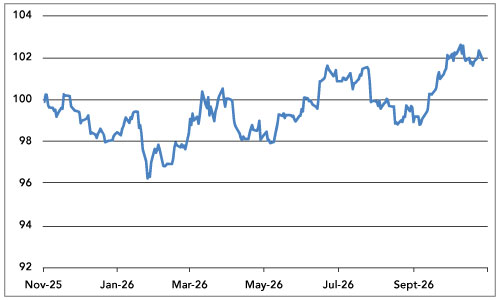
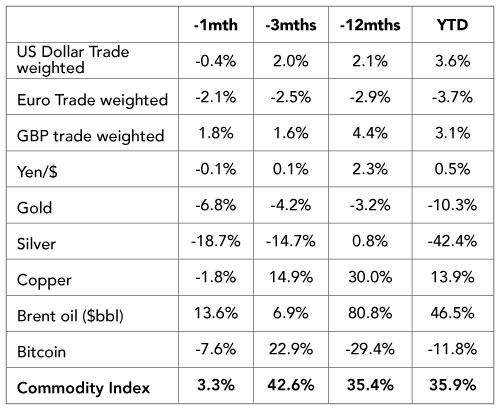
The trade-weighted dollar gained 0.4% in October and is up 3.6% this year. That is not a dramatic move given US yields and geopolitical risk. The dollar remains supported by yield, liquidity and energy security, but the fiscal premium embedded in Treasuries limits the argument for a one-way appreciation.
Sterling gained 1.8% trade weighted while the euro fell 2.1%. The yen was almost unchanged against the dollar in October. Japanese policy remains the more interesting story. Domestic inflation and a very weak yen leave the Bank of Japan with less room to remain patient, and a more hawkish BoJ would increase the risk of further unwinding of yen-funded carry trades.
Gold fell 6.8% and silver 18.7%. The fall in gold looks less like a collapse in the strategic case than forced selling into high real yields and a stronger dollar. Gold’s year-to-date return is now negative, but fiscal risk, geopolitical fragmentation and central-bank diversification remain intact. We would add in stages rather than chase it.
Bitcoin fell 7.6% in October and remains down 11.8% for the year. Its behaviour continues to look more like a high-beta liquidity asset than a reliable geopolitical hedge.
Chart 6: US DXY Dollar Index
Source: Bloomberg
Sterling and the euro were largely uneventful. Sterling gained 0.8% trade-weighted, helped by high gilt yields and an energy-heavy equity market, though a 5% ten-year yield is compensation for fiscal and political risk as much as for inflation. The euro slipped 0.2%, caught as usual between adequate growth data and a central bank with limited room to be helpful.
Bitcoin rose 7.3% but remains down 28.2% this year and 46.0% over twelve months. A monthly gain in a month of war escalation and equity stress will be presented as evidence of hedging properties. It is not. Over any horizon that matters it has behaved as a high-beta liquidity asset, and the Korean episode was a useful reminder: when retail equity positions are liquidated, crypto volumes contract with them rather than absorbing the flow.
Table 4: Currencies and precious metals – to end July ‘26
Source: Bloomberg
Commodities
The broad commodity index gained 3.3% in October and is up 35.9% year to date. Brent did almost all the macroeconomic damage, rising 13.6% in the month and 46.5% this year. Copper fell 1.8% in October despite remaining up 13.9% year to date.
The combination of strong oil and weak copper is not a benign inflation signal. Oil is responding to geopolitical scarcity; copper is beginning to reflect concern about the growth consequences of higher financing and energy costs. If the divergence persists, it points towards weaker real growth and higher nominal input costs – an uncomfortable mix for both central banks and corporate margins.
Energy security remains one of the most underappreciated constraints on the AI investment story. Data centres do not operate on earnings forecasts. They operate on electricity. Grid equipment, generation capacity and skilled labour are increasingly the binding constraints. The investment opportunity therefore extends beyond chips to power infrastructure, but only where financing and permitted capacity are credible.
Bottom line
October was a regime-change month in miniature.
The economy did not break. Markets did not capitulate. But investors started demanding evidence that growth can finance itself.
The equity message was rotation rather than retreat: energy, healthcare and staples rose while technology fell. The bond message was more important: Treasuries rallied after an inflation shock, suggesting that the market is beginning to fear the consequences of high rates as much as inflation itself.
The investment implications are straightforward. Keep exposure to growth, but insist on balance-sheet quality. Own AI through companies that generate cash rather than those that require permanently open capital markets. Use short and intermediate high-quality bonds as protection, but be wary of long-duration sovereigns with weak fiscal arithmetic. Maintain energy as insurance against Gulf escalation and rebuild gold gradually after forced selling.
November begins with three tests. The first is geopolitical: whether the US resumes attacks on Iran after the midterms. The second is credit: whether stress spreads from leveraged AI borrowers into broader high yield and private credit. The third is monetary: whether inflation and oil force the Fed and other central banks to tighten into a slowing, more fragile financing cycle.
The world still has growth. What it no longer has is free capital.