


Share This

Two Risks, One Channel
Nov 3, 2026
• Two risks, one channel: Higher oil prices keep interest rates elevated just as the AI investment boom becomes increasingly dependent on external financing.
• Markets at odds: Falling bond yields signal weaker growth and eventual policy easing, while central banks remain focused on persistent inflation.
• AI investment priorities are shifting: Favour cash-generative beneficiaries over debt-dependent infrastructure providers, while remaining cautious on credit and bond duration.
Financial markets have two apparently unrelated risks: the sell-off in AI stocks and the risk of renewed US strikes against Iran. Both raise the cost of capital: higher oil prices make inflation more difficult to control while the development of AI infrastructure increasingly needs external financing rather than internally generated cash.
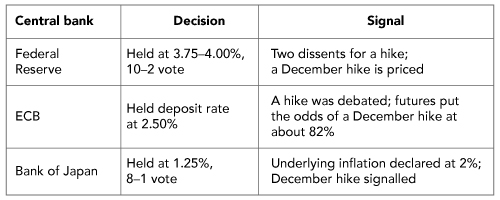
October showed the tension. Brent rose about 11% but the US 10-year yield fell almost 40 basis points. Bond investors seem to think financial stress will eventually force central banks to relent for increasing rates while Fed, ECB and BoJ signal tighter policy. The disagreement matters more over coming months than any one corporate earnings release.
The Current Picture
The change in the AI story isn’t a sudden collapse in demand. It is a change in how much of that demand will be financed by the market. The four largest hyperscalers look on track for $735bn of capex for 2026 an increase of 79% over this year. In the figures cited this week Meta joins Alphabet and Amazon as reporting negative free cash flow, with Microsoft the only one of the four in positive territory. Amazon reported quarterly free cash flow was -$42.4bn; Meta reportedly wants $95bn of equity financing. How much of each type of financing is used matters but the point is clear: investment is growing faster than the cash available to fund it. Once a capital expenditure cycle is outside funded interest rates are central to its valuation.
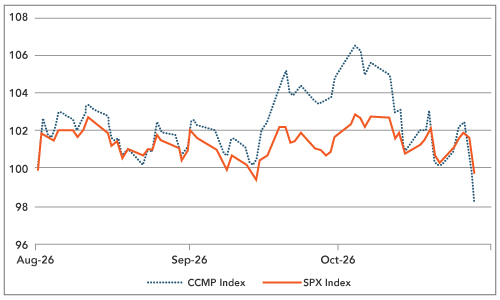
The market is showing the stress. On October 14 when a strong US inflation report drove a global sell-off in chipmakers and again last Friday when Nasdaq lost 2.9% (its worst session since June). Earnings still look on track but investors are paying more attention to the price of getting there. The consensus view is that this is a healthy correction cushioned by lower yields. The risk is that cushion fails. In 2022 the energy shock kept monetary policy tight as long duration equities fell; bonds were poor protection. However, inflation is lower today and hyperscalers are more profitable but the transmission mechanism is familiar.
The distinction also changes how we interpret corporate results. Strong demand and higher revenue estimates won’t work if the incremental dollar of sales requires ever more investment and external funding. The question is whether that cash return eventually justifies the capital invested. That’s a tougher test than the one investors applied to AI infrastructure just a year ago. These days are a far cry from the share buybacks and positive cash flow of the past five years.
Chart 1: NASDAQ marginally underperforms S&P 500 over three months
Index
Source: Bloomberg
For portfolios we see it as repricing who finances AI not a verdict on whether AI will work. The difference makes sense so be more selective within the theme rather than abandon it.
Economy
The economic data offered central banks little encouragement to ease. US and European inflation remains troublesome, Japan is moving into a different monetary regime, and India is especially exposed to higher oil prices.
• US: September PCE inflation rose 0.5% on the month and 3.6% on the year.
• Euro area: headline inflation is 3.8% against core of 2.5%, the mark of a supply shock. Banks have tightened lending standards, and 10-year yields are about 35bp above September levels.
• Japan: the BoJ declared underlying inflation at 2%. After three decades, that is a statement about the regime.
• China: third-quarter GDP grew 4.5% year-on-year, beating forecasts on exports. China is a stabiliser this quarter, not a risk.
• India: the rupee is near ₹95, about 6% weaker this year, with Brent around $115.
Central Banks and Bonds
Central bankers met last week with rate hikes still ‘promised’.
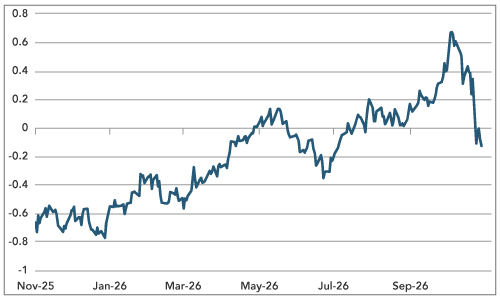
Bonds are a less direct message. The US 10-year yield fell from 5.29% in October to around 4.90%. The latest rally was at the front end only: two year yields fell 10bp to 4.59% while 30-year yields were unchanged at 5.32%. Oil is up and US inflation is at 3.6% so long end pricing is not easy.
Chart 2: 2-30 year yield Curve Steepness Moves Negative Again
Source: Bloomberg
The ECB also faces a leadership change. Madame Lagarde the ECB President is set to leave in February, (Chief Hawk) Schnabel in January and Lane’s term expires in May. That would be awkward timing: energy inflation + French fiscal concerns?
There is a big difference between falling bond yields because inflation is rising and falling because financial anxiety is rising. The former supports equity prices; the latter may come with widening credit spreads and weaker earnings expectations. Until oil and inflation provide more comfort, don’t read into the decline in Treasury yields that they are signalling an unqualified need to add risk.
Our conclusion is that the front end of the bond market may have moved ahead of the central banks. With oil above $110 we would not extend duration simply on the expectation of a rapid pivot in policy to loosening.
Equities
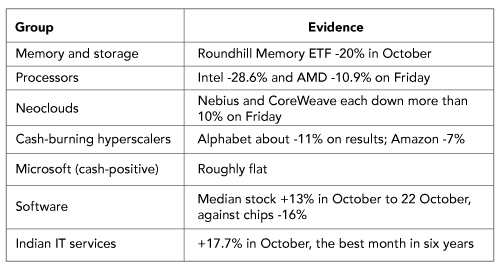
The correction has not been uniform across technology. Pressure is concentrated among those building AI capacity and financing it ahead of future cash flow. The distinction between beneficiaries and financiers matters more than a blanket sector call.
Some repricing is justified. Negative free cash flow and widening CDS spreads signal genuine financing risk. The late-1990s telecom boom is a good template: demand was real, but credit-financed capacity frequently delivered poor returns. Today’s hyperscalers have much stronger underlying businesses, so the analogy is about funding discipline, not in our view inevitable failure.
The market may be overreacting in memory. SK Hynix’s fourth-quarter profit estimate rose 13.9% over a month while its shares fell 13.5%. Still, peak cyclical earnings rarely attract peak multiples; Samsung de-rated on record profits in 2018. The rotation extends beyond technology. The equal-weight S&P 500 beat the capitalisation-weighted index by 5.85 percentage points in October, the widest margin since April 2009. Energy, staples and healthcare led. Investors are becoming selective, not simply reducing risk.
Korea and India demonstrate different exposures. The Kospi was heading for an October decline of around 17%; Samsung and SK Hynix represent nearly half the index, making Korea highly sensitive to memory. A recovery could be powerful, but concentration is a near-term liability. India’s Nifty gained 1.9%, helped by minimal AI hardware exposure and an earlier de-rating. Yet India is no safe haven from an oil shock. Foreign investors sold ₹48,056 crore through 25 October, taking 2026 outflows above ₹3 lakh crore. A weaker rupee and expensive imported energy remain significant risks.
Credit and Liquidity
Credit markets were warning about AI financing before the equity correction gathered pace. Oracle’s five-year CDS reached a record 288bp on 15 October, CoreWeave traded above 1,000bp, Meta’s spread reportedly reached around 119bp following disclosure of $825bn in infrastructure commitments, and Broadcom touched 175bp. The names and structures differ, but the message is consistent: creditors are beginning to demand a higher price for exposure to the build-out.
The pressure remains concentrated, not systemic. Broad US high-yield spreads were around 310bp in early October, still relatively tight. Yet some risk is embedded in leases, joint ventures and private-credit vehicles beyond conventional bonds. We would scrutinise these exposures before the stress becomes visible in wider credit indices.
Commodities and Geopolitics
Oil is responding primarily to supply and transport risks rather than a sudden improvement in global demand. Brent touched $117.84 on Friday, its highest level since late April, taking October’s gain to around 11% and marking a fourth consecutive monthly rise. Renewed military escalation could push prices towards $120 or beyond. Equally, the geopolitical premium can disappear rapidly: when strikes were paused earlier in the year, Brent fell more than 10% in a single session.
Gold has offered little offset, falling in October to around $3875. Elevated real yields are outweighing geopolitical demand. We would not assume a further Gulf escalation automatically produces a sustained rally.
The oil risk sits within an already disrupted regional market. Hormuz has been effectively closed since the war began in February, while the US maintains a blockade of Iranian ports. The Houthis also claimed a missile attack this week on Saudi Arabia’s Ras Tanura refinery. These developments increase the vulnerability of energy supply and transport even before any fresh US operation is considered.
Distinguish events from reports. US officials have reportedly warned Gulf allies of possible strikes after the 3 November midterms, including energy and nuclear facilities, but no final decision has been reported. Portfolios should price the risk without treating the timing as certain.
Oil exporters and importers will experience the shock differently. Higher crude prices support fiscal balances across some energy-producing markets, while importers face pressure on currencies, corporate margins and domestic demand. The geographical distinction matters for emerging-market allocations and reinforces our preference for balance-sheet strength and adequate liquidity over apparently cheap valuations alone.
The portfolio implication is not to trade the date of a possible strike. An attack on energy infrastructure could reduce supply directly and provoke retaliation against Gulf facilities. We would instead test whether portfolios could withstand Brent at $130 for a quarter without forced selling. The ability to maintain liquidity through that scenario matters more than the ability to forecast the first headline.
Structural Change: AI Becomes a Capital-Markets Story
The lasting change is that AI has become a capital-markets story. Cash-rich technology companies are drawing on debt, equity, leases and infrastructure commitments to sustain expansion. Widening CDS spreads show creditors are reconsidering the risk. Depreciation assumptions also deserve scrutiny, since asset lives influence reported profitability.
Three consequences follow. More AI equity issuance will test investor appetite. Free cash flow and returns on invested capital should matter more than revenue growth. Finally, grid and power constraints may give infrastructure owners durable pricing power. As with railways and fibre networks, the greatest economic gains may accrue to users rather than builders. Prefer the users and the toll roads.
The GCIO Asset-Allocation View
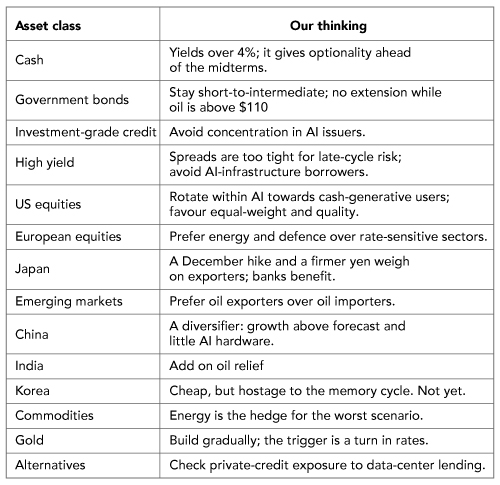
The week sharpens selection rather than changing our overall allocation. We favour cash-generating AI users over funding-dependent builders, maintain liquidity and keep bond duration restrained. An oil-driven inflation shock could undermine the usual protection from government bonds.
Watch list
The midterms on 3 November. The reported strike window opens after them.
1. Brent at $120. A sustained break would make December pauses at the Fed and ECB hard to justify.
2. AI CDS. Oracle above 300bp would show the funding squeeze deepening before equities confirm it.
3. Nvidia results, expected around 18 November (date unconfirmed). Before that come Apple, AMD, Qualcomm and Palantir next week.
4. The US 2-year (4.59%) against the Fed on 9 December. Whichever moves first shows who blinked.