


Share This

The Tide Has Gone Out
Oct 6, 2026
Warren Buffett’s line about the tide going out is usually applied to a single market accident. But this time it appears to apply to a regime as well. For nearly 20 years, low interest rates and contained inflation provided cover to a lot of anomalies. Governments borrowed with impunity. Investors borrowed heavily and built up their portfolios without paying for the risk. Capital – plenty of it – chased asset-light business models but left physical capacity behind.
The tide is now going out. Last week, the 10-year Treasury yield surged to 5.27%, its highest since June 2007, and the 30-year was at 5.62%, a level last seen in 2002. France, meanwhile, was the first to be exposed. It won’t be the last, however. As things stand currently, this does not simply signify a turn in the rate cycle. This does not feel like part of the cycle, either; in all probability, it is a change of regime.
1. The big picture: the destination is normal, the journey is notWhile the two-year Treasury yield fell 3bp this week, the 10-year rose 11bp and the 30-year 13bp. The 10-year had a cumulative 87bp surge in the third quarter, the largest quarterly rise since 1994. The long end sold off even as the odds of an October Fed hike fell sharply – from 70% to 23%, which also explains the fall in two-year yields. That move in long rates is not about monetary policy. It is supply, weaker foreign official demand, and forced selling.
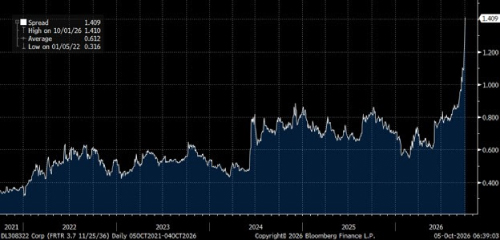
In Europe there are signs of things falling over. The French–German 10-year spread closed at 141bp on Friday, up 32bp on the week. It had touched 158bp at one point on Friday, the widest since 2011. France has nominal growth of perhaps 3–3.5% against a 10-year yield of 4.87%, and a deficit heading to 5.4% of GDP. When interest rates exceed nominal growth and the budget stays in deficit, the debt ratio rises mechanically. The US, with a 5.27% yield against nominal growth near 5.5%, still passes that test, but with federal debt near 100% of GDP against 35% in 2007.
Chart 1: The Spread of French 10-year bond versus Germany
%
Source: Bloomberg
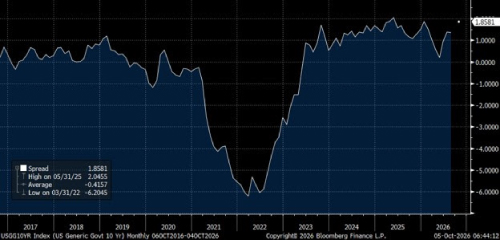
GCIO view. Normalisation is the right word as far as current yields are concerned. Real 10-year yields near 2.2% are close to their 2005–07 levels. What is not normal is the debt built on the assumption that such high nominal yields would not return. Higher rates are imposing discipline, but through margin calls rather than through orderly repricing. The yield levels are just about tolerable for the US, but increasingly inconsistent with debt stabilisation in France without fiscal adjustment. The speed of the move matters more than the level, because the speed forces deleveraging.
2. Economy: strong, narrow, and still inflation-prone Global growth is strong on output measures. The global manufacturing PMI hit a five-year high in September, and US third-quarter GDP is tracking 3.5% annualised. But the drivers are narrow: AI and power capex, an inventory rebuild, and Asian tech exports. US payrolls rose only 29,000 in September, and wage growth fell to 3.0%, the lowest since 2021.
Inflation may persist because commodity prices are not the only problem. Inflation is embedded in physical capacity. ISM Manufacturing Prices Paid Index, for instance, jumped to 77.9 in September:
• Middle East crude exports are back to about 98% of pre-war levels, but refined product exports are at only 58%.
• Qatar’s LNG plants are running at around 20% of capacity.
• Supertanker freight rates are $1.2mn a day, and five- and ten-year-old tankers now sell for more than new ones.
• China is again restricting fuel exports, and Washington is threatening to ban diesel exports.
In Japan, Tokyo core inflation rose to 2.7% year-over-year in September, and rents rose for the first time since 1994.
3. Bonds: a discerning buy We are discerning buyers of government bonds. At a real yield near 2.2%, US Treasuries offer long-term value. The price is being set by forced sellers, so we would add gradually.
In Europe, we prefer Bunds to French bonds. The ECB’s Transmission Protection Instrument, its tool against disorderly spreads, sets a high bar for countries under the EU’s excessive deficit procedure, and France is one. Italy’s spread widened about 24bp to roughly 115bp; that is the better guide to contagion.
Chart 2: US Real 10-year Bond Yield
%
Source: Bloomber
4. Credit: where the tide is going out first Credit is where the anomaly – rather, bad behaviour – is coming to the fore:
• CCC spreads rose above 1,000bp for the first time since March 2023, and high-yield CDS posted their largest weekly rise since March.
• Paramount Skydance’s $52bn buyout financing traded down to 96 cents within a day. Its CDS reached a record 430bp.
• AI borrowers’ bonds hit record yields: Oracle’s 2036s at 7.49%, CoreWeave’s 2032s at 12.29%, Meta’s 2036s at 6.23%.
• Blue Owl’s technology lending fund received redemption requests for 39% of its shares and paid out 5%. Australia’s Metrics Credit Partners suspended some redemptions.
Banks are better capitalised than in 2007–09, and much of the riskiest lending now sits with private credit funds and insurers. But less direct exposure is not the same as less exposure. Banks lent tens of billions of dollars to Situational Awareness, a young hedge fund whose AI bet imploded this summer, and they fund the off-balance-sheet vehicles behind data centres. This week, the Fed also finalised stress-test changes the industry had long sought. US bank shares fell 2.8%.
The reset is staggered. Leveraged speculators, floating-rate borrowers, commercial property, and the neoclouds (specialist AI cloud providers) feel it now. Most companies termed out their debt, so the wider hit arrives with the 2027–31 maturity wall. US high-yield maturities rise from $68.5bn in 2027 to $314bn in 2029
5. Equities: four stocks and the falling cost of money By Creative Planning’s count, Nvidia, Microsoft, Apple, and Meta delivered about 200% of the S&P 500’s third-quarter gain, so, effectively, the rest of the index fell during the quarter.
A Federal Reserve study by Michael Smolyansky, titled “End of an Era: The Coming Long-Run Slowdown in Corporate Profit Growth and Stock Returns,” shows how much of the past was borrowed from falling rates. For S&P 500 non-financial companies, falling interest and tax rates explain over 40% of real profit growth from 1989 to 2019. Interest and tax costs halved, to 27% of EBIT from 54%, during this period, lifting profits by 59% with no operating improvement. Real EBIT grew only 2.2% a year. Falling risk-free rates explain all of the rise in P/E multiples over the period. With the 10-year back at 2007 levels, that support has gone.
The reversal will be slow, arriving as debt is refinanced. But it reverses the long pattern of profits outgrowing operating income: reported profit growth is now likely to trail it. The S&P 500 net margin is expected to reach a record 13.9% in 2026, against a ten-year average of 11.0%.
GCIO view. The headline index hides how fragile it is underneath. We prefer quality companies that generate cash, equal-weight exposure, and Japan. We are cautious on companies whose revenue depends on other companies’ borrowing.
6. Commodities and geopolitics Crude oil fell 1.4% to $91 on normalising flows, while refined products and LNG stay tight. Gold fell 3.4% to $4,141, sold for liquidity rather than bought as a refuge.
The US is sending a third carrier group to the Gulf, and President Trump says he is considering renewed strikes on Iran, with a decision expected after the 3 November midterms. Oil prices assume flows keep normalising, so the risk is to the upside.
7. The regime change: what low rates hid Capacity. 15 years of near-zero real rates rewarded asset-light models and buybacks over refineries, LNG trains, ships, grids, and chip plants. That capacity is now falling short even as the cost of capital rises, which raises the hurdle for building more. The one area adding capacity aggressively is AI, and it is doing so with plenty of debt and uncertain revenue.
Distribution. Financial assets inflated while wages lagged. Since 2019, the top 0.1% of Americans have more than doubled their wealth to about $28tn. Labour’s share of non-financial corporate value added has dropped to 56% today from 66% in 2001. US 30-year mortgage rates are 7.28%, the highest since 2023, making mortgage debt unaffordable for many households.
That settlement now constrains policy. Discontent over wages, housing, and migration has helped fragment parliaments, including France’s. That makes fiscal consolidation harder to pass.
GCIO view. Some of these imbalances are now too large to correct quickly, and they will not disappear on their own. What has changed is that they now face higher interest rates. The current regime will expose companies and countries that hitherto relied on cheap money to cover weak balance sheets. The fourth quarter offers a window to regain some lost ground. Growth is still reasonable, US core inflation has eased, and the Fed is likely to move cautiously, perhaps with one more hike in December. Further tightening is more likely next year. We would use this period of relative calm to rebalance portfolios. That means moving away from assets that depend on cheap money and towards companies with strong cash generation and balance sheets
8. The Watch List
• French and Italian spreads. A French spread back below 120bp would suggest the washout is over; above 160bp it becomes a policy event.
• The US 10-year at 5.30–5.35%. Watch September CPI in mid-October and the 28 October FOMC meeting.
• India’s RBI on 7 October. A 50bp move would signal Asian central banks prioritising currency defence.
• Third-quarter earnings starting mid-October. The test is free cash flow against reported earnings, and how hyperscalers finance capex.
• CCC spreads and private-credit redemptions. These show whether the stress stays contained or tightens credit for the wider economy.
The tide has gone out. The investment challenge is not waiting for it to return, but identifying which business models were only viable because the tide was in.