


Share This

What Breaks First?
Oct 12, 2026
What has changed since last week?
Last week, we advised clients to watch out for five important developments. Here is how those developments unfolded.
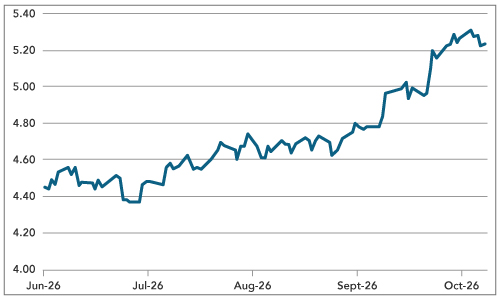
• US 10-year at 5.30–5.35%. Tested and rejected. Yields rose briefly above 5.3% before settling around 5.24%, a little below the preceding week’s 5.27% close.
• India’s RBI on 7 October. A 25bp hike to 5.50% duly arrived, not the 50bp we said would signal Asian central banks prioritising currency defence. Pressure, not panic.
• French and Italian spreads. The French–German spread is 137bps, against 141bps a week ago. Italy 109bps vs 115bps.
• CCC spreads and private-credit redemptions. 1252bps versus 1250bps over the course of the week.
• Still ahead: September CPI on 14 October, third-quarter earnings from mid-October, and the FOMC meeting on 28 October.
Our key thoughts this week
• The bond market has paused, not turned. Forced selling has eased, but a $2 trillion deficit keeps the term premium under pressure.
• Inflation that companies cannot pass on is becoming an earnings problem. Combined with rising interest costs, margins face a double squeeze just as earnings season begins.
• US consumption rests on wealth, and that wealth rests on four stocks. A correction in a handful of mega-caps could reach the shops quickly.
• The AI test has moved from credit to equity: Firmus has reportedly pulled its IPO even as Anthropic’s listing approaches.
• Our positioning is unchanged.
Inflation: the squeeze moves to margins
Last week, we argued that the current inflation problem has its roots in physical capacity, in refineries, LNG trains, and tankers, rather than in commodity prices alone. Nothing that happened in the past week changes that assertion. What is becoming clearer is who pays.
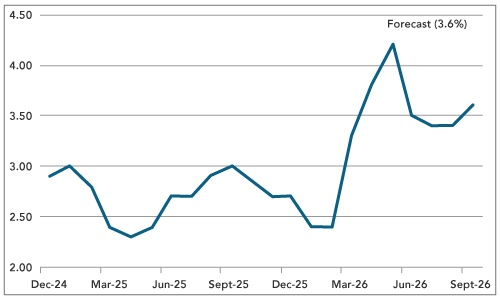
Gulf energy disruption has pushed US energy prices up more than 16% over the past year, taking headline CPI to 3.4% in August. Yet core CPI has eased to 2.4% and wage growth to 3.0%. Costs are rising faster than companies can pass them on to households whose purchasing power is already weak.
That leaves corporate margins in a double squeeze. Last week we showed that falling interest and tax costs explain over 40% of real profit growth since 1989, a phenomenon that is now reversing course as debt is refinanced at higher rates. Add rising input costs that cannot be passed on, and the record 13.9% net margin expected for the S&P 500 this year looks exposed from both sides. Inflation that cannot be passed on becomes an earnings problem, and third-quarter earnings season is about to begin.
The September CPI release on 14 October is the next test. Consensus expects headline prices to rise around 0.6% on the month, led by higher energy costs, with core up a more modest 0.2%. A hot core print, however, would revive the October hike debate the market had just set aside, and make volatility more likely.
Chart 1: US CPI pushing higher again
Source: Bloomberg
The consumer: spending on four stocks
US households continue to spend faster than they earn. Real consumer spending has grown at 2.6% annualised since early 2024, against a 1.8% growth in real disposable income, with a two-point fall in the savings rate closing the gap. Rising wealth did the rest: household net worth is up an estimated $42 trillion since the end of 2023.
Last week, we noted how unevenly that wealth is held, and borrowing costs have risen further since, with the 30-year mortgage rate inching up to around 7.45% from 7.28%. The point to note is where the wealth comes from. Nvidia, Microsoft, Apple, and Meta delivered about 200% of the S&P 500’s third-quarter gain. The spending power of America’s highest earners now rests on the narrowest part of the equity market, the part most exposed to AI financing and higher yields.
Aggregate balance sheets are healthy, and leverage is far below 2008 levels. This is not a repeat of the financial crisis. But the sequence may run from markets to spending rather than the other way. A correction in a handful of mega-caps would reach the shops faster than the payroll data suggest.
10-year Bonds: the 5.3% line holds, for now
At the end of September, we flagged 5.30–5.35% on the 10-year Treasury as the level to watch. It was tested last week and rejected. The 30-year ended at 5.59%, down from 5.62%. One week does not end what appears to be a certain regime change, but forced selling likely has eased. That aligns with our view that Treasuries, with real yields near 2.2%, are worth adding to gradually.
The fiscal news offered no comfort. The US closed fiscal 2026 with a $2.0 trillion deficit, about 6.2% of GDP: spending of $7.4 trillion against revenues of $5.4 trillion. Deficits of that size have previously occurred only during war or recession. Supply will keep the term premium under pressure, so we would keep buying into weakness rather than chase rallies.
Chart 2: US 10-year government bond yield capped at 5.3%… for the moment
Source: Bloomberg
Outside the US, the UK has a budget to navigate in the coming weeks, and in Asia the Reserve Bank of India’s 25bp hike, citing inflation, oil, and a weaker rupee, suggests central banks are under pressure but not yet in crisis mode.
AI: from credit to equity
Last week, stress in AI financing showed up in credit markets, with Oracle, CoreWeave, and Meta bonds trading at record yields. This week it reached equity issuance. The Nvidia-backed Australian data-centre operator Firmus has reportedly pulled what would have been one of Australia’s largest IPOs after demand faded. Anthropic’s listing, expected in the coming weeks, will test whether public investors will finance exceptional revenue growth alongside heavy losses and ongoing capital needs.
We remain convinced that AI is a profound technology. But the economic value of AI and the return on the capital spent to build it are not the same thing. Railways, telecoms, and the internet all changed the world; not all of them rewarded those who financed the build-out.
Third-quarter results are where these questions get answered. In hyperscaler results, we will be looking at three things:
1. Financing. How much capex is funded by cash flow, and how much by debt and off-balance-sheet vehicles as yields rise.
2. Depreciation. Whether useful-life assumptions on hardware are being stretched, flattering reported earnings relative to free cash flow.
3. Returns. Whether AI revenue is growing fast enough to justify the capital being committed.
We are not declaring the cycle over. The real question is whether AI investment can become self-financing before capital markets insist on stricter fiscal discipline.
Europe, Japan, and China: three versions of the same problem
Europe has been more resilient than expected, but the support is wearing thin. Analysts have been cutting forecasts for euro area consumption growth for H2 to 0.75% annualised from 1.4% as the energy shock bites (real disposable incomes could fall by around 0.5% annualised, inflation may even reach 5% annualised in Q4). Consumption has to grow, so households have to save less. They can, but during the 2022–23 energy shock Europeans saved more, not less. With France’s finances under pressure, governments have little room to cushion households.
Japan shows us where fiscal reflation ends. Prime Minister Sanae Takaichi has tried to reassure investors that fiscal discipline and Bank of Japan independence are in place, but policy remains expansionary. If spending fuels inflation, then the BoJ will need to raise rates again (increasing the costs of servicing one of the world’s largest public debts). This doesn’t change our preference for Japanese equities, which benefit from reflation and corporate reform. The risk sits in Japanese government bonds.
China has the opposite problem. Its manufacturers and exporters remain very competitive, and the market sees fiscal support ramping up in fourth-quarter growth; but domestic consumption is still held back by the slump in property prices and cautious households. A growth model based on exporting to partners whose purchasing power is weakening (and whose politics are turning against imports) is becoming harder to sustain.
None of the three is out of options. But each shows how hard it has become to sustain growth through conventional stimulus.
Our Investment Conclusion: No Change, Sharper Focus
The resilience of the global economy remains impressive, and we would be reluctant to abandon growth assets simply because the risks to own them have risen. But the supports for growth, wealth-funded consumption, crisis-sized deficits, and the AI build-out are all exposed to the same two threats: persistent inflation and a higher cost of capital. Nor are they independent. Higher yields hit AI valuations, a correction hits the wealth effect, and slower growth hits both earnings and government finances.
Our positioning is unchanged from last week:
• We advise adding to US Treasuries gradually at real yields near 2.2%, buying into weakness.
• We prefer Bunds to French government bonds.
• In equities, we favour quality companies with strong cash generation; in countries, our preference is for Japan.
• We stay cautious on companies whose revenue depends on other companies’ borrowing.
• We hold gold as a strategic diversifier against fiscal and geopolitical risk.
What makes this week significant is earnings. We sense that the tech sector results season will be particularly key to markets. Retail investors’ interest tends to revolve around quarterly results. We would use the results season to test which companies can protect margins against both higher input costs and higher interest costs. The question is no longer how much further the expansion can run, but which of its supports gives way first.
The watch list
• September CPI, 14 October. A core print above 0.2% would revive hike expectations from the 28 October FOMC meeting.
• Third-quarter earnings. Margins against input and interest costs; hyperscaler free cash flow against reported earnings.
• Anthropic’s listing. Pricing and first-day demand as a gauge of public appetite to fund AI.
• The 10-year Treasury. A break above 5.35% would reopen the sell-off; below 5.0% would suggest forced selling is over.
• French spread. Below 120bp the washout is over; above 160bp it becomes significant pressure.
• FOMC, 28 October. Whether the Fed skips and waits for December.
Viral Complacency Revisited
In February 2020, we published a Weekly titled, “Viral Complacency?”, asking whether markets were taking the coronavirus outbreak seriously enough. At that time, investors were confident that the outbreak would be contained quickly and that stimulus would bridge any disruption. We were less convinced, given how little was known about the virus, the disruption already visible in Asia, and the market’s faith in a return to normal within weeks. Within a short time, the world learned how dangerous those assumptions were.
More than six years on, two stories compel us to revisit the theme:
The first is the death on 2 October of a 28-year-old technician at the Irkutsk Anti-Plague Research Institute in Siberia, after a severe pneumonia. Early Russian media reports suggested pneumonic plague. Moscow says no plague cases have been recorded, and no dangerous pathogens were found among the deceased’s contacts. The WHO says the cause remains unconfirmed and the risk to the general population appears low, while Washington has pressed Russia for transparency.
The second, raised by Bloomberg Opinion, is the possibility that warming could release ancient microorganisms long preserved in Arctic permafrost. Scientists have shown that some viruses remain viable after extraordinarily long periods frozen in the ground. It sounds like a Hollywood plot that could perhaps be too vague and inconsequential for investment research, but the scientific questions are serious enough to warrant attention.
There is no known link between the two, and no convincing evidence that ancient pathogens pose an imminent threat. Our concern lies elsewhere.
COVID exposed deep flaws in international cooperation, information sharing, and the speed of political response. In 2020, we questioned whether incomplete information from China was feeding market complacency. Today, geopolitical fragmentation, mistrust between governments, and the politicisation of scientific institutions raise an uncomfortable question: is the world better prepared to detect and contain the next outbreak, or worse? Meanwhile, investors have largely returned to treating pandemic risk as remote, despite the enormous damage COVID inflicted.
We are not predicting another pandemic, much less one emerging from the Siberian ice. But 2020 taught us that the most damaging events rarely feature prominently in conventional forecasts.
Sometimes the greatest danger is not the risk nobody has identified, but the one everybody has grown used to ignoring.