


Share This

Investment Strategy
Oct 8, 2026
• Global growth remains resilient, but elevated inflation likely to keep rates higher for longer.
• Bonds and Equities diverge, bond reflect persistent inflation risks while equities don’t.
• Indian growth remains strong despite global headwinds.
• We are constructive on Indian equities and would use near-term volatility to add exposure.
• Within equities, we favour large caps given greater valuation comfort.
• In debt, we prefer shorter maturities and remain cautious on duration.
Higher for Longer
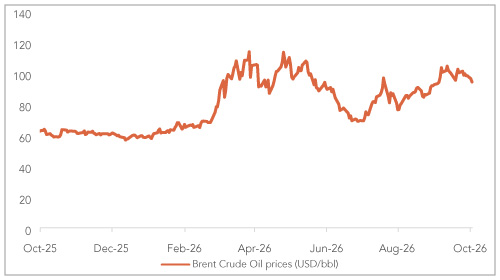
Global bond yields remained in focus through September 2026. Global growth proved resilient, while inflation remained above central-bank targets. The escalation of conflict in the Middle East pushed Brent crude back above USD 100/bbl, adding to inflationary concerns. Against this backdrop, the Fed, ECB and BoJ each raised policy rates by 25 bps during the month. Global bond yields edged higher, with the U.S. 10-year yield touching multi-decade highs.
Yet, equity markets continued to move higher. This divergence between bond and equity markets raises a fundamental question: can both be right?
Against this backdrop, the Sanctum Investment Committee reviewed our proprietary asset-pair model to anchor tactical allocation in fundamentals rather than market noise. We remain constructive on Indian equities over the medium to long term, while viewing near-term volatility as an opportunity to add tactically. We favour large caps on valuations, while selective SMID opportunities remain attractive for active managers. In fixed income, we prefer shorter maturities and limited duration, while continuing to hold gold as a portfolio diversifier.
Global Macro Update
The Middle East crisis remains front and centre of the global macro environment. A rapid Houthi advance in Yemen has opened a second front near the Bab el-Mandeb, putting two of the world’s key energy corridors under pressure at the same time. So far, the global economy has absorbed the energy shock better than feared, with supply buffers, softer Chinese demand and available spare capacity limiting the pass-through from higher oil prices. But these buffers are being drawn down quickly, while the conflict shows little sign of resolution. With Brent averaging above USD 100/bbl through most of September, the risk is shifting from a price shock to a more persistent and potentially broader supply disruption.
Brent crude back above USD 100/bbl
Source: Bloomberg, Sanctum Wealth
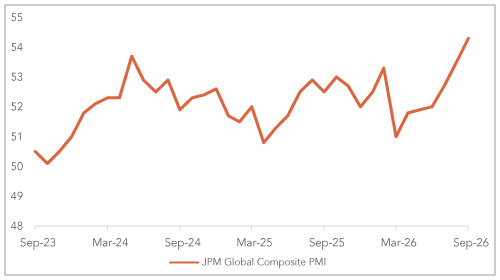
Against this challenging geopolitical backdrop, the global economy remains remarkably resilient. The J.P. Morgan Global Composite PMI rose to 54.3 in September, a 40-month high, as economic activity accelerated for a sixth consecutive month. Capital spending remains a key growth engine, with U.S. core capital goods orders rising 1.6% month-on-month in August amid strong AI-related investment. South Korea’s September exports surged 83.5% year-on-year to a record $120.9 billion, driven by a 263% jump in semiconductor exports, while Europe has held up better than expected, supported in part by Germany’s fiscal stimulus.
Global economic activity is strong
Source: Bloomberg, Sanctum Wealth
The paradox is that growth is no longer simply a source of comfort, it is increasingly becoming a policy problem. With the global economy running hot, central banks risk having to keep policy restrictive for longer to contain inflation. This helps explain the market’s positive reaction to softer-than-expected U.S. September job growth: the moderation increased the perceived room for the Fed to hold rates at its next meeting.
Meanwhile, inflation is proving more persistent and structural than purely supply-driven. U.S. core PCE inflation has remained above 3% for most of the year. Although core inflation came in below expectations in August following a change in BEA methodology, it still stood at 3% year-on-year, well above the Fed’s target. In Europe, headline inflation reached a near three-year high of 3.2% in August. With oil above USD 100/bbl and gas above EUR 70/MWh inflation pressures are likely to continue.
This mix of resilient growth, persistent inflation and rising energy risks leaves central banks with a difficult balancing act. The Fed, ECB and BoJ have already raised rates once this year and remain inclined to keep policy restrictive, with another 25bp hike likely. The key risk is no longer simply whether growth can withstand higher rates, but whether central banks can contain inflation without tightening enough to ultimately break growth.
Global Market Update
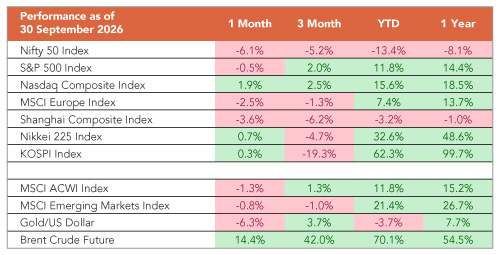
Global equities slipped 1.3%, but the divergence across markets was striking. The Nasdaq, despite being one of the most rate-sensitive equity indices, gained 1.9% even as 10-year yields rose 50bp, supported by strong AI earnings. Japan gained 1.5% in dollar terms on a firmer yen following the BoJ hike, while Europe was the weakest developed region, with Europe ex-UK down 4.7% amid higher energy costs and renewed French fiscal concerns. Emerging markets also diverged, with India down 6.1% and China 3.6%, even as Korea ended with positive returns.
Source: Bloomberg, Sanctum Wealth
Above returns are only price change in local currency terms and not total returns
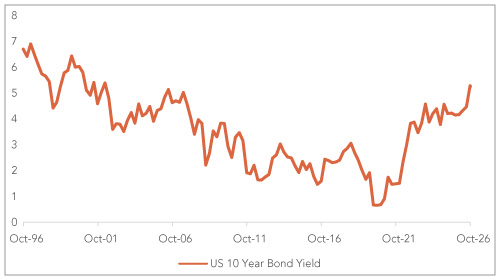
The bigger repricing, however, has been in bonds. Major fixed-income indices all fell, with global aggregate bonds down 1.6%. The U.S. 10-year yield ended September near 5.3%, while the 30-year crossed 5.6% and the two-year yield rose nearly 60bp. Japanese yields also reached multi-year highs, while borrowing costs across France, Germany and the UK rose sharply. The bond market is increasingly pricing the persistence of the energy and inflation shock, alongside growing concerns around government debt and fiscal sustainability.
US 10-year bond yield at 25 year high
Source: Bloomberg, Sanctum Wealth
This creates a clear tension between equities and bonds. At nearly 19x forward earnings, the S&P 500 offers an earnings yield of roughly 5.3%, around the same as the 10-year Treasury yield, leaving little or no equity risk premium. So far, rising earnings expectations, particularly from AI-linked companies across memory, storage and semiconductors, have allowed equities to absorb higher yields far better than in 2022. But at current valuations, the equity case increasingly depends on earnings continuing to surprise on the upside.
Across regions, the picture remains uneven. In U.S. earnings growth is strong but valuations are expensive. Europe offers more attractive valuations, but the combination of an ECB tightening into an energy shock, a weaker euro and renewed French fiscal concerns has kept sentiment subdued, making stock selection increasingly important. Japan retains structural support from reflation, policy normalisation and corporate governance, although equity performance is increasingly sensitive to rising domestic bond yields. In China, the Trump–Xi summit delivered limited progress, including an extension of the trade truce and continued dialogue on rare earths and AI, reducing some trade uncertainty, while domestic demand remains weak.
Meanwhile for bonds, the concern is not just tighter monetary policy but a heavier supply burden. AI-linked companies have issued more than $500 billion of debt this year, while U.S. corporate issuance is running about 30% above last year. At the same time, Japan and China are buying fewer Treasuries, increasing reliance on private investors, who are demanding a higher term premium. Credit is already showing early signs of strain. Oracle’s 10-year yield has risen to 7.34% and its five-year CDS hit a record 237bp, while spreads have widened across Meta, Amazon and Microsoft. High-yield spreads are also at their widest since April. It is not systemic yet, but credit is beginning to signal that financing demands may be running ahead of underlying cash flows.
The broader message from markets is therefore becoming clearer: equities are still being supported by earnings, while bonds are increasingly demanding compensation for inflation, energy and fiscal risk. How long that divergence can persist is ultimately a question of where yields settle, and that makes the bond market the more important signal for the next phase of the cycle.
In the near term, U.S. midterm elections add another layer of political risk. A hostile Congress could constrain war funding and increase pressure on President Trump to pursue a deal. Political noise is likely to intensify as the election approaches, creating a source of tail risk that is not obviously reflected in current market pricing.
India Macro Update
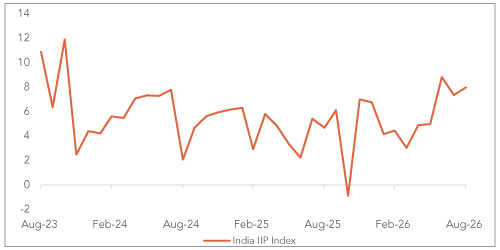
India’s macro backdrop remains resilient, with IIP growth accelerating to 8% YoY in August, manufacturing growing 9%, capital goods output rising 16.9% and credit growth remaining in the high teens. However, there are early signs of moderation, with softer new orders and some easing in high-frequency services and rural indicators. The bigger concern is that the external environment has become considerably less benign.
India’s economic activity remain strong
Source: Bloomberg, Sanctum Wealth
The escalation in the Middle East is adding pressure to India’s import bill, inflation and corporate margins. The weak monsoon compounds these risks: rainfall has been around 15% below normal, while reservoir storage is around 70% of capacity, below both last year and the 10-year average. A sustained rise in food and energy inflation could therefore weigh on rural consumption while limiting the RBI’s options.
At its latest policy meeting, the RBI raised rates by 25bps as expected and shifted its stance to “calibrated tightening,” mentioning that near-term rate cuts are off the table. It noted that economic momentum remains strong and broad-based despite global headwinds. While inflation expectations remain elevated, the RBI sees limited evidence of supply-side pressures becoming embedded in pricing, suggesting inflation remains largely supply-driven. Overall, the tone was cautiously hawkish and broadly in line with expectations. We expect the RBI to remain data-dependent in its policy decisions.
Overall, the near-term macro risks have clearly increased, but the underlying domestic economy remains strong. Healthy credit growth, robust investment activity and resilient domestic demand provide meaningful support. We therefore remain constructive on India’s medium-term growth outlook, while recognising that the combination of oil, food inflation and tighter global financial conditions warrants greater caution in the near term.
Equity Outlook
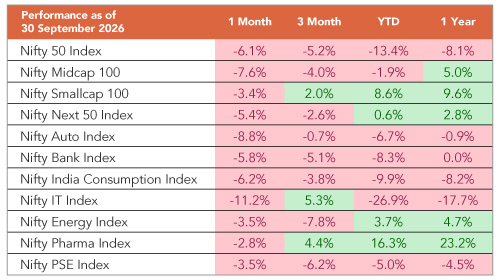
Indian equities, represented by Nifty 50, have now declined for nine consecutive weeks, their longest losing streak in 25 years, despite a resilient economy, healthy corporate earnings, ample liquidity and strong domestic flows. The market has also remained in a prolonged consolidation phase since September 2024, weighed down by persistent global, geopolitical and macroeconomic headwinds and sustained FPI outflows. Over the past 24 months, FPI outflows of ~USD 56 billion have effectively offset the cumulative inflows of the preceding eight years, leaving net FPI investment broadly unchanged over the past decade. In contrast, DIIs have invested a record ~USD 177 billion over the same period, 23% more than their cumulative inflows over the previous eight years.
Source: Bloomberg, Sanctum Wealth
Above returns are only price change and not total returns
While the market remained range-bound below its peak over the last 2 years, significant divergence emerged beneath the surface. Sharp rotation into power, data centres and semiconductors, supported by the AI capex cycle and with greater mid- and small-cap representation, drove SMID outperformance and cushioned the broader market from a sharper drawdown.
At this stage, we step back from the noise and focus on fundamentals. Economic activity remains resilient, while valuations have improved as earnings recover and the market has consolidated for nearly two years. Earnings growth, which was a concern a few quarters ago, has also rebounded, with Q1FY27 growth in the high teens and expectations of 14–16% through FY28.
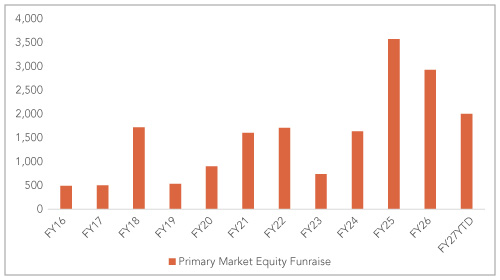
Domestic liquidity remains a key support. Between Apr’23 and Sep’26, a record INR 10.1trillion was mobilized through IPOs, FPOs, OFS and QIPs. While the vibrant primary market has absorbed a meaningful share of available liquidity, diverting some flows from the secondary market, it also highlights the underlying strength of India’s equity ecosystem and capital formation.
Primary markets underscore India’s equity strength
Source: Motilal Oswal Financial Services
The key drag remains FPI outflows. India continues to trade at a premium to EMs, even after its significant underperformance, as EM earnings growth has been stronger and valuations have therefore improved more meaningfully. India’s earnings recovery, while encouraging, still lags the upgrades seen across much of the world, while the absence of a strong AI-led growth narrative and near-term macro headwinds, including INR weakness and higher energy prices, continue to weigh on investor sentiment. FPI inflows may therefore remain elusive. Importantly, however, India does not need a sharp reversal in FPI flows; with domestic flows remaining strong, a moderation in FPI selling may be sufficient to provide a meaningful market catalyst.
Overall, we remain constructive on Indian equities over the medium to long term, supported by resilient fundamentals, improving earnings and strong domestic liquidity. In the near term, however, global geopolitical tensions and macro headwinds could keep markets volatile. We view such weakness as an opportunity to accumulate, rather than a reason to turn cautious. With the market already down more than 5% from its peak, we suggest deploying a portion of fresh capital now while staggering the remainder to take advantage of any further volatility.
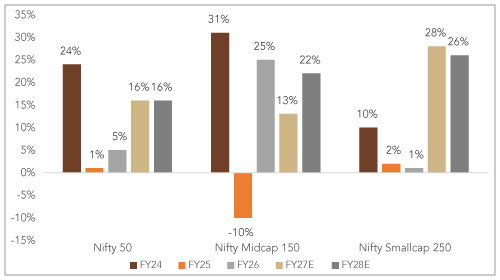
Within equities, we favour large-caps, where valuations are more attractive relative to mid- and small-caps. The earnings growth gap has also narrowed, with large-cap growth improving while SMID faces a higher base. That said, select SMID pockets continue to deliver strong earnings growth, creating opportunities for active management to generate alpha.
Earnings growth gap between large and midcaps has narrowed
Source: Motilal Oswal Financial Services
Fixed Income Outlook
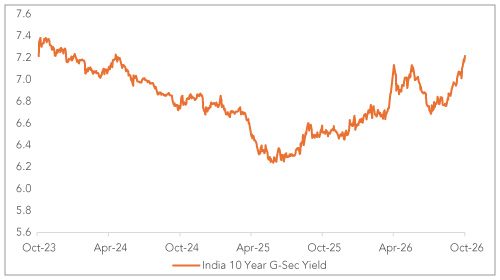
Indian bond yields have edged higher in line with the global rise in yields, with the 10-year government bond yield up nearly 30bps to 7.2%. Higher energy prices and concerns around food inflation amid a weak monsoon have added to near-term pressure on yields. However, the broader domestic fixed-income backdrop remains relatively supportive, with improved macro stability, strong liquidity and healthy corporate balance sheets.
Indian 10-year bond yields now near 2.5 year high
Source: Bloomberg, Sanctum Wealth
Robust FCNR deposit mobilisation has strengthened FX flows, reserves, the INR and the balance-of-payments outlook, while also driving strong deposit growth and record banking-system and durable liquidity. With liquidity now abundant, the RBI may look to absorb some of the excess through a combination of short- and long-term measures. While geopolitical risks remain elevated and deficient monsoon, El Niño and crude prices remain key risks, the domestic growth, fiscal and external-sector outlook has improved.
The credit environment is also broadly healthy. Corporate balance sheets are relatively strong following significant deleveraging, while upgrades continue to outpace downgrades among higher-quality investment-grade issuers. However, stress is increasingly visible in the high-yield segment, where downgrades are rising and issuers are more vulnerable to higher energy prices and elevated global bond yields. We therefore remain selective about high-yield credit.
Against this backdrop, we prefer to remain invested in short-duration bonds rather than take significant duration risk. While the early August monetary policy was dovish, the accompanying minutes were more hawkish, with the MPC highlighting the need to recalibrate policy in response to the evolving inflation trajectory. The timing and direction of the next policy move will remain sensitive to geopolitical developments, inflation, crude prices and the global rate cycle. With these risks still fluid, we favour carry from the short end while maintaining flexibility to extend duration as the macro and rate outlook becomes clearer.
INR Outlook
The INR has come under renewed pressure as crude prices rise, with the currency approaching its all-time lows. Higher energy prices are widening India’s import bill and inflation risks, while US 10-year yields above 5% are strengthening the dollar’s appeal and weighing on emerging-market flows. Persistent FPI selling has added to the pressure.
India’s external buffers have nevertheless strengthened, with the RBI’s FCNR(B) initiative attracting over US$127bn and supporting FX liquidity and the balance of payments. These reserves give the RBI room to contain excessive volatility but are unlikely to fully offset sustained pressure from high crude and global yields. We therefore expect the INR to retain a depreciation bias, with RBI intervention likely to smooth rather than prevent the adjustment.
Gold and Silver Outlook
Gold corrected sharply in September, falling 6.3% during the month, as rising real yields and a stronger dollar increased the opportunity cost of holding a non-yielding asset. The correction came despite higher energy prices and persistent geopolitical uncertainty, highlighting the importance of real rates in the near-term price action.
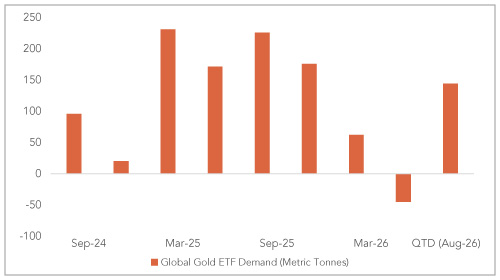
However, the longer-term structural case remains intact, supported by strong central-bank demand, renewed institutional and ETF interest, and growing acceptance of gold as a portfolio diversifier amid fiscal and geopolitical uncertainty. Gold’s over valuation relative to other commodities has also improved. We expect gold to remain under pressure until real yields peak but would view any further weakness as an opportunity to accumulate. For Indian investors, INR depreciation also provides some cushion to gold returns in rupee terms, enhancing its diversification benefits.
Global Gold ETF demand picked up in last two quarters
Source: Bloomberg, Sanctum Wealth
Silver also experienced heightened volatility, following a sharp August rally with a correction as rate-hike concerns resurfaced. Unlike gold, silver faces the additional risk of weaker industrial demand in a growth slowdown, making it more sensitive to both real yields and the dollar. At the same time, structural demand from electrification, data centres and other industrial applications provides a longer-term tailwind, while its relative affordability can support investment demand. We therefore prefer gold as the core precious-metals allocation, with silver as a higher-beta tactical satellite. We would favour accumulating both in stages on weakness rather than chasing rallies, with silver warranting a greater margin of safety given the wider range of potential outcomes.