

Share This

Good News, Wrong Type
Sep 22, 2026
• We like a bit more cash, hence recommend keeping duration shortish;
• We recommend avoiding weaker credit;
• We wouldn’t chase US equities just because they’ve corrected (corporate earnings are still an important cushion; valuations in the US have already moved closer to fair value);
• Asia increasingly has something that the US does not — growth without the same combination of fiscal excess, tightening monetary policy, and extreme foreign ownership concentration.
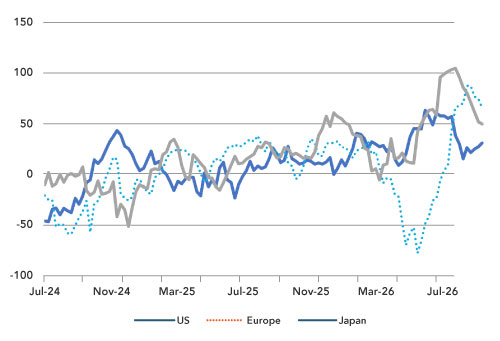
For most of the past two years, investors have been waiting for the global economy to break. Higher interest rates, higher energy prices, the war in the Gulf, and repeated geopolitical shocks should have made that a reality. But the economy continued to show resilience. Economic data, which has remained broadly positive, helped keep the momentum alive despite headwinds. The US economy, for instance, keeps surprising to the upside; Europe is holding up better than many expected; Japan is holding up, too; corporate profits are strong; business investment, especially around technology and AI infrastructure, remains remarkably robust. JP Morgan now expects US GDP growth at a 3.5% annualised rate in the third quarter and has raised its forecast for global growth for the second half of 2026 by half a percentage point since mid-year. US real consumption is also estimated to be expanding at about 3.5% annualised in the current quarter.
While all of this sounds good, we increasingly believe that it’s the wrong sort of good news for financial markets.
Chart 1: Global Economic Surprise Indices – Inflation and Growth
Index
Source: Bloomberg
Echoes of 2006
One thing you learn after more than four decades watching the markets is the assertion “the economy is coping remarkably well with higher interest rates” should always make you slightly nervous, it lasts until something proves it cannot. There’s something particularly uncomfortable about rereading economic commentary from 2006. The parallels aren’t exact (history rarely does), but they are striking.
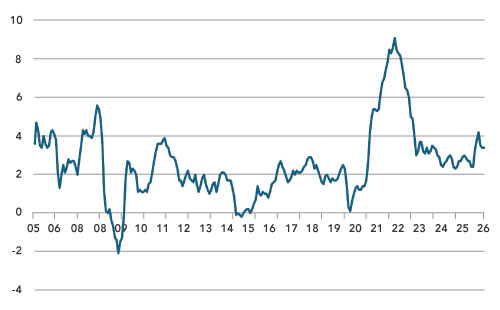
In June 2006, Ben Bernanke, the then Fed chairman, was worried that US core CPI had been running at an annualised rate of 3.2% over the previous three months and core PCE was at 3%. “Unwelcome developments” is how he described the situation. Cut to the present, and those numbers look familiar today — but the point, of course, isn’t just that inflation was around 3% then and is again near those levels; it’s also that the economic environment back then was surprisingly resilient. By September 2006, the IMF had raised its global growth forecast to 5.1% despite tighter financial conditions and expected 2006–07 to be part of the strongest four-year global expansion since the early 1970s. There was a widespread belief the global expansion was broad enough to withstand a US slowdown.
Markets were similarly loose. One of the more memorable contemporary observations was from the ECB’s December 2006 Financial Stability Review: corporate credit and emerging-market debt were “pricing for perfection” even though long-term rates and credit spreads remained remarkably unperturbed by tighter G3 monetary policy. The phrase sounds uncomfortably dated now.
The lesson isn’t that 2027 must replicate 2007. The vulnerabilities this time are different. Housing today is struggling, but it isn’t the systemic financial fault line it was back then — today mortgage underwriting is stronger, household equity cushions are larger, and the banking system isn’t sitting on the same mountain of poorly understood mortgage risk. The real lesson is simpler: an economy can remain healthy while monetary tightening quietly accumulates inside the financial system. Rates don’t have to break the economy immediately to be breaking things underneath it.
Chart 2: Core PCE inflation Moving Closer to Fed’s Target
Source: Bloomberg
A Synchronised Tightening
The historical perspective matters because the Fed’s rate hike last week shouldn’t be viewed in isolation. The more important development is that the global monetary cycle appears to have turned again. September has seen rate hikes from the Fed, the ECB, and the Bank of Japan. JP Morgan identifies three common forces driving the hikes: diminishing tolerance for persistent inflation, growing confidence in the resilience of economic activity, and a recognition among central banks that policy may not have been as restrictive as they initially thought.
For 18 months, investors have been asking when central banks could finally cut. We may instead now need to ask: how high do rates have to go before policy actually becomes restrictive?
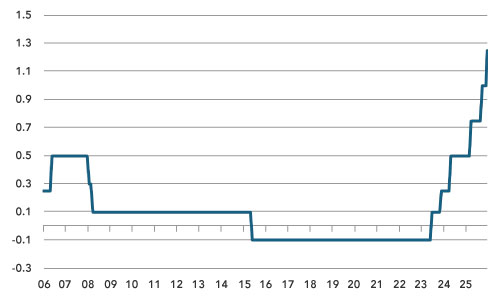
Japan makes the point dramatically. The BoJ’s policy rate now stands at 1.25%, with Governor Ueda asserting the “policy phase has changed.” JP Morgan believes Japanese rates could move beyond 2% next year. The synchronisation matters – higher rates in America alone are one thing, but higher rates simultaneously in the US, Europe, and Japan tighten the global price of capital. Emerging-market central banks then have to respond; exchange rates, capital flows, and refinancing costs all come into play. And yet markets are taking all of this remarkably calmly. Perhaps too calmly.
Chart 3: BoJ raises rates 25bps
Source: Bloomberg
Economic Risk vs Market Risk
There’s an increasingly important distinction between economic risk and market risk. While the economic risk presently looks relatively contained, the market risk looks less comfortable. So far, equity markets have absorbed a Fed rate rise, Treasury yields around 5%, oil above $100, and a major geopolitical conflict with relatively little damage. One can admire that resilience, but one shouldn’t necessarily extrapolate it.
Equities continue to enjoy strong profits, extraordinary technology spending, and still-benign credit conditions, but valuation mathematics eventually comes into the picture. Highly valued, long-duration assets don’t require a recession to fall — they merely require the discount rate to move far enough. That’s why I don’t think the key equity market question over the coming weeks is whether earnings would suddenly collapse. They probably won’t. The question is whether equities can keep tolerating 5% Treasury yields, another phase of tightening, and $100-plus oil without multiples contracting. I remain cautious.
Cracks Beneath Credit
Whenever equity valuations become demanding, I find myself looking towards credit markets, where investors tend to be less romantic. At first sight, credit remains reassuring — spreads are still low by historical standards and there’s no conventional credit crisis. Yet there are interesting noises beneath the surface.
Private credit is worth watching closely. Morgan Stanley’s North Haven Private Income Fund received redemption requests equal to 11.4% of outstanding shares in the third quarter, after 11.6% the previous quarter, while the fund has capped withdrawals at the usual threshold of 5% for a third consecutive quarter. This is not a crisis, but it is worth remembering how financial stress normally begins — rarely through an index declaring itself in trouble. Problems tend to emerge in individual loans, financing structures, liquidity mismatches, and businesses discovering that refinancing at 7–9% bears little resemblance to refinancing at 2%.
Housing: Not the Fault Line This Time
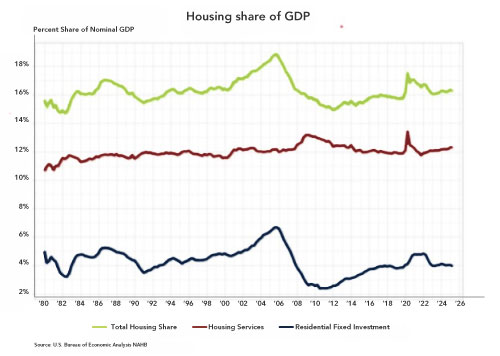
Housing provides a useful reality check. The US market is clearly struggling — mortgage rates around 7% have crushed affordability, transactions remain weak, and homebuilders are leaning on incentives. Lennar’s home-sale gross margin recently fell to 15.8% from 17.5% a year earlier. However, there’s a crucial distinction from 2006: housing today doesn’t appear to be the systemic problem it was back then. So, if something eventually breaks, it may not be housing, which is precisely why investors should resist fighting the last war and look elsewhere: private credit, highly leveraged borrowers, AI-related debt, commercial property, hedge-fund leverage, and market liquidity.
Chart 4: US Housing Much Less of a Problem than 2006
Washington’s Other Weapon
Washington adds another dimension to the ongoing saga. The US midterms matter not just because they influence tax, regulation, and fiscal policy, but also because Congress could ultimately influence the duration of the Iran conflict. Polling swung away from Republicans, and a Democratic sweep of both chambers is a distinct possibility. Our research work this week on congressional war powers made an important point: a hostile Congress can’t simply order troops home because a withdrawal legislation could be vetoed, and overriding that requires two-thirds majority. But Congress has another, more powerful weapon in its armoury—power of the purse. It can keep financing troops, bases, and missile defence while prohibiting spending on designated offensive operations.
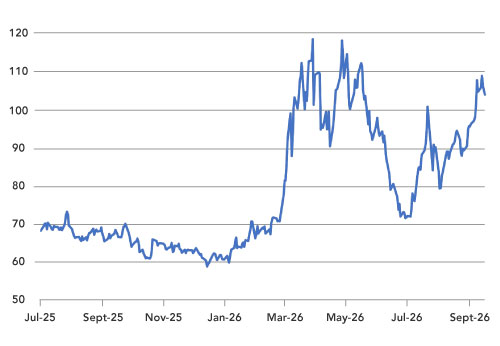
A change in control wouldn’t automatically end the Iran war, but the political clock increasingly matters alongside the military one. Oil markets now have another variable beyond missiles, pipelines, tankers, and the Strait of Hormuz: the November ballot box. Could the Gulf war finish sooner than markets expect? There’s reason to ask, though there’s not yet enough evidence to call peace imminent. Wars often generate their most serious diplomacy when costs become hardest to bear, and America already has an inflation problem. Moreover, the Gulf states want a normalisation of life, Iran is under economic pressure, and China has an energy-security problem. No state escapes indefinitely from $100-plus oil.
Chart 5: Brent Oil still at its Recent Highs
Source: Bloomberg
President Trump and Xi – What’s the substance?
China’s position brings us to what may be the most important meeting this week: Trump hosts Premier Xi Jinping in Washington on 24 September. The temptation will be to focus on the optics — handshakes, photographs, and commentary about who had the upper hand. The substance matters more. Rare earths sit close to the centre of the discussions. America has enormous leverage through semiconductor technology, dollar finance, and sanctions; China has leverage through its dominance of the processing chain for critical minerals used in EVs, electronics, robotics, and defence. For years, we’ve heard semiconductors are the new oil, perhaps rare earths are becoming the new Strait of Hormuz.
China has its own vulnerability too: energy dependence, which ties its relationships with Russia, Iran, the Gulf, and increasingly the US into the broader geopolitical landscape. Trump–Xi increasingly looks like a great barter; America wants reliable mineral access and tech restraint; China desires energy security, continued tech access, and tariff relief. I wouldn’t go as far as saying that settling Iran and Ukraine is imperative at this juncture — foreign policy is rarely that neat — but these issues can no longer be treated in isolation. An escalation that simultaneously restricts critical minerals, constrains energy supply, and intensifies the inflation shock would be a particularly unwelcome outcome for a world where central banks are already tightening.
The Paradox
And yet speculative enthusiasm has continued to persist alongside. Crypto has enjoyed a decent run over the past month. I’m less interested in a directional call on Bitcoin and more in what that rebound tells us: liquidity remains alive, investors are still willing to speculate, equity valuations remain elevated, credit spreads remain tight, corporates are spending heavily, consumers are still consuming — and crypto is rallying even as the Fed raises rates. Central bankers can see exactly the same things, and can reasonably conclude financial conditions still aren’t tight enough to force them to stop.
That’s the paradox confronting investors. The global economy doesn’t presently look like it’s falling into recession — the immediate picture may be healthier than many expected a few months ago. Yet the resilience itself is allowing the price of money to move into territory where vulnerabilities inevitably become more important.
Back to 2006
The resemblance isn’t that housing is about to implode again, or that another Lehman is hiding around the corner, or that economic cycles follow a predetermined timetable. The connection is more subtle: in 2006 the global economy was growing strongly, inflation was proving persistent, energy prices had risen substantially, central banks had implemented tightening measures, credit spreads remained extraordinarily benign, and markets concluded the economy had absorbed the higher cost of money remarkably well. For a while, they were right. The Fed stopped raising rates in June 2006; the US recession didn’t begin until December 2007. The lag was long enough for investors to believe that monetary tightening had largely worked without inflicting serious damage. The confidence didn’t last long.
Perhaps that’s the lesson worth carrying into the closing months of 2026. Resilience in the face of high interest rates isn’t evidence that high interest rates don’t matter. It may simply mean the lag hasn’t yet run its course. History rarely tells us beforehand where the fracture will appear — in 1994 it was leveraged bond positions and Orange County; in 1998, Russia and LTCM; in 2007, mortgage credit the financial system had convinced itself was safely dispersed. Housing today looks considerably less systemically dangerous, so we should resist fighting the last war.
Watch private credit. Watch highly leveraged corporate borrowers. Watch the financing behind the AI capex boom. Watch hedge-fund leverage. Watch Treasury yields. Watch Washington. Watch the Gulf. And next week, watch Trump and Xi.
The global economy is still remarkably healthy. Increasingly, that may be the reason investors should be careful rather than comfortable.