


Share This

Investment Strategy
Sep 11, 2026
• US Treasury borrowing costs likely to stay elevated amid fiscal concerns.
• September Fed rate-hike probability has risen to 60% amid hawkish Fed commentary.
• Indian economy remains resilient despite global headwinds.
• Q1 earnings were better than expected, with no meaningful downgrades to FY27 estimates.
• We remain positive over the medium-to long term, with a preference for large-caps given their stronger margin of safety.
The Price of Money
Six months into the U.S.-Iran conflict, there is still no clear end in sight. The conflict continues to ebb and flow, keeping oil markets volatile and adding to the uncertainty. Renewed U.S. strikes on Iran and attacks on two Saudi supertankers recently pushed Brent crude back toward USD 95 a barrel.
Yet oil was not the biggest concern for markets in August. Global equities held up well, while the real focus shifted to long-dated U.S. Treasury yields, which rose to their highest levels since the Global Financial Crisis. The US Treasury stepped up efforts to contain yields, but the impact proved short-lived.
In India, economic activity remained resilient despite the challenging global backdrop. Q1 FY27 GDP growth surprised on the upside, while corporate earnings showed improvement. Foreign investors also returned to Indian equities, and relative valuations became more supportive. These factors helped drive a strong rebound from the March lows. However, risks remain. India has limited exposure to the global AI investment boom, while elevated oil prices and the ongoing Middle East conflict continue to weigh on the outlook.
Global Macro Update
The U.S. 30-year Treasury yield touched 5.34% in August, its highest level since 2007. Treasury Secretary Scott Bessent responded by doubling planned liquidity-support purchases of long-dated securities from USD 2 billion to at least USD 4 billion per operation. Yields initially fell nearly 10 basis points, but the relief proved short-lived, with yields reversing course within a day.
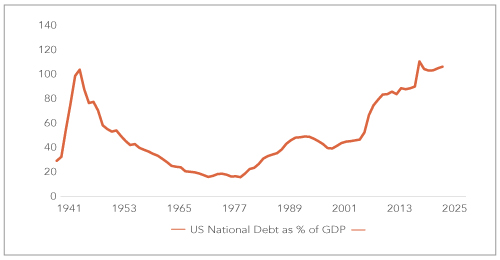
US national debt as % of GDP near all-time high
Source: U.S. Office of Management and Budget
The episode highlights an important distinction: the pressure on Treasury yields appears to be less about liquidity and more about fiscal concerns. There is little sign that investors are unwilling to finance the U.S. as Treasury auctions continue to clear and foreign holdings remain substantial. The deeper concern is the scale and persistence of US borrowing. The fiscal deficit remains around 6% even as the economy grows, with little evidence of meaningful efforts to rein in debt. Investors appear to be demanding a higher term premium to compensate for the growing fiscal risk.
Meanwhile, Fed Chair Warsh adopted a hawkish stance at Jackson Hole, arguing that monetary policy remains insufficiently restrictive, employment is close to full capacity, and underlying inflation remains elevated. The stronger-than-expected labour market data reinforced this cautious stance: August non-farm payrolls increased by 162,000, significantly above the 55,000 consensus, while the unemployment rate remained unchanged at 4.1%. Against this backdrop, markets are now pricing a nearly 60% probability of a 25-basis-point hike at the upcoming September Fed meeting.
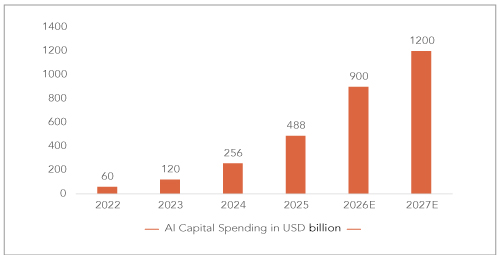
AI remains a key driver of global growth, supported by strong investment, revenue and earnings growth. AI-related investment is expected to reach USD 900 billion this year and could exceed USD 1.2 trillion in 2027. Monetization is also showing signs of progress, with major Hyperscalers reporting average cloud revenue growth of 48% YoY in Q2, ahead of consensus and accelerating from 40% in Q1 and 34% in the final three months of 2025.
AI capital spending to cross USD 1 trillion by 2027
Source: UBS
However, the scale of investment is raising questions about financing and returns. Hyperscalers are increasingly using debt to fund capital expenditure, adding to corporate bond supply at a time when government issuance is already elevated. Higher Treasury borrowing costs therefore also increase the cost of capital for the technology sector. Additionally, concerns about circular financing have resurfaced following Nvidia’s partnership with six major financial institutions to assemble a financing package of more than USD 500 billion for AI infrastructure. These are important risks to watch as the AI investment cycle matures.
For now, strong investment is still translating into strong growth. The key question, however, is whether the current investment cycle can generate sustainable revenues, earnings and productivity gains. With a relatively small group of companies driving hundreds of billions of dollars in spending, the stakes are rising. As long as monetization keeps pace with investment, the momentum is likely to continue. But if returns disappoint, the sheer scale of AI spending could become a growing vulnerability for markets.
Global Market Update
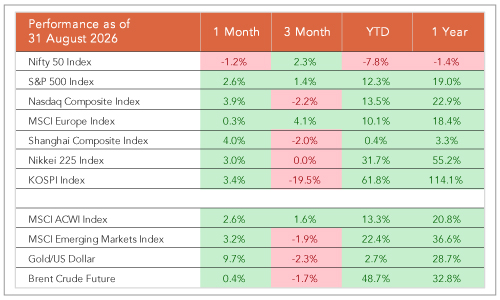
Global equities had a strong August, rising 2.6% and taking Yp returns to 13.3%. Technology sector bounced back after July’s setback, driven by renewed confidence in the AI investment cycle. The rally wasn’t limited to the Nasdaq, with AI-related markets such as China, Korea and Japan also performing strongly. Nvidia’s standout results, with Q2 revenue more than doubling to $96.2bn, were a key driver of renewed confidence in the AI story. While European equities may have received less attention than Korea or Japan, they have also performed well and are not far behind US equities on a one-year basis.
Source: Bloomberg, Sanctum Wealth
Above returns are only price change in local currency terms and not total returns
Strong corporate earnings have provided an important fundamental underpinning for the recent equity rally. In the U.S., S&P 500 underlying Q2 profits grew nearly 35% YoY, the strongest growth in more than four years, with 80% of companies beating estimates by an average of 5.5%. Importantly, median-company earnings growth also remains healthy at around 14%, despite the boost to index-level growth from AI-related technology and higher oil prices.
Earnings momentum is also broadening globally. In Europe, 58% of companies beat Q2, while earnings growth accelerated to 22% YoY. Asia ex-Japan is expected to deliver around 70% earnings growth, although this is heavily concentrated in TSMC, SK Hynix and Samsung. In China, domestic growth remains weak, but progress in semiconductors, AI, EVs and strategic technology localisation provides some support.
Overall, strong earnings have helped sustain elevated global equity valuations, but the market’s growing dependence on AI-related spending is becoming increasingly apparent. A slowdown in AI remains a key risk to equities, although earnings momentum remains supportive for now.
In our international model portfolios, we are slightly reducing our U.S. equity allocation and increasing cash. With the U.S. mid-term elections approaching, political pressure could raise the risk of policy missteps. At the same time, further Fed rate hikes could challenge elevated equity valuations, while keeping rates unchanged could unsettle bond markets. This leaves the Fed with limited room for an easy policy choice. We therefore believe it is prudent to tactically reduce risk and preserve liquidity, giving us flexibility to act if market volatility creates opportunities.
India Macro Update
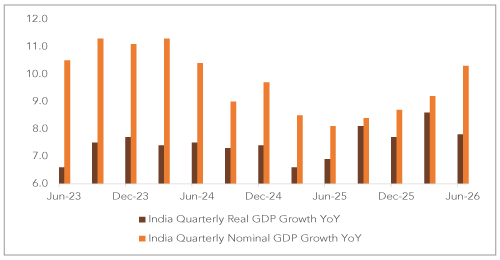
The Indian economy continues to show resilience despite external headwinds. Q1FY27 GDP growth surprised on the upside at 7.8%, well above the RBI’s 7% forecast and market expectations, with both services and manufacturing delivering strong growth. Nominal GDP growth also crossed double digits at 10.3%, versus 8.9% in FY26. High-frequency indicators reinforce this momentum: cumulative Apr–Aug’26 two-wheeler sales grew 18% YoY, while PV and CV volumes rose 28% and 22%, respectively. IIP growth reached a near two-year high of 7.3% in June, led by 7.8% manufacturing growth, while the August manufacturing PMI remained in expansion territory at 52.8.
India’s GDP growth surprised positively
Source: Bloomberg, Sanctum Wealth
Domestic demand remains broad-based, supported by resilient rural consumption and healthy urban passenger vehicle demand. Export orders also continued to expand, although the pace of manufacturing activity moderated in August, as reflected in the manufacturing PMI. The monsoon, however, remains a key watchpoint, with rainfall around 13% below normal through end-August and South India recording a deficit of more than 25%. A significant or uneven rainfall deficit could weigh on rural incomes and consumption in the months ahead.
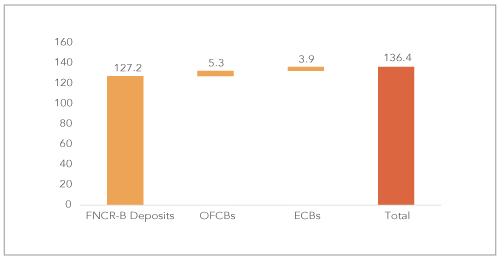
Inflation remains broadly manageable, despite some food-price pressures. CPI inflation edged up to 4.45% in July from 4.38% in June, driven by meat, eggs and spices, while core inflation remained steady at 3.9%. External balances have also shown improvement. Net FDI turned positive at USD 1.3 billion in June, while Q1 FY27 inflows reached USD 7.8 billion, up from USD 4.8 billion a year earlier. Non-resident deposit inflows have also strengthened following the RBI’s June policy measures, with FCNR(B) deposits seeing strong inflows through late August.
RBI’s 2026 scheme has led to USD 136bn in inflows
Source: Bloomberg, Sanctum Wealth
Overall, the economy continues to absorb external shocks without losing momentum. Liquidity has improved, supported by government spending and RBI measures, while the currency and foreign-exchange reserves remain comfortable. Key risks include tariffs, developments in West Asia, uneven monsoon distribution and global rate uncertainty, but none currently appears sufficient to derail the broader growth outlook. The focus now shifts to festive-season demand and whether incoming data allow the RBI to maintain its neutral stance or look at raising rates.
Q1FY27 Earnings
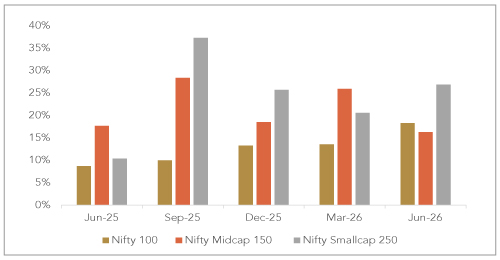
The June quarter delivered a better-than-expected earnings performance, with the recovery broadening beyond financials to metals, consumer discretionary, real estate and telecom. Mid- and small-caps outperformed large-caps on earnings growth, while large-cap earnings were strong. Financials remained the key driver, supported by strong credit growth, benign asset quality and lower provisions.
Earnings momentum continues in Q1FY27 as well
Source: Amsec
Weakness was concentrated in OMCs, aviation, pharmaceuticals and infrastructure, while IT growth remained modest. Autos saw healthy demand, although rising commodity costs weighed on margins. Overall, lower provisions, operating efficiencies and favourable base effects supported profitability, while low-cost inventory helped cushion higher input costs. Margin pressure could become more visible in Q2FY27 as the low-cost inventory buffer exhausts, but management commentary remains confident on passing through higher costs.
Looking ahead, the FY27 earnings outlook remains constructive, with consensus expecting Nifty 50 earnings growth of 14–15% in FY27 and FY28. The absence of meaningful downgrades after Q1 is encouraging, although achieving FY27 estimates requires 16–17% growth over the remaining nine months. The key question is therefore no longer whether earnings are recovering, but whether the momentum can be sustained.
Equity Outlook
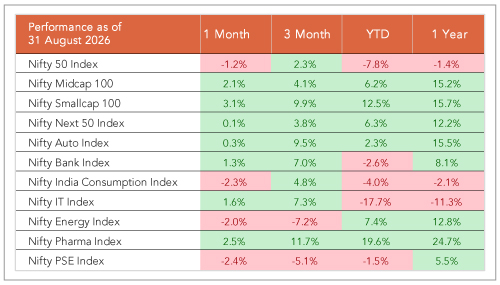
Indian equities edged lower in August, although mid- and small-caps continued to outperform. Over the past year, the Nifty Midcap 100 and Nifty Smallcap 100 have outperformed the Nifty 50 by 16.6% and 17.1%, respectively, while the Nifty Next 50 has outperformed by 13.6%. Energy, consumption and PSE stocks weighed on August returns, while banks, IT and pharma were among the stronger performers.
Source: Bloomberg, Sanctum Wealth
Above returns are only price change and not total returns
Looking ahead, we remain positive on Indian equities over the medium to long term. The economy has remained resilient despite global headwinds, while earnings growth has recovered and overall valuations look more reasonable relative to emerging-market peers and India’s own history, although pockets of the market remain expensive. Domestic flows remain strong, and foreign flows have also turned positive over the past two months.
Within equities, we continue to prefer large-caps, which offer a better margin of safety given improving earnings and more reasonable valuations. Mid- and small-cap earnings growth has been strong, but these segments have also rallied sharply since the March correction, leaving less room for disappointment. The small-cap universe remains broad and highly differentiated, however, creating opportunities for active managers to identify high-quality, high-growth companies at reasonable valuations.
India remains relatively insulated from the global AI investment cycle at the broader market level, although parts of the Indian IT and technology ecosystem have benefited from AI-related spending and are beginning to look expensive. We would therefore remain cautious about excessive exposure to these names. In contrast, more defensive, domestically oriented sectors such as banks continue to offer attractive valuations.
With the corporate earnings season now behind us, the Sanctum Investment Committee will undertake its quarterly asset allocation review. We will discuss the resulting house views and any changes to our positioning in greater detail in our next monthly note.
Fixed Income Outlook
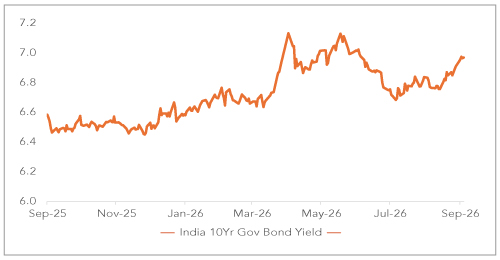
The RBI’s August policy minutes suggest that inflation remains a key consideration for the central bank. Meanwhile, global bond yields moved higher following Fed Chair Kevin Warsh’s hawkish tone at Jackson Hole, adding upward pressure on Indian yields. While CPI inflation remains broadly manageable despite the recent rise in July, higher energy prices and the risk of firmer food inflation amid a below-normal monsoon could become a concern.
Against this backdrop, while Indian bonds may remain relatively insulated from global volatility, we do not believe the potential return from adding duration adequately compensates for the risks. We therefore continue to favour the 3–5-year segment through corporate bond and short-duration funds, rather than taking significant duration risk.
Indian bond yields have also moved up in last few weeks
Source: Bloomberg, Sanctum Wealth
The credit environment remains broadly healthy, supported by low corporate leverage and strong balance sheets. However, elevated crude prices, geopolitical uncertainty and the risk of a deficient monsoon warrant some caution. We continue to favour diversification and high-quality credits rather than reaching for yield without due consideration of credit risk, particularly as the risk-reward across longer-duration and lower-quality credit remains less compelling.
Gold and Silver Outlook
Gold surged 9.7% in August in dollar terms, recovering much of its weakness from earlier months and taking its 12-month gain to 28.7%. The strength of the rally is notable given the backdrop of elevated real yields, which have historically been a headwind for gold. This time, growing concerns around fiscal sustainability and a desire to diversify away from US Treasuries appear to be key drivers. Gold’s safe-haven appeal has benefited from this shift, with central banks and global gold ETFs continuing to see strong demand and inflows.
The pace of the rally has been sharp, leaving room for some near-term consolidation. However, we remain positive on gold over the medium to long term, supported by continued central-bank demand and its role as a diversifier against fiscal and geopolitical risks.
Silver has also rallied from its recent lows, broadly tracking gold. Unlike gold, however, we view silver as a more tactical exposure. Long-term fundamentals remain supportive, particularly given the persistent gap between supply and demand, but silver is significantly more volatile. We therefore prefer to maintain measured exposure rather than chase the rally. At current levels, we continue to hold silver in our asset-allocated portfolios.