

Share This

Macro and Markets Review for August 2026
Sep 3, 2026
August was a good month for risk assets, but not a comfortable one. Global equities rose 2.6%, the US gained 2.7%, technology returned to leadership and emerging markets advanced 3.4%. Gold rose almost 10% and Bitcoin more than 25%. Yet the most important market during the month may have been the bond market, where long-dated US Treasury yields remained close to levels last seen before the Global Financial Crisis.
Two competing stories are now running in parallel. The first is strongly bullish. Artificial intelligence continues to generate extraordinary investment, revenue and earnings growth. Nvidia’s results at the end of the month reinforced the argument that the AI capital spending cycle is measured in years rather than quarters. The second story is considerably less comfortable. Governments, technology companies, defence programmes, electricity grids and energy infrastructure are all competing for capital at the same time. The world has plenty of savings, but the claims on those savings are becoming much larger. The days of exceptionally cheap-long-term money look long gone.
US economic growth continues to hold together, although its composition is becoming increasingly narrow and has showed less momentum than other parts of the world. Consumer spending in particular has disappointed while investment in technology, data centres and AI infrastructure remains extremely strong. July employment fell by 23,000 jobs, retail data softened and real consumer expenditure was essentially unchanged. Business investment is doing much more of the work.
One-dimensional growth is still growth. But it creates greater dependence on a relatively small group of companies continuing to invest hundreds of billions of dollars and eventually generating an adequate commercial return from that investment.
Inflation simultaneously refused to slip back. Headline US PCE inflation remained at 3.7% and core inflation at 3.3%, leaving both measures substantially above the Federal Reserve’s 2% target. Chairman Kevin Warsh used Jackson Hole to challenge the comfortable assumptions about a benign inflation outlook. By month-end, markets were again pricing roughly even odds of a September rate increase.
The US economy therefore enters September with challenges. The labour market is weakening, parts of the consumer economy are slowing and interest-sensitive sectors are already feeling considerable pressure. Yet inflation remains too high for the Fed to declare victory, while technology investment is sufficiently strong to keep aggregate growth respectable. The Federal Reserve has rarely had an easy job. September’s meeting is crucial for setting the tone for the balance of the year.
The Price of Capital Returns
The structural story of August was the competition for capital. Artificial intelligence has become one of the largest private investment programmes in modern economic history. Hyperscaler capital expenditure is expected to approach $750 billion in 2026. Alphabet, Amazon and Meta alone have issued almost $220 billion of bonds this year, more than double their combined issuance in all of 2025.
History offers an encouraging precedent. The technology and telecommunications investment boom of the late 1990s eventually produced enormous productivity gains. Information-processing equipment and software contributed around 0.76 percentage points annually to US GDP growth between 1996 and 2000. However, one important thing was different. The federal government was getting out of the bond market’s way. Federal debt held by the public declined from around 48% of GDP in the early 1990s to approximately 34% by 2000 and the US federal budget moved into surplus. Today, federal debt held by the public is around 100% of GDP and the budget deficit remains close to 6% of GDP despite low unemployment and continued economic growth. Gross federal debt passed $40 trillion during August.
Governments and technology companies are therefore approaching the capital markets together. Add defence spending, electricity grids, energy security, semiconductor manufacturing and the rebuilding of strategic supply chains and the global auction for savings becomes increasingly crowded. Money has a price again.
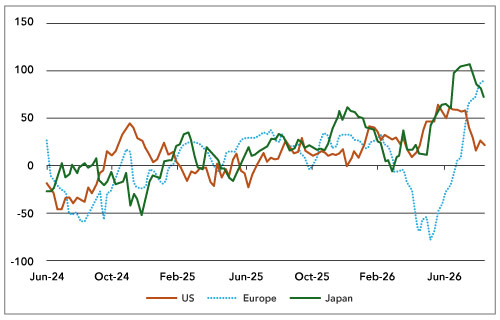
Chart 1: Global Economic Surprise Indices – Growth by country/region
Index
Source: Bloomberg
Washington Meets the Bond Market
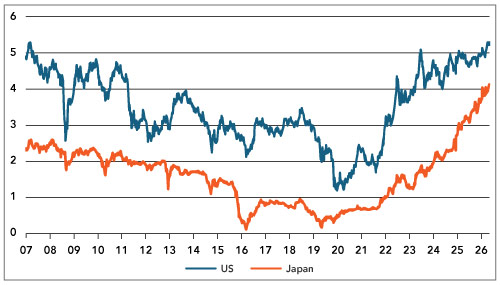
The US 30-year Treasury yield touched 5.34% during August, its highest level since 2007. Treasury Secretary Scott Bessent responded by doubling the maximum size of planned liquidity-support purchases of long-dated securities from $2 billion to at least $4 billion per operation.
Initially the market obliged. Thirty-year yields fell almost ten basis points. The relief lasted barely a day. The episode matters because it separates a liquidity problem from a fiscal one. There is little evidence that investors are refusing to finance the United States. Treasury auctions continue to clear and foreign holdings remain substantial. America can borrow enormous sums of money.
The issue is the price. Treasury has considerable power to manage that price in the short term. It can issue more bills and fewer long bonds, alter the maturity composition of issuance, repurchase less-liquid securities and support market liquidity. Bills now represent roughly 22% of outstanding marketable debt, above the 15–20% range previously regarded as sensible over the medium term.
But shortening issuance does not eliminate debt. It shortens the refinancing cycle. The danger is that debt management begins to resemble yield-curve targeting. America is nowhere close to Japan-style yield-curve control, but investors may reasonably demand a larger term premium if they suspect Treasury issuance decisions are increasingly designed to influence market prices rather than simply finance the government in a regular and predictable manner.
Central banks are now openly braced against inflation rather than growth. The Federal Reserve held at 3.50–3.75% for a fifth consecutive meeting on 29 July, but the vote was 9–3 with three dissents in favour of a quarter-point hike. The statement was again dramatically shorter than the pre-Warsh norm, forward guidance was withheld on the grounds that it is not suited to the current conjuncture, and the Chair insisted there is no soft inflation target while noting that tighter financial conditions are doing some of the Fed’s work. Markets read a hold as a hawkish event: the 30-year yield closed at its highest since 2007 and the Dow had its worst day in more than a year. The ECB can afford to pause with eurozone inflation at 2.8%; the Bank of England is holding with ten-year gilts around 5%; and the Bank of Japan, where a clear majority of economists now expect 1.25% by year-end, found the currency weakness, not the policy rate, forcing its hand at month-end.
The political calendar has become a market variable. The US midterms are now less than 65 days away, with the President’s approval near the lows of his term and the economy, principally prices and petrol, the dominant issue. The administration has a clear incentive to bank a Gulf settlement before November. That cuts both ways for investors: it raises the probability of a deal, and it raises the probability that a deal is announced before it is durable. Equity markets have learned to look through the headlines; bond markets have not, and are probably right not to.
Asset Markets
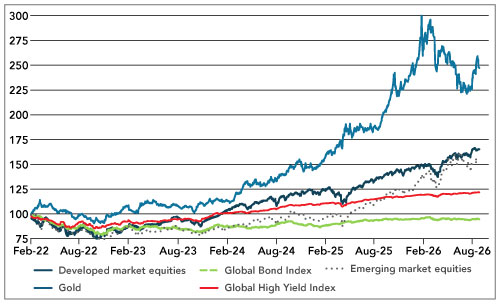
Chart 2: Asset Class Performances
rebased to Jan ’22 =100
Source: Bloomberg
Global Equities
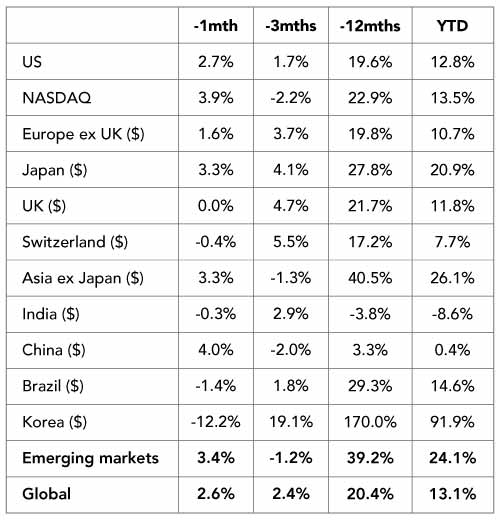
Global equities rose 2.6% in August and are now 13.1% higher year to date. Unlike July, when the global index barely moved and enormous rotation took place beneath the surface, August delivered a broadly positive headline.
The US gained 2.7% and the NASDAQ 3.9%. Technology regained leadership after July’s setback, helped by renewed confidence in the AI investment cycle. Nvidia ended the month having delivered another remarkable set of numbers. Second-quarter revenue more than doubled to $96.2 billion and the company expects revenue growth of around 70% in the year ending January 2028, substantially above previous market expectations.
Asia: Strength, but Concentration Matters
Asia ex Japan gained 3.3% and emerging markets 3.4%, leaving them up 26.1% and 24.1% respectively for the year. Those are substantial returns and continue to challenge the assumption that US equities must automatically dominate every global portfolio.
China rose 4.0%, recovering part of July’s sharp decline, although the market is still only 0.4% higher for the year. Chinese equities remain caught between two stories. Domestic growth has been unconvincing, but China continues to make significant progress in semiconductors, AI, electric vehicles and the localisation of strategic technologies. Investors may eventually have to distinguish between a disappointing Chinese macroeconomy and an increasingly competitive Chinese technology sector.
India fell 0.3% and remains the conspicuous laggard, down 8.6% in dollars this year. Higher oil prices remain a direct pressure on the trade balance, inflation and the rupee, while India lacks the large internationally accessible semiconductor and AI companies that have driven North Asian returns. The long-term demographic and domestic-consumption story remains powerful, but international investors do not buy demographics; they buy listed companies at prevailing valuations.
Korea remained the market’s spectacular outlier. It fell another 12.2% in August but is still up 91.9% year to date and 170% over twelve months. Korea demonstrates both the extraordinary returns available from technological concentration and the risks created by it. A market heavily exposed to semiconductors, retail leverage and a small number of benchmark-dominating companies can turn a global change of opinion into a domestic liquidity event remarkably quickly.
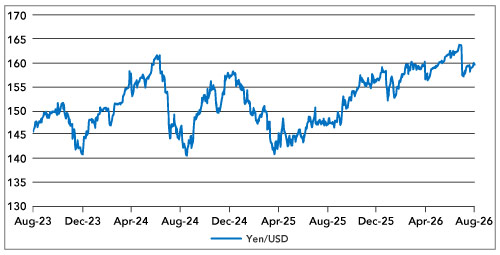
Japan has been the quiet winner gaining 3.3% in dollars and is up 20.9% this year. Corporate reform, improving capital allocation and rising shareholder distributions continue to provide a stronger structural foundation than existed during previous Japanese rallies. The yen gave back 1.5% against the dollar during August after the extraordinary coordinated intervention at the end of July, underlining that currency policy rather than equity fundamentals may remain the more volatile component of the Japanese investment case.
Europe ex UK gained 1.6%, taking the year-to-date return to 10.7%, while the UK was unchanged. Europe continues to benefit from reasonable valuations, industrial recovery and rising defence and infrastructure expenditure. It’s easily forgotten that the European markets have matched the US for returns in USD dollar terms over the past year.
Table 1: Equity Market returns to end August ‘26
Source: Bloomberg
Equity sector performance
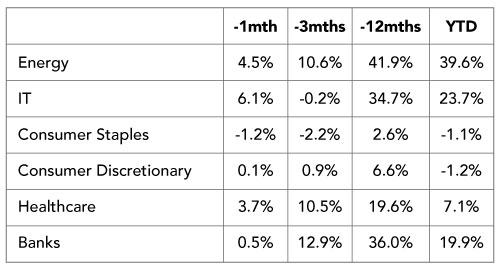
Technology and energy led August. Information technology gained 6.1%, reversing July’s decline, while energy rose 4.5% and has now returned 39.6% year to date. Energy’s performance remains remarkable. What began as an oil-price response has broadened into refining margins, energy security, infrastructure and the recognition that the AI boom itself is enormously energy intensive. Healthcare gained 3.7%, up 10.5% over 3mths, while consumer staples fell 1.2%. Banks rose just 0.5% but remain up almost 20% for the year.
Consumer discretionary remains the conspicuous weak spot, essentially flat in August and down 1.1% year to date. That divergence sits comfortably with the macroeconomic evidence. Corporate investment is booming in selected areas; the average consumer is not.
Table 2: Global Sector Performances in August ‘26
Source: Bloomberg
Bond markets
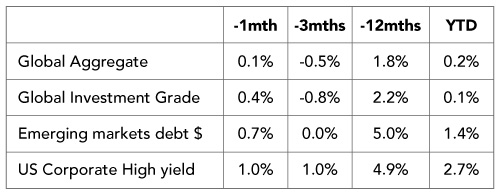
Bond returns were modestly positive despite the drama in Treasury yields. Global aggregate bonds returned 0.1%, global investment-grade credit 0.4%, emerging-market dollar debt 0.7% and US high yield 1.0%.
Again, credit did better than sovereign duration. That has been one of the more interesting features of recent months. Investors are not pricing an imminent corporate default cycle. They are demanding greater compensation for owning long-duration government debt. Rising Treasury yields do not automatically imply a poor economic outlook. They can also reflect unusually strong demand for capital, persistent inflation uncertainty and rapidly rising government supply.
The 30-year Treasury yield moved above 5.3% during the month before easing, while the ten-year yield ended around 4.7%. Jackson Hole pushed the two-year yield higher as investors reconsidered the likelihood of another Federal Reserve tightening.
A long bond somewhere between 5% and 6% changes a great deal even without a recession. Mortgage rates remain elevated, infrastructure becomes more expensive, leveraged private equity transactions require greater returns and the present value of distant corporate earnings falls.
The irony is difficult to miss. America needs enormous technology investment to generate the productivity growth that could make its fiscal arithmetic more manageable. Yet the investment requires enormous amounts of capital. Government is competing for the same capital, and the resulting increase in its price raises the hurdle rate for the technology investment itself.
Chart 3: From East to West 30-year Government Bond Yields at Multi-decade Highs (%)
Source: Bloomberg
Table 3: Bond market returns to end Aug ’26
Source: Bloomberg
FX
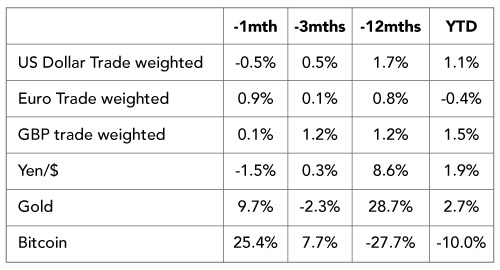
The trade-weighted dollar fell 0.5% in August and is now only 1.1% higher for the year. Given the high level of US yields, the dollar’s inability to strengthen is worth noting. The benign interpretation is that global growth and risk appetite have improved sufficiently to broaden capital flows beyond the United States. The more troubling interpretation is that investors increasingly require higher US yields simply to compensate for fiscal and inflation risk.
A strong dollar alongside high real yields would suggest capital being drawn towards exceptional American returns. A weak dollar alongside rising yields would be a much less comfortable signal.
The yen was another reminder that currency markets are becoming increasingly politicised. Treasury Secretary Scott Bessent appeared willing to lean against further yen weakness, effectively signalling that Washington no longer viewed the exchange rate as Japan’s problem alone, while the Bank of Japan remained comparatively passive. Intervention can punish one-sided positioning and temporarily reverse momentum, but it cannot sustainably overcome a large interest-rate differential. The awkward conclusion is that the US Treasury was trying to influence the price of the yen while the institution with the most direct ability to alter its fundamentals—the Bank of Japan—largely looked on
Chart 4: Yen/$ – a four-decade low, then coordinated intervention
Source: Bloomberg
Gold was altogether less subtle. It surged 9.7%, reversing much of its weakness from earlier in the year, and is now 28.7% higher over twelve months. The move came despite elevated real yields and therefore deserves respect. Fiscal concerns, intervention in bond and currency markets, geopolitical uncertainty and the continuing desire of investors and central banks to diversify reserve assets all provide support.
Bitcoin rose 25.4% during August. Yet even after that extraordinary monthly gain it remains down 10.0% for the year and 27.7% over twelve months.
There remains a tendency to group Bitcoin and gold together as a single “debasement trade”. They are not the same asset. Gold has thousands of years of monetary history, significant central-bank ownership and relatively low technological or regulatory obsolescence risk. Bitcoin remains principally a liquidity-sensitive, high-volatility speculative asset. They can rise together without serving the same purpose in a portfolio.
Table 4: Currencies and precious metals – to end August ‘26
Source: Bloomberg
Commodities
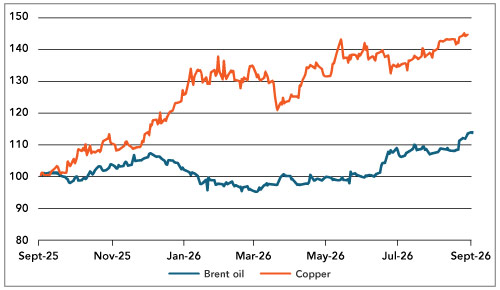
Oil did not repeat July’s 20% surge, but neither did the geopolitical risk disappear. Some shipping through the Strait of Hormuz improved during August, helping Brent retreat towards the high-$80s by month-end. Yet the conflict with Iran remains unresolved and hostilities flared again at the end of the month.
Copper deserves attention because its August rally was more than a traditional signal of stronger global growth. Prices moved close to record highs, with LME copper reaching around $14,300 a tonne and US futures setting new records. Part of the move reflects genuine structural demand from electricity grids, data centres and AI infrastructure, while mine disruption in Chile and smelter problems elsewhere have constrained supply. But policy has distorted the market too: the prospect of future US tariffs on refined copper has pulled extraordinary volumes of metal into American warehouses, leaving inventories abundant in the US while tightening availability elsewhere. In that sense copper fits August’s broader theme rather well — governments, AI and infrastructure are all competing for the same finite physical and financial resources, and the price is rising accordingly.
Chart 5: Oil and Copper prices (rebased to -1Y=100)
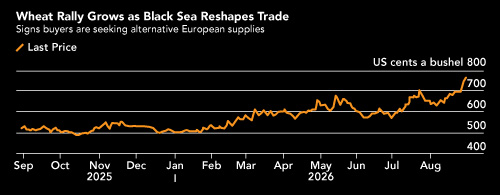
Energy risk has broadened beyond crude oil. Ukrainian attacks on Russian refineries have disrupted production and contributed to restrictions on Russian diesel exports. Diesel refining margins rose sharply as a result. Freight, insurance and refined-product availability remain potential transmission mechanisms from geopolitics into broader inflation. The Ukraine- Russia conflict also impacted the soft commodity markets with Wheat prices up sharply.
Bottom line
August strengthened the bull case and the bear case at the same time.
The bull case is straightforward. Global equities rose 2.6%, US equities 2.7% and technology 6.1%. Nvidia demonstrated again that the AI investment boom remains extraordinarily powerful. Corporate earnings are strong, major technology companies continue to invest and the US economy is still growing despite weakness in parts of the consumer sector. Emerging markets are up 24.1% this year and Japan more than 20%. There is no global earnings recession.
The more difficult story is the price being paid for that growth. The US government is running a deficit close to 6% of GDP while gross debt has passed $40 trillion. Technology companies are embarking on one of the largest private investment programs in history. Defence, energy security, grids and strategic manufacturing all require capital at the same time. Inflation still exceeds the target and geopolitical disruption continues to threaten energy supply. That combination does not necessarily lead to a crisis. It may produce something more mundane and ultimately more important to investors: structurally higher long-term interest rates.
The investment implications remain fairly clear. Long-duration government bonds are less attractive than they were in the world of excess savings and quantitative easing. High-quality corporate credit can outperform sovereign duration. In the stock market, companies able to fund growth from their own cash flow should be more attractive than companies that depend on coming back to the capital markets constantly. Investors are now more and more challenged to discern between high technology and ordinary financial balance sheet arithmetic in AI.
September begins with markets still willing to pay for growth. Nvidia has given them good reason to do so. But the bond market is sending a different signal. Growth is not free; government borrowing is not free and capital itself is no longer free. Investors worried for much of the past forty years about where all that excess capital would go. The next decade may have the opposite problem. Everyone wants it.