


Share This

Investment Strategy
Jul 14, 2026
• The reopening of the Strait of Hormuz has eased a key geopolitical overhang.
• India’s macro outlook is improving, supported by lower energy prices, a stable rupee, and progress on US–India trade talks.
• Earnings growth will be the key market driver, with Q1 weakness likely to be temporary.
• We remain overweight Indian equities, supported by improving fundamentals and resilient domestic inflows.
• We retain a large-cap bias as mid- and small-caps have rebounded sharply from March lows.
• In fixed income, we prefer short-duration bonds over duration risk.
Let’s Move On
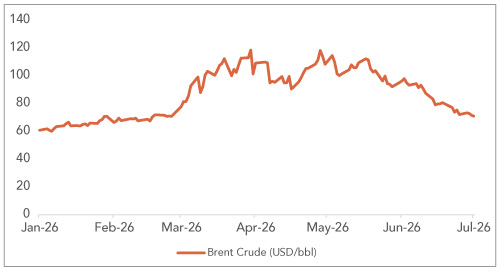
The US-Iran peace agreement and the reopening of the Strait of Hormuz have removed a key overhang for the global economy and financial markets. With shipping resuming through the Strait, energy risks have eased, and Brent crude has retreated from its conflict peak of around USD 120/bbl to nearly USD 70/bbl, close to pre-conflict levels.
Crude prices nearly back to pre-war levels
Source: Bloomberg, Sanctum Wealth
At the same time, a more hawkish Fed under its new chair has increased scrutiny of elevated equity valuations and debt-funded AI capex. Despite this, AI infrastructure investment remains the largest driver of global earnings growth and, by extension, global equity market returns.
For India, the worst of the macro headwinds appears to be behind us. Energy prices have eased, progress on the US–India trade deal continues, and the INR has begun to stabilise. As a result, the market’s focus is likely to shift back to corporate earnings. Following an improvement over the past two quarters, the sustainability of earnings growth will be the key factor investors monitor. While India has largely been overlooked amid the global AI trade, any sustained moderation in AI-driven market leadership could renew global investor interest in Indian equities. Hence, we remain overweight Indian equities.
Global Macro Update
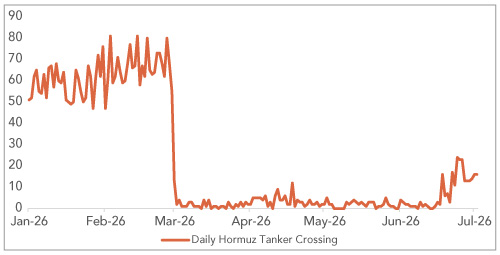
The interim US–Iran peace agreement has led to the gradual reopening of the Strait of Hormuz. While shipping volumes remain below pre-conflict levels, the resumption of traffic has eased concerns over energy supply disruptions and elevated oil prices. The resulting decline in crude prices should reduce pressure on inflation, current accounts, corporate input costs, and central banks. However, the path to a durable agreement remains uncertain, and geopolitical volatility is likely to persist.
Strait of Hormuz gradually opening up
Source: Bloomberg, Sanctum Wealth
The Fed, under its new Chair Kevin Warsh, kept policy rates unchanged as expected but struck a distinctly hawkish tone. Warsh reaffirmed the Fed’s commitment to returning inflation to its 2% target and signalled a shift away from forward guidance in favour of a data-dependent approach. While he refrained from publishing his own rate projections, the updated dot plot points to one rate hike by year-end. Markets have responded by raising the probability of one hike to around 75%, from around 50% before the meeting.
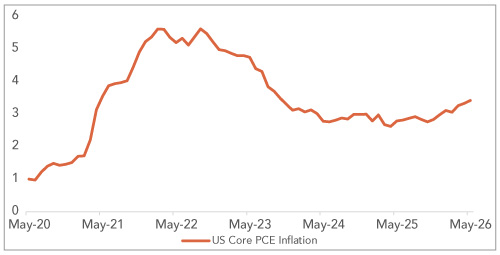
That said, a sharp decline in oil prices and a weaker-than-expected U.S. labour market have tempered expectations of further tightening. June non-farm payrolls rose by just 57,000, well below the consensus forecast of 115,000, reinforcing hopes that a softer labour market could allow the Fed to remain on hold. Although core PCE inflation accelerated to 3.4% y/y in May, its highest level since late 2023, lower energy prices are expected to provide a disinflationary offset, giving policymakers greater flexibility even as they remain cautious.
U.S. inflation above Fed’s target rate
Source: Bloomberg, Sanctum Wealth
The uncertainty around the Fed’s policy path has, in turn, brought the global AI trade under greater scrutiny. The Nasdaq 100, South Korean, and Taiwanese equities have experienced heightened volatility, with Korea’s KOSPI witnessing several 5%+ daily declines followed by equally sharp rebounds. Higher interest rates pose a double challenge for the AI investment cycle: they put elevated valuations and the scale of AI capex under greater scrutiny, while also increasing financing costs as an increasing share of AI infrastructure investment is funded through debt.
AI investment also presents a policy dilemma for central banks. In the near term, the scale of AI infrastructure spending is inflationary as it competes for scarce resources such as power, skilled labour, semiconductors, and electrical equipment. Over time, however, AI-driven productivity gains should prove disinflationary by lowering production costs and improving efficiency across the economy.
Meanwhile, other major central banks, including the ECB and the BOJ, have already tightened policy in response to higher energy prices. However, with oil prices now retreating and inflationary pressures beginning to ease, the path for global monetary policy will increasingly depend on whether this disinflationary trend proves durable.
Global Market Update
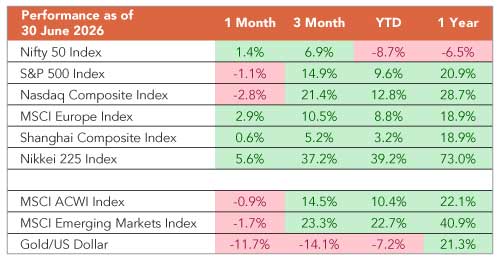
Global equities posted their strongest quarter since 2020, although recent weakness has tempered some of the rally’s momentum. Gains were broad-based across developed markets, with the U.S., Europe and Japan all contributing, but emerging markets remained the standout performers. Technology continued to drive returns, extending well beyond U.S. mega-cap names, as South Korea, Taiwan and Japan led the sector higher. Notably, the Mag-7 have lagged the broader technology sector both during the quarter and year to date.
Source: Bloomberg, Sanctum Wealth
Above returns are only price change in local currency terms and not total returns
Looking ahead, U.S. equities remain supported by resilient earnings and the strength of the technology sector, but leadership is beginning to broaden. With markets already pricing in exceptional growth, margins and capital discipline, the scope for positive surprises is narrowing, reinforcing the case for greater geographic diversification.
Europe is gradually attracting renewed investor interest. While structural challenges persist and earnings growth may remain subdued, modest expectations provide a more favourable starting point for returns.
Japan continues to stand out, underpinned by corporate reform, stronger capital discipline, improving nominal growth and a healthier inflation backdrop. The investment case extends well beyond technology, reflecting a broader transformation in corporate Japan.
Elsewhere, South Korea and Taiwan remain key beneficiaries of the AI infrastructure cycle, with earnings continuing to support market performance. Both markets remain highly sensitive to the broader AI investment cycle. Any moderation in AI spending or sentiment could weigh on returns, as seen during the June pullback. Hence, while we continue to hold a small position in South Korea in our international model portfolio, but we have reduced it by half and remain vigilant about the AI narrative.
Across emerging markets, performance is increasingly bifurcated. AI-driven markets such as South Korea and Taiwan have led returns, while China and India have lagged. China’s technology sector offers pockets of opportunity, but weak confidence in the broader economic recovery is likely to keep the wider market constrained.
India Macro Update
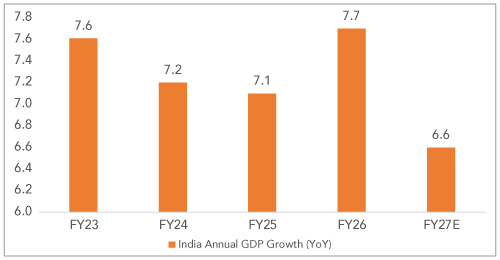
India’s FY26 GDP growth of 7.7% exceeded expectations, driven by a broad-based recovery in domestic demand, with private consumption and investment leading the expansion alongside a rebound in government spending. Only one month of disruption from the West Asia conflict also helped the outcome. Looking ahead, growth is expected to moderate towards 6.5–6.7% in FY27 as the economy faces a high base, headwinds from elevated energy prices, ongoing supply chain adjustments and the risk of a weaker monsoon amid El Nino which could weigh on rural demand and food inflation.
FY26 GDP growth exceeds expectations
Source: Bloomberg, Sanctum Wealth
Despite headwinds, high-frequency indicators continue to point to a resilient economy. Manufacturing and Services PMI moderated slightly but remained firmly in expansion at 54.2 and 57.3, respectively, in June, while infrastructure ordering rebounded sharply, signalling a recovery in the capex cycle. Credit growth accelerated to 17.7% YoY, reflecting healthy loan demand despite tighter banking system liquidity. Consumption also remained robust, led by passenger vehicle sales, which rose 27.8% YoY in June, although other discretionary spending indicators softened modestly.
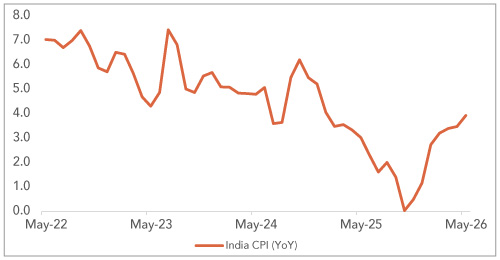
Inflationary pressures are beginning to build, with CPI inflation rising to 3.9% in May from 3.5% in April as higher fuel prices started filtering through to consumers. Producer price inflation accelerated more sharply, with WPI rising to 9.7% from 8.3%, driven by a 30% surge in fuel and power costs, although much of the increase has yet to be fully passed on to consumers. With oil prices having since retreated, the RBI is likely to look through this near-term inflation spike. After revising its FY27 inflation forecast higher to 5.1% from 4.6%, the central bank is expected to remain data dependent. While the rate-cutting cycle appears to be firmly over, the case for policy tightening remains uncertain.
Higher energy prices feeding into inflation
Source: Bloomberg, Sanctum Wealth
Indian Market Update
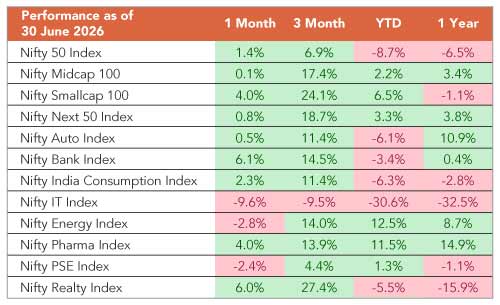
Indian equities have presented a mixed picture over the past month, with large-cap stocks correcting while mid- and small-caps continued to rally, reinforcing the broadening of market leadership. The Nifty Next 50 has outperformed the Nifty 50 by more than 12.5% year-to-date. The Nifty’s relative weakness has been driven largely by its two biggest sectors: banks, where sustained FII selling has overshadowed solid earnings, and IT, where investors continue to reassess the sector’s long-term outlook amid the rise of AI.
Source: Bloomberg, Sanctum Wealth
Above returns are only price change and not total returns
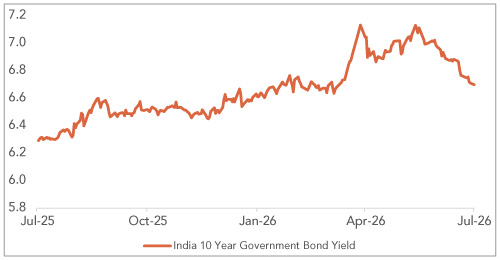
Ahead of the last RBI policy, markets had begun to worry that INR pressure and India’s balance-of-payments position could force the central bank into hiking despite a slowing growth backdrop. Instead, the RBI held rates and announced a package of currency-support measures, which helped ease those fears and supported a decline in bond yields.
Bond yields have declined post RBI policy
Source: Bloomberg, Sanctum Wealth
Quarterly Asset Pair Review
Each quarter, the Sanctum Investment Committee reviews a broad set of macroeconomic, market and valuation indicators to determine the most attractive opportunities across asset classes. These views guide our tactical asset allocation. At our latest meeting, we reaffirmed an overweight stance on equities with a preference for large-cap stocks. We also expect the INR to appreciate modestly from current levels and continue to favour gold as a strategic long-term allocation.
INR Outlook
Stable to appreciation bias
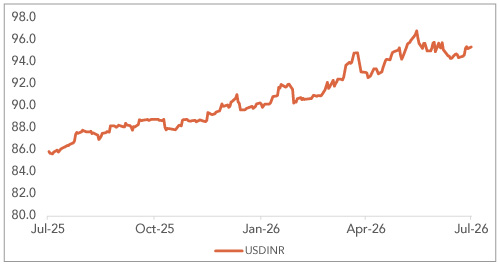
We begin with the rupee, as its weakness had become a key impediment to foreign capital flows into India. Following its sharp depreciation over recent months, the rupee now appears significantly undervalued on a real effective exchange rate (REER) basis. Measures introduced by the RBI, coupled with lower energy prices, have helped stabilise the currency, while foreign inflows into Indian debt have begun to recover.
INR has stabilised after sharp depreciation
Source: Bloomberg, Sanctum Wealth
Having already recovered from its recent lows, the rupee is likely to remain range-bound in the near term, with risks skewed towards appreciation. Renewed foreign portfolio inflows, particularly into equities, together with a softer US dollar as geopolitical uncertainties ease, could reinforce this positive bias. A more stable rupee would, in turn, remove an important hurdle to the return of foreign capital into Indian markets.
Equity Outlook
Overweight equities with large-cap bias
With global macro headwinds beginning to ease, investor focus has shifted back to India’s domestic fundamentals. The economy has remained resilient despite elevated energy prices and an uncertain external environment, while corporate earnings have improved over the past two quarters. Consensus now expects earnings growth to accelerate into the mid-teens in FY27, supported by a recovery in consumption, easing cost pressures and improving profitability. Although the recent West Asia conflict could weigh on Q1 FY27 earnings through higher crude prices, markets are likely to look through any near-term disruption unless geopolitical tensions escalate materially. The key for Indian equities will be whether this earnings recovery proves durable, especially as strong earnings growth across global markets continues to raise the bar for relative performance.
Modest return since the September 2024 peak has led to normalisation of valuations across the market. Nifty 50 valuations are now marginally below their long-term averages, while mid- and small-cap valuations have also cooled and are only modestly above historical norms. Beneath the index, the reset has been even more pronounced in select sectors such as private banks and IT, where valuation multiples have corrected meaningfully.
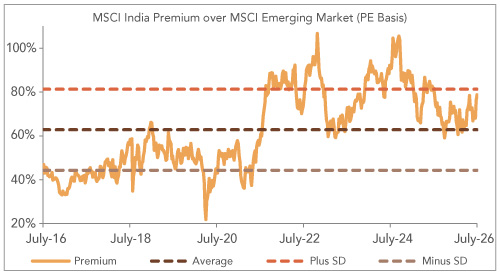
India’s premium to emerging markets has also narrowed considerably after underperforming the broader EM basket by nearly 50% in USD terms. Admittedly, stronger earnings growth across several emerging markets has justified part of this divergence, and India continues to trade at a valuation premium. However, that premium has reverted much closer to its historical average. More importantly, India’s equity market is far broader and more diversified than markets such as Taiwan or South Korea, making comparisons based purely on valuation multiples somewhat simplistic.
India’s relative premium to EM has moderated
Source: Bloomberg, Sanctum Wealth
Despite the improvement in valuations, foreign investors have remained cautious and are yet to return in a meaningful way, even as the rupee has stabilised and concerns around energy prices have eased. The difference this time, however, is that the market is no longer as reliant on foreign capital as it once was. Domestic inflows have remained remarkably resilient, with SIP contributions continuing at around ₹30,000 crore a month despite a period of relatively modest returns. The steady stream of household savings into equities has provided an important cushion. In this backdrop, India does not necessarily need a strong revival in FPI buying to sustain the market. A moderation in selling, coupled with continued strength in domestic inflows, may itself be sufficient to keep the market well supported.
Overall, we believe the worst is behind Indian equities. The combination of more reasonable valuations, an improving earnings outlook and resilient domestic inflows reinforces our overweight stance on the market. Within equities, we continue to favour a modest large-cap bias. While mid-caps are still expected to deliver faster earnings growth, the gap in earnings expectations between large- and mid-caps has narrowed, whereas the valuation gap remains relatively wide, making the risk-reward more favourable for large-caps.
That said, we believe the opportunity set is increasingly driven by stock and sector selection rather than market-cap allocation alone. Attractive opportunities exist across the market-cap spectrum, but dispersion in earnings and valuations has increased, making active management more important. We therefore continue to recommend maintaining exposure to mid- and small-cap equities through skilled active managers, who are better positioned to identify companies with sustainable earnings growth and reasonable valuations.
Fixed Income Outlook
Credit spreads attractive
Indian fixed income markets have become more constructive after a challenging period marked by rupee weakness, foreign outflows and concerns that the RBI may need to raise interest rates to support the currency. Coordinated measures by the government and the RBI, including the subsidised FCNR deposit scheme and tax exemptions on government bonds for foreign portfolio investors, have helped stabilise the rupee and improve foreign flows into the Indian government bond market. Policymakers have also demonstrated their willingness to take further action if required, providing an additional layer of confidence.
The external environment has also improved. The easing of geopolitical tensions and moderation in crude oil prices have reduced pressure on India’s external balances, although energy prices remain an important risk to monitor given the country’s dependence on imports.
Domestically, inflation continues to warrant close attention, but expectations of an imminent RBI rate hike have receded. The central bank is likely to remain data dependent, with inflation, the progress of the monsoon and commodity prices guiding future policy decisions. As rate hike expectations have moderated, bond yields have eased. While there may be some room for further moderation, we believe the opportunity to generate meaningful excess returns through duration is now relatively limited.
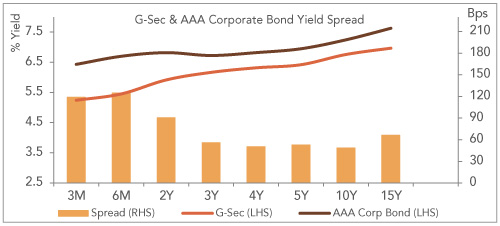
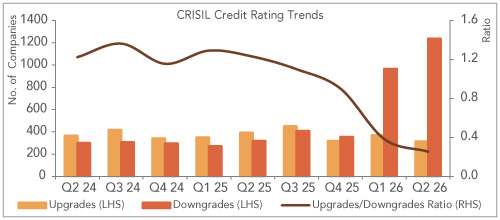
Against this backdrop, corporate bonds offer a more attractive opportunity. Credit spreads remain appealing, particularly at the shorter end of the yield curve. Although credit downgrades increased over the past two quarters, these were largely driven by the unexpected energy shock. With those pressures beginning to ease, we believe investors should continue to focus on accrual strategies through high-quality corporate bonds.
Corporate credit spreads most attractive at the short-end
Source: Bloomberg, Sanctum Wealth
Credit rating trends a concern, but could be one-off
Source: Bloomberg, Sanctum Wealth
For investors with shorter investment horizons, money market funds remain our preferred choice. Although portfolio yields have moderated following recent RBI policy actions, they continue to offer an attractive balance of yield and liquidity and are likely to outperform liquid funds. For investors with a longer investment horizon, short-duration and corporate bond funds remain well positioned to benefit from attractive carry while maintaining relatively low-interest rate risk.
Gold and Silver Outlook
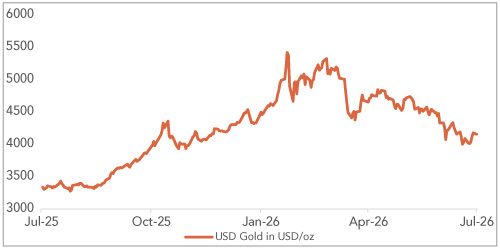
Gold has corrected significantly from its recent peak, easing concerns around extreme valuations to some extent. While the pullback has reduced some of the excess, gold continues to trade at a premium relative to other commodities following its strong multi-year rally. Positioning has also become less crowded, with speculative interest moderating, a key factor behind the recent consolidation.
Gold has come off significantly from its Jan peak
Source: Bloomberg, Sanctum Wealth
Looking ahead, the medium-term structural case for gold remains intact. Persistent central bank buying continues to provide strong underlying support, while gold’s role as a long-term portfolio diversifier and inflation hedge remains relevant despite its recent disconnect with inflation trends. Technical indicators suggest that much of the near-term correction has already played out. However, with the Indian rupee expected to remain stable or strengthen modestly against the US dollar, INR-denominated gold returns are likely to be more muted.
Silver has broadly tracked gold but with greater price sensitivity. Following the recent correction, its risk-reward profile appears relatively more attractive on technical parameters. Accordingly, we are modestly reducing our gold allocation and initiating a small tactical allocation to silver in our model portfolios.
Sanctum Multi-Asset Portfolios
We manage our multi-asset portfolios known as SMAPS, which reflect our tactical asset allocation decisions across three profiles: Shield (conservative), Enhancement (balanced), and Generation (aggressive).
Over the past few months, we have incrementally increased our equity allocation. In April, we added exposure to the MidSmall Momentum Quality Index following the correction in mid- and small-cap stocks, a position that has since benefited from the subsequent recovery. We continue to maintain a tactical overweight in Nifty Private Banks, where valuations are attractive and could benefit from a sustained return of FPI flows. Our tactical allocation to the Nifty Commodities Index has also delivered positive performance, offering indirect exposure to the commodity upcycle.
Within commodities that we can allocate to, we have modestly reduced our gold allocation and initiated a small tactical position in silver, reflecting its relatively more attractive near-term risk-reward profile. Our overweight on gold has led to some underperformance in the near-term but over longer time horizon its has been a major contributor.
We have fully exited our REIT and InvIT allocations in favour of tax-efficient debt-oriented funds, which offer relatively stable post-tax returns of 7–8% with lower volatility. While we do not anticipate a sharp correction in REITs and InvITs, we believe the strong returns delivered over the past few years are unlikely to be sustained. At current valuations, the tax-efficient debt-oriented strategies offer a more attractive risk-reward profile.
All our portfolios have delivered strong risk-adjusted performance across investment horizons, with lower drawdowns and reduced volatility. Despite a challenging backdrop for Indian equities over the past 12–24 months, our strategies have continued to generate near-double-digit returns across investment approaches. Here is an update on the performance of our three multi-asset portfolio strategies:
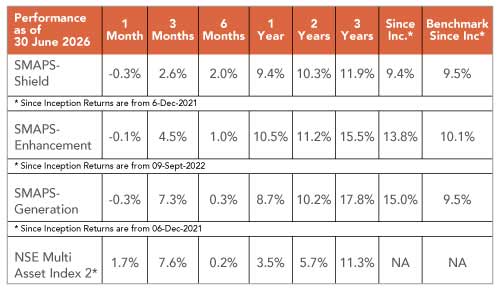
Performance is calculated using Time Weighted Returns, net of fees and expenses. Returns over one year are compounded annually; returns for less than one year are absolute. Please note that SEBI does not verify the performance information provided above. Please note that past performance is not a guarantee of future performance.
NSE Multi Asset Index 2 composition is 50% Nifty 500, 20% Nifty 50 Arbitrage, 20% Nifty Medium Duration Debt Index, 10% Nifty REITs and InVITs