


Share This

When the Tech Growth Story Meets the Bond Market
Aug 31, 2026
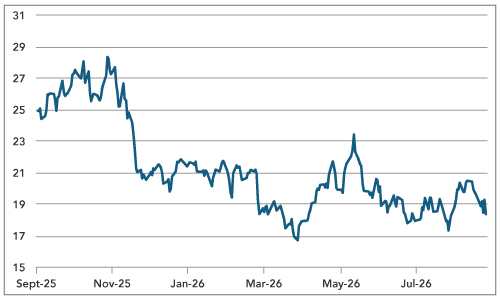
Two forces pushed markets in opposite directions last week. Nvidia’s quarterly results provided a fantastic boost to the AI investment theme. Meanwhile, Federal Reserve Chairman Kevin Warsh sounded cautious on inflation, saying it was still too high and suggesting that interest rates needed to rise. Nvidia encapsulates the bull market. The chipmaker delivered almost everything that the equity bulls wanted. However, it was telling that the stock ended the week up just 0.8%. Nvidia said it expects revenue to grow by about 70% in the year ending January 2028—significantly above the market’s anticipated 44%. Nvidia’s second-quarter revenue more than doubled to $96.2 billion, and its latest collaboration with Amazon will see it bring two million GPUs to market by 2028. Nvidia’s valuation is starting to resemble a bank rather than a tech stock – and indeed it is, as it increasingly acts as a lending bank to many of its customers.
Nvidia is at the core of the bullish story for a large proportion of the stock market. Orders remain strong, analysts’ revenue expectations have risen substantially, and the AI investment cycle appears to be years rather than months long. However, while the market enjoys the tech growth story, it cannot brush aside inflation. Nvidia has told some of its biggest customers that the prices of some server systems containing its top-end chips will rise by more than 15%. The companies expect the systems delivered early next year to cost more, as sharply higher memory costs weigh on prices. AI computing is clearly becoming more expensive and a source of whole-economy inflation. Such pricing power is excellent news for Nvidia, but it could be one aspect of the broader inflation problem that the Fed will be worried about.
Chart 1: Nvidia’s Valuation Slips Lower Despite Good Earnings News
Nvidia forward PE mulitple
Source: Bloomberg
One-Dimensional Growth is Still Growth
US economic growth is beginning to look increasingly one-dimensional. Technology investment remains strong while many consumer-facing and interest rate-sensitive parts of the economy are losing momentum. Real consumer expenditure was essentially unchanged in July, but business investment, particularly in technology and AI infrastructure, is still driving aggregate GDP. One-dimensional growth is still growth, but its concentration means that the economy and equity market depend on a relatively smaller number of companies still investing at a remarkable rate. The old Magnificent Seven story meant that ownership of almost any leading technology platform was possible. The Magnificent Seven label was once shorthand for exposure to AI via any leading technology platform. As the growing excitement around AI extended to semiconductors, cloud computing, data centres, and software companies, the group ballooned to 10 or 15 names. However, investors are now increasingly distinguishing between individual companies, sectors, and subsectors. They want to see orders, margins, cash flow, and evidence that AI expenditure is making a commercial return.
The broader market, meanwhile, had a rough week, with the tech-heavy Nasdaq gaining 0.8% and the S&P 500 rising 0.5%, driven by a nearly 2% rise in the tech sector. The small-cap Russell 2000, however, ended the week down about 1.3%, while healthcare and energy dropped more than 2%.
The Bond Market Sets the Price of Growth
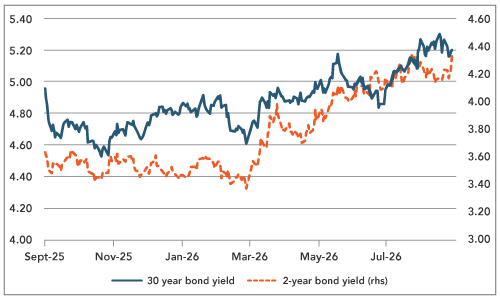
As growing bond issuance defy analyst estimates and inflation persists, the bond market is struggling to find its way. Last week’s inflation numbers were not good. The US headline PCE inflation remains at 3.7%, with core inflation at 3.3%. Both are uncomfortably far above the Fed’s 2% target. Kevin Warsh’s Jackson Hole speech raised the likelihood of an interest rate hike in September to about 56% from 35%. The two-year Treasury yield rose to 4.36% and the 10-year yield to 4.73%. While the tech sector would have appreciated Nvidia’s stellar numbers in the past, the dynamics have changed now. Strong revenue growth now implies significantly higher spending, which implies higher cash deficits and more corporate debt issuance. Bond markets are now in fear of the tech sector given its insatiable appetite for fudnign from the bond market. How much the tech sector’s need for funding push up bond yields is open to debate but I think the direction of travel is agreed.
Chart 2: Bessent May Hold the 30-year in Check but not the 2-year Treasury
Source: Bloomberg
Central Bank Credibility is Back in the Market
The Fed will have an uncomfortable choice. Rising rates are putting pressure on housing, smaller firms, and consumer groups not only for the money but for the economy. The more the Fed remains on the sidelines, the more it undermines its credibility; and if inflation remains persistently above target, its credibility takes an even bigger hit. At the annual conference of global central bankers at Jackson Hole, Warsh didn’t predict an imminent rate hike, but he did shatter the comfortable market assumption that the Fed’s next big move would be down, noting also, in the same breath, that financial conditions were not very strict. The Fed is unlikely to give technology shares or the bond market a free pass just because the aggregate economy is growing. The problem is complicated by the US Treasury’s effort under former hedge fund currency market antagonist Scott Bessent to influence longer-term borrowing costs through greater bond buybacks and other interventions. European central bankers left Jackson Hole concerned about unilateral US Treasury operations, political meddling in financial markets, and the future predictability of traditional international arrangements.
Midterms Move Into Market Time
Politics is adding another layer of uncertainty to the rate outlook. The US midterm elections are now at the forefront, and opinion polls show rising support for the Democrats. Prediction markets currently peg the Democrats’ chances of winning the House at about 89%, and the Senate at about 51%. Democratic control of both houses is now a realistic possibility. And it matters more than the probabilities. The Democratic chances of winning both chambers have consistently risen over the past month or so. A Democratic sweep would also limit the administration in its final two years. Congressional investigations, budget disputes, and legislative gridlock could intensify. Markets may welcome gridlock because it slows down radical policy. But gridlock is far less comforting when the government must come together on budgets and debt issuance and take urgent fiscal decisions.
Canada Looks Across the Atlantic
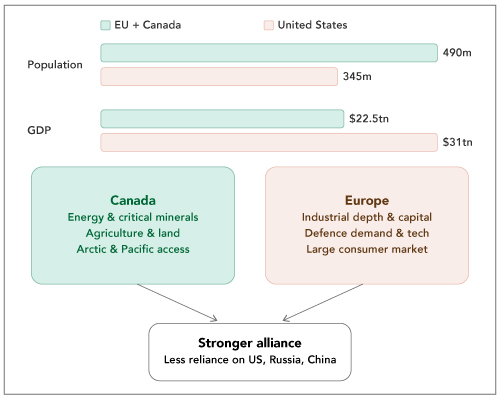
Trade tensions are reshaping alliances outside of the US as well. The collapse of US-Canada trade talks might ultimately prove more historic in favour of a stronger realignment of Canada with Europe. The United States has slapped 50% tariffs on roughly $20 billion of Canadian products, and Canada is preparing for dollar-for-dollar retaliation. Prime Minister Mark Carney is aware the old relationship with the US is now a thing of the past and is looking to build stronger trade, security, and investment ties with Europe. Carney is due to address the European Parliament in September. Canada has already joined the European Union’s Security Action for Europe initiative and wants to double its non-US exports in the next decade. Together, the European Union and Canada have a population of approximately 490 million, compared with about 345 million in the United States. Their combined nominal GDP is roughly $22–23 trillion, against approximately $30–31 trillion for the US. The attraction lies less in simply adding together two sets of GDP numbers than in the complementary nature of the economies. Canada possesses energy, critical minerals, agricultural capacity, land, and access to the Arctic and Pacific. Europe has industrial depth, capital, defence demand, technology, and a large, regulated consumer market. Canada could help Europe reduce its dependence on Russian energy and Chinese critical minerals. Europe could help Canada reduce its overwhelming dependence on US trade.
Chart 3: A Europe- Canada combo Challenges the US
Source: Bloomberg
Nepal: Climate Change Loads the Gun
We step away from markets this week to mourn what has been an insurmountable tragedy. Our thoughts are with those affected by the catastrophic glacier collapse and flooding in Nepal and Tibet. The tragedy should not be dismissed as an isolated act of nature. It will take time to establish what caused the catastrophe, but the climatic background is already clear. Himalayan glaciers are now melting approximately 65% faster than during the previous decade. Glaciers are retreating, permafrost is thawing, and entire mountain slopes are becoming less stable.. Scientists cannot yet say that climate change caused that precise moment of collapse. However, global warming is certainly creating conditions where these catastrophic events become more likely. Climate change may not have pulled the trigger on this particular disaster, but it is loading the gun.
The Week Ahead: Friday’s US employment report follow on from July’s loss of 23,000 jobs, market expectations for August are subdued. A strong report would increase the probability of a September rate rise and put further upward pressure on the dollar and short-term bond yields. A very weak report would reduce the likelihood of tightening but raise more serious questions about the consumer and the wider economy. Markets will also watch US job vacancies, private-sector payrolls and the manufacturing and services ISM surveys. In Europe, inflation data will test the market’s expectation of further ECB tightening, while Chinese purchasing managers’ surveys will show whether global growth is broadening beyond US technology expenditure. Oil remains another potential inflationary shock. Brent fell by more than 5% last week as hopes increased that shipping through the Strait of Hormuz could improve. However, the geopolitical risk has not disappeared. Russian restrictions on diesel exports and continuing attacks on energy infrastructure also leave global fuel markets vulnerable to renewed disruption.