


Share This

Investment Strategy
Aug 14, 2026
• Middle East risks remain elevated, keeping energy and shipping routes under pressure.
• Middle East developments are a key risk to global inflation, even as growth remains resilient.
• India’s economic activity remains resilient, while external account pressures have moderated.
• Q1FY27 earnings are sustaining the recovery, while valuations remain reasonable.
• We remain overweight Indian equities, supported by improving earnings, resilient domestic flows, attractive relative valuations and potential improvement in foreign flows.
• We prefer large-caps after the sharp run-up in mid and small-caps, while remaining selective in mid and small-cap segments.
A Long Way from Peace
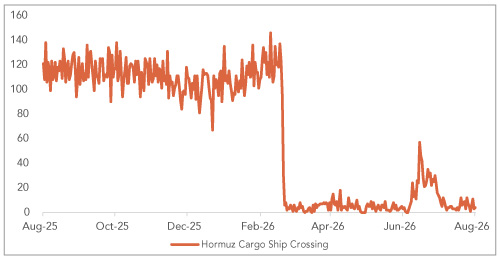
The initial peace agreement between the U.S. and Iran raised hopes that the world was moving beyond the war. Five months on, uncertainty remains. De-escalation announcements have repeatedly been followed by renewed hostilities, with the conflict now threatening critical shipping and energy routes beyond the Strait of Hormuz. Attacks in Egypt and renewed Houthi strikes on Saudi-linked shipping have heightened risks across the Red Sea, while traffic through the Strait of Hormuz has fallen sharply again. The prospect of disruption across both corridors has added to concerns over global energy flows and trade. Brent crude briefly touched USD 90/bbl before retracing to USD 80/bbl levels as we write.
Traffic through Strait of Hormuz back to war levels
Source: Bloomberg, Sanctum Wealth
Yet, a tentative diplomatic opening offers a potential silver lining. Iran and Oman have been engaged in discussions around reopening the Strait, although the outcome remains uncertain. Markets have consequently remained volatile but broadly resilient.
With no clear endgame in sight, staying entirely on the sidelines may not be the answer. For long-term investors, periods of geopolitical uncertainty can create opportunities to invest selectively through the volatility.
Global Macro Update
The biggest implication of the war is the risk of renewed inflation. While energy prices are the immediate concern, disruption in the Red Sea and Strait of Hormuz could also raise freight and war-risk insurance costs, creating second-order inflationary pressures. Beyond energy, agricultural commodity prices have also risen amid heightened geopolitical tensions. U.S. CPI inflation eased to 3.5% in June, largely on lower energy prices, but the subsequent rise in energy prices initially pushed the market-implied probability of a September Fed hike above 65%. That probability has since fallen below 50%, following the decline in energy prices and a much weaker-than-expected July jobs report, which showed a loss of 23,000 nonfarm jobs versus expectations of 80,000 additions. However, markets still assign a probability of over 75% to at least one Fed hike by year-end. The developments in the Middle East therefore have their most direct implication through the inflation outlook.
Sep’26 rate hike odds moderate, but one hike in 2026 priced-in

Source: CME Group, Fed watch tool
Meanwhile, economic activity remains resilient despite the oil shock, with the U.S. Composite PMI rising to 53.6 in July. The key growth driver remains AI-related capital spending, which has pushed technology investment to record levels as a share of GDP and is increasingly spreading to non-tech sectors. While household savings remain low, strong equity markets are supporting retail spending through the wealth effect. This creates a vulnerability, as business activity is increasingly exposed to a reversal in AI-driven equity valuations.
Eurozone economic activity also remains resilient, with the Composite PMI staying above 50 and Germany also returning to expansion after a period of weakness. However, Germany continues to face what may be a more structural export challenge. Still, higher German fiscal spending and a gradual recovery across the region should support a stronger finish to the year than the Eurozone’s weak start.
Japan enters H2 2026 with strong momentum, supported by a robust export cycle and improving domestic activity. Manufacturing PMI rose to 54.7 in July, while corporate investment remains resilient. A tight labour market and strong wage growth should also support consumption, providing a broad-based foundation for growth.
China, in contrast, is losing momentum. Manufacturing PMI fell to 49.2 in July, while non-manufacturing PMI slipped to 49. Both are now in contraction. Q2 GDP growth also slowed to 4.3%, below the government’s 4.5–5% target. Domestic demand remains weak and consumer confidence fragile. Traditional manufacturing is facing weaker orders and higher costs, while high-tech and equipment sectors remain resilient. The government appears focused on longer-term structural reforms rather than near-term stimulus. The recovery is therefore likely to remain gradual and uneven.
Global Market Update
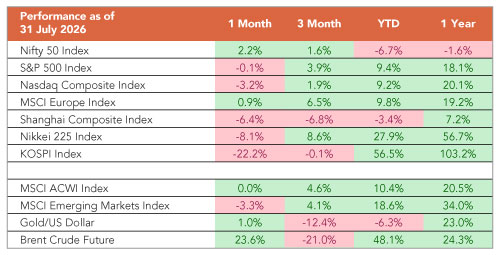
Global equities were largely flat in July. This hides the underlying wide dispersion. AI and AI-supply chain took a back seat while energy and banks did the heavy lifting and South Korea, one of the biggest outperformers this year lost a sixth of its value in dollars in one month.
Source: Bloomberg, Sanctum Wealth
Above returns are only price change in local currency terms and not total returns
U.S. earnings remain strong, with 86% of S&P 500 companies reporting above estimates. Strong earnings have been a key support for equity markets despite ongoing geopolitical tensions. However, scrutiny of AI-related spending is increasing. Hyperscalers issued over USD 100 billion of debt in 2025, with issuance expected to exceed USD 300 billion this year, potentially funding a third of AI capex versus less than 10% previously. Credit markets are beginning to reflect these concerns. Investor reactions are also becoming more selective: companies such as Microsoft and Amazon have been rewarded for demonstrating visible revenue from AI investments, while Alphabet faced pressure after raising capex guidance without similar visibility. The AI trade is therefore becoming increasingly differentiated rather than moving as one.
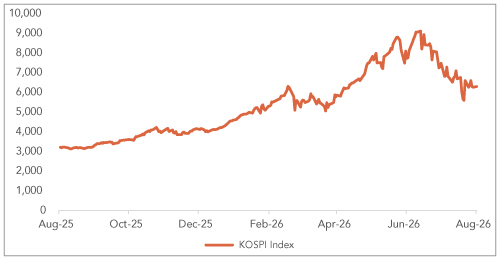
South Korea was the biggest drag on emerging markets in July, falling 16.8% in dollar terms and pulling the EM index down 3.1%. The sell-off was exceptionally volatile, with the KOSPI entering a bear market before rebounding 14% on the final day of July, the largest one-day gain in its history. Concerns over Chinese advances in memory chips and the returns on AI capex triggered the correction, but the deeper vulnerability is market concentration and high retail leverage. Despite losing a sixth of its value in July, Korea remains up more than 50% this year.
Korea’s KOSPI index corrected sharply in July
Source: Bloomberg, Sanctum Wealth
Chinese equities also corrected amid the AI-sell off. The Shenzhen Composite, an index more concentrated in AI, fell more than 15%, the the steepest monthly contraction since 2016. Ironically, the sell-off came as China made significant advances in semiconductors, including listing of a DRAM champion and a new lithography technology moving to production. The correction appears less a verdict on Chinese technology and more a broader unwinding of global AI supply-chain exposure.
Meanwhile, Europe moved up marginally and continues to deliver respectable returns for the full year, supported by improving industrial data and attractive valuations rather than a meaningful change in its growth outlook.
In Japan, the currency was the key focus. It weakened past ¥163 per dollar, its lowest level since 1986, prompting intervention from both Japan and the U.S. This was the first U.S. intervention to support the Yen since 2011. The Yen subsequently rebounded to end the month around ¥158.
India Macro Update
INR weakness was a major headwind for India earlier this year. The RBI’s measures in June have since helped mobilise over USD 40 billion by end-July and stabilise the currency, despite another spike in July as the Middle East conflict intensified. The RBI has also added liquidity to the system in recent weeks.
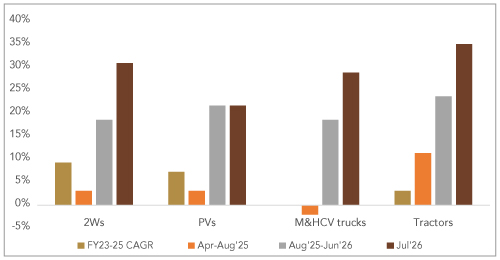
Economic activity remains strong. Bank credit is growing at a healthy pace, while July auto sales were robust, with two-wheelers up 30%, passenger vehicles 21% and tractors 34% YoY. Industrial activity also picked up, with IIP growth at 7.3% in June. The RBI’s August policy acknowledged this resilience and raised its FY27 growth forecast by 0.1 percentage points to 6.7%.
Auto sales have picked up sharply over the last few months
Source: GoI, Jefferies
The outlook is not without risks. PMIs have moderated, with the Composite PMI falling to 54.3 in July from 57.1 in June. A weak monsoon and a prolonged West Asia crisis could weigh on growth, particularly if oil prices rise above USD 100/bbl. For now, however, the underlying momentum remains healthy.
Inflation has also started to rise, with CPI inflation reaching 4.4% in June. However, the increase has been more contained than initially feared, with core inflation (ex of fuel, food and precision metals) remaining moderate at 2.3–2.5%. Food and fuel prices remain the key risks, with the monsoon and West Asia crisis potentially creating second-order inflationary pressures. Despite this, the RBI has marginally lowered its FY27 CPI inflation forecast to 5% and expects inflation to peak in Q3FY27 before moderating thereafter.
Overall, the RBI’s August policy was broadly in line with expectations, with a wait-and-watch stance. With growth remaining resilient and inflation still uncertain, we expect the RBI to remain on hold for now. The next move will likely depend more on the direction of inflation than on growth. A clearer trend in inflation, either higher or lower, will be key in determining the RBI’s rate trajectory.
Equity Outlook
Indian equities delivered positive returns in July, with small-caps outperforming large-caps, while mid-caps lagged. IT staged a sharp rebound after several quarters of underperformance, supported by better sentiment around the sector. Auto stocks also performed well, backed by strong sales data.
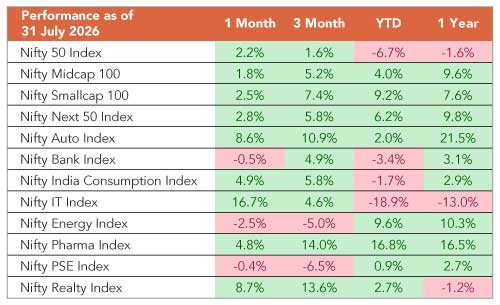
Source: Bloomberg, Sanctum Wealth
Above returns are only price change and not total returns
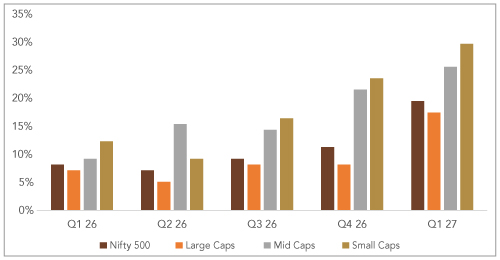
Q1FY27 earnings have started on a strong note. With around half of the Nifty 500 companies having reported results so far, revenue growth is above 20% and adjusted PAT growth is above 10%. Excluding commodities such as cement, oil & gas, and metals & mining, earnings growth stands at 19.5%. Earnings growth has been broad-based, with large-caps up growing earnings over 17%, mid-caps over 25% and small-caps over 29%, excluding commodities. More companies have also beaten estimates than missed them. This suggests that the earnings recovery seen over the past two quarters is likely to continue through the current season.
Earnings excluding commodities has picked up in last few quarters
Source: ICICI Prudential AMC
Foreign flows are also turning more supportive. FPIs became net buyers after four consecutive months of selling. This helped India outperformed its emerging-market peers in dollar terms as the global AI rally moderated. Despite the recent buying positioning remains light. Emerging-market funds are significantly underweight India, and India’s weight in the index itself has declined over the past few years as the market underperformed its peers.
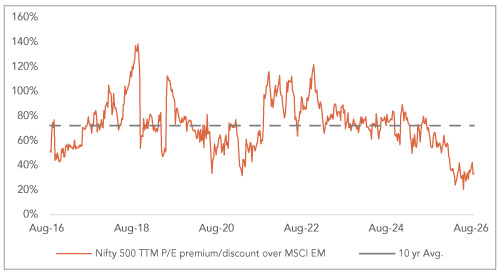
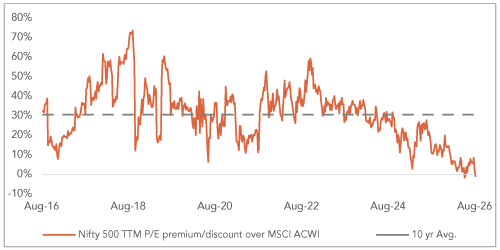
The valuation backdrop has also improved meaningfully. India’s P/E premium to both emerging and developed markets is now well below historical averages, while earnings growth is recovering. This combination of improving fundamentals and more reasonable relative valuations makes the outlook more constructive.
India’s relative valuation premium to global markets has significantly moderated
Source: Bloomberg, Sanctum Wealth
Domestic flows remain a strong support despite Indian equities delivering limited or negative returns over the past two years. Since the March correction, mid and small-caps have significantly outperformed large-caps, with market breadth also improving. However, fewer than 15% of stocks are currently near their 52-week highs, suggesting that the broader market still has room to participate.
Overall, we remain positive on Indian equities. Global risks, including geopolitical tensions, commodity price volatility and trade policy uncertainty, remain relevant. However, India is relatively well positioned given its strong domestic fundamentals. Improving earnings, resilient domestic flows, attractive relative valuations and a potential improvement in foreign flows provide a supportive backdrop. Within equities, we currently have a modest preference for large-caps given the sharp run-up in mid and small-caps and better valuations in some segments of large-cap, while continuing to see opportunities for active management to generate superior returns in the mid- and small-cap segments.
Fixed Income Outlook
The RBI’s latest policy had a mildly dovish tone despite maintaining a wait-and-watch stance. It viewed the recent rise in inflation as largely supply-driven, linked to higher energy prices, while noting that core inflation remains benign. Bond yields responded positively, with the 10-year G-sec yield falling to around 6.75% from a peak of 7.12% during the height of the conflict.
The external backdrop has also improved. INR weakness has stabilized following RBI and government measures, while Brent crude has eased to around USD 80/bbl. If geopolitical pressures moderate further and the INR strengthens, yields could decline somewhat more. Additionally, the 10-year yield already offers a wide spread over the repo rate, implying one or two rate hikes remain priced in.
However, we continue to view duration as a tactical opportunity rather than a more longer-term allocation, and one that may be difficult for most retail investors to implement effectively. We, therefore, prefer corporate bond and short-duration funds with 2–5 years maturities. For investors with shorter investment horizons, money market funds may offer a modest yield advantage over liquid funds given the steepness of the yield curve.
Gold and Silver Outlook
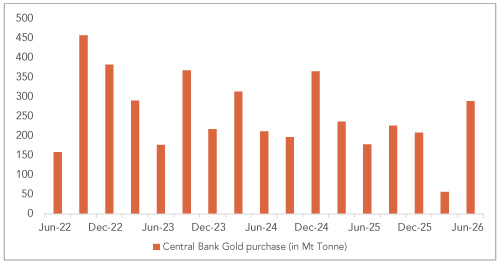
After significant volatility in the first half, gold remained largely range-bound in July but has regained momentum in early August. Global physically backed gold ETFs recorded USD 3 billion of inflows in July after two consecutive months of outflows. Central bank demand also remains strong, with net purchases of 51 tonnes in June, well above the 12-month average of 27 tonnes.
Central bank demand recovered sharply in last quarter
Source: Bloomberg, Sanctum Wealth
Central bank buying appears to be structural, although it remains sensitive to gold prices. Poland and China continue to accumulate gold, while Russia and Turkey have been net sellers. While higher U.S. interest rates and a stronger dollar remain near-term headwinds, technical indicators have turned positive after gold held key support levels. Overall, we remain positive on gold over the long term.
Silver has been more volatile than gold, but its technical indicators have also turned positive after holding key support levels. We have therefore tactically added a small silver allocation back to our model portfolio. This remains a short-term tactical position.